

Article
Thomas de Waal
{
  "authors": [
    "Thomas de Waal"
  ],
  "type": "commentary",
  "centerAffiliationAll": "",
  "centers": [
    "Carnegie Endowment for International Peace",
    "Carnegie Europe",
    "Carnegie Russia Eurasia Center"
  ],
  "collections": [],
  "englishNewsletterAll": "",
  "nonEnglishNewsletterAll": "",
  "primaryCenter": "Carnegie Europe",
  "programAffiliation": "",
  "programs": [],
  "projects": [],
  "regions": [
    "Caucasus",
    "Georgia"
  ],
  "topics": [
    "Political Reform"
  ]
}
Source: Getty
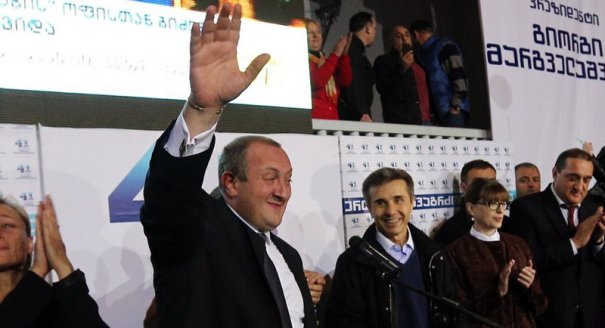
Giorgi Margvelashvili, won the presidential election in Georgia with 62 percent of the vote. Second place and 22 percent went to former speaker of parliament, David Bakradze, of the United National Movement. That was quite a disastrous performance from a party which only one year ago was running the country.
In the end it was all rather comfortable. The favorite, Giorgi Margvelashvili, won the presidential election in Georgia with 62 percent of the vote.
Some of the headlines dwelt on the low turnout of 46 percent. That in itself was a kind of perverse tribute to the democratic process, suggesting that Georgian voters did not see the election as a life-and-death struggle and were achieving Western-style levels of apathy. As the head of the NATO Parliamentary Assembly delegation, Matt Raidma, said, “Essentially, what we observed yesterday was a European election.”
Most of the intrigue in the days before the vote had been on who would win second place.
Former speaker of parliament Nino Burjanadze caused some late excitement with a firebrand campaign in which she openly called for warmer relations with Russia. If she had captured second place, it would have sent a signal that Georgia’s foreign policy orientation was in doubt. Eventually, Burjanadze got 10 percent of the vote and any hopes Moscow may have had of diverting Georgia off course came to nothing.
Second place and 22 percent of the vote went to former speaker of parliament, David Bakradze, of the United National Movement (UNM), Mikheil Saakashvili’s former governing party.
Bakradze himself was easily the best candidate the National Movement could find, the one least tainted by the abuses of the previous government and most ready to talk about reforming the party.
But his performance was not convincing either. An email from a National Movement spin-doctor informed me that the outcome was “solidifying the UNM’s place as the leading opposition force in the country,” while also arguing that the low turnout indicated “declining enthusiasm” for the new governing coalition, Georgian Dream.
Well, a low turnout almost meant fewer votes for Bakradze—to be precise, around 300,000 of them, or less than ten percent of the electorate. That was quite a disastrous performance from a party which only one year ago was running Georgia and predicting that it would stay in power almost indefinitely.
This is probably the wake-up call the UNM needed: a poor result which did not wipe it off the map. Saakashvili must draw the biggest conclusions as he steps down from office after a decade in power. His time truly is over and a colossal work of reinvention is needed to make his party relevant again.

Senior Fellow, Carnegie Europe
Thomas de Waal is a senior fellow at Carnegie Europe, specializing in Eastern Europe and the Caucasus.
Recent Work
Thomas de Waal
Thomas de Waal
Carnegie does not take institutional positions on public policy issues; the views represented herein are those of the author(s) and do not necessarily reflect the views of Carnegie, its staff, or its trustees.

Transactional relationships are stable but can be shallow.



Paul Haenle, Maha Yahya, Benjamin Ho, …

It’s about managing oil prices, bread prices, and strategic partnerships.



Amr Hamzawy, Karim Sadjadpour, Aaron David Miller, …
The murder of George Floyd has underscored the deep inequities that have long plagued American society. In a note to the Carnegie community, Bill Burns reflects on Carnegie’s commitment to build a more just future here at home and around the world, without which peace will remain beyond our grasp.
William J. Burns

While the world hoped this pandemic might lead to more cooperation between these two great powers, American and Chinese leaders instead fell into a blame game and allowed their increasing suspicions to guide their decision-making.
Lyu Jinghua

Biological viruses and computer malware differ in important respects. They have considerable potential to spread widely, invading, disrupting and destroying their targets.
Ariel (Eli) Levite, Lyu Jinghua