

Commentary
Dmitri Trenin
{
  "authors": [
    "Dmitri Trenin"
  ],
  "type": "commentary",
  "centerAffiliationAll": "",
  "centers": [
    "Carnegie Endowment for International Peace",
    "Carnegie Russia Eurasia Center"
  ],
  "collections": [
    "Europe’s Eastern Neighborhood"
  ],
  "englishNewsletterAll": "",
  "nonEnglishNewsletterAll": "",
  "primaryCenter": "Carnegie Russia Eurasia Center",
  "programAffiliation": "",
  "programs": [],
  "projects": [],
  "regions": [
    "Russia",
    "Eastern Europe",
    "Ukraine",
    "Europe"
  ],
  "topics": [
    "Political Reform",
    "Economy",
    "Foreign Policy"
  ]
}
Source: Getty
The choice between Russia and the West should be Ukraine’s, and Russia should respect that choice and structure its relations with its neighbor accordingly.
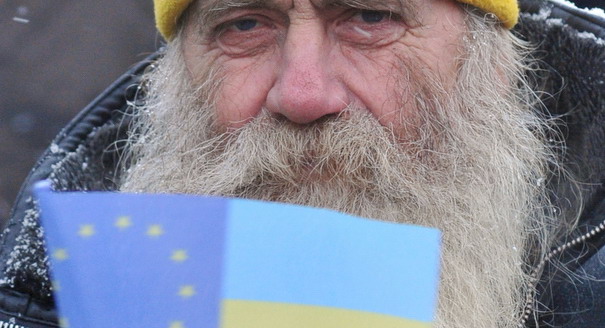
Over the weekend, one tweet that made big news around the world came from the Economist's Edward Lucas. The tweet announced an agreement in Sochi on Saturday between President Vladimir Putin and President Viktor Yanukovych about Ukraine joining the Customs Union in return for Moscow's economic assistance. The existence of such an agreement was promptly denied by the Ukrainian prime minister and the Russian presidential spokesman, but suspicions have remained. Last Sunday's speeches at the Euromaidan often referred to the choice between "European freedoms" and "Moscow servitude." A Russian TV correspondent reported that, at the Euromaidan, the West is lionized as a friend and Russia is treated as an enemy. What should Russia do in these circumstances?
Above all else, it needs to stay calm. Ukraine is going through a difficult and potentially dangerous patch in its post-Soviet evolution. Up until this fall, it had managed to avoid a clear choice between Russia and the West, but the EU Association Agreement saga put that choice front and center. Whatever the end result, the choice should be Ukraine's, and it will have to live with it. Russia, as President Putin said on a number of occasions, will respect that choice and structure its relations with its neighbor accordingly.
Russia also needs to stay away from the fast-moving political developments in Ukraine. It has no reason to send its government officials and politicians there or to make public statements encouraging those it may see as its allies, as many European governments have been doing. In particular, Russia should make no move which might be seen as supporting separatist trends in Crimea or elsewhere in the Russophone south-east of Ukraine. Regional differences in Ukraine are substantial and regional attitudes to the EU and Russia vary widely, but becoming involved in a civil conflict across the border is the last thing Russia should want.
Russia should stop offering economic assistance to Ukraine. President Yanukovych desperately needs financial relief, and, in extremis, he can promise anything in return. He is fighting for his political life and, very probably, for his family's property and personal freedom, too. This does not mean, however, that he can deliver on his promises. More likely, he will later claim those had been extracted from him by threats of force. Instead, Russia should protect its economic interests vis-a-vis Ukraine, but do so in such a way as not to damage itself. In other words: the goal should be to protect oneself, rather than to punish one's partner.
Finally, Russia needs to follow the Ukrainian situation closely and be ready to adjust course at short notice. Ukraine has entered uncharted waters. Whatever the outcome of the current political standoff in Kiev and of the forthcoming presidential elections, the economic situation of the country is very difficult. This, however, is Ukraine's problem, and Russia should dearly wish that Ukraine manages it, with the European Union and the IMF providing assistance.
As for Russia itself, it needs to confound the old—and false—dictum that it can only be great if Ukraine is safely embedded within it. In the 21st century world, this is particularly not true. A hypothetical accession by Ukraine—as it presently is—to the Customs Union would only weaken Russia, drain its resources, and make the union itself unstable. The Russian Federation does not lack land, resources, or even people. The issue is upgrading the quality of governance and the quality of the people, starting with the elites. Ukraine—take it or leave it—will not help.
Former Director, Carnegie Moscow Center
Trenin was director of the Carnegie Moscow Center from 2008 to early 2022.
Recent Work
Dmitri Trenin
Dmitri Trenin
Carnegie does not take institutional positions on public policy issues; the views represented herein are those of the author(s) and do not necessarily reflect the views of Carnegie, its staff, or its trustees.

China’s banking crisis in the 2000s was resolved by transferring the costs to households through financial repression—a decision that recapitalized the banks while exacerbating the structural imbalances that continue to shape the Chinese economy today.

Michael Pettis

But their "principal to principal" model will only be as effective as the political strength of each leader back home.

Damien Ma

U.S. unpredictability has allowed China to capitalize on its positioning as the “responsible great power”. Paradoxically, the more China wins the perception game, the more likely expectations will rise for Beijing to deliver not just words but to demonstrate with its deeds.

Chong Ja Ian

Hanoi and Beijing have long treated each other as distant cousins rather than comrades in arms. That might be changing as both sides draw closer to hedge against uncertainty and America’s erratic behavior.

Nguyễn Khắc Giang

Across Asia, China is better positioned to withstand energy shocks from the fallout of the Iran war. Its abundant coal capacity can ensure stability in the near term. Yet at the same time, the country’s energy transition away from coal will make it even less vulnerable during the next shock.
Damien Ma