

Article
- +1
Toby Dalton, Mark Hibbs, Nicole Grajewski, …
{
  "authors": [
    "Mark Hibbs"
  ],
  "type": "legacyinthemedia",
  "centerAffiliationAll": "dc",
  "centers": [
    "Carnegie Endowment for International Peace",
    "Carnegie China"
  ],
  "collections": [],
  "englishNewsletterAll": "ctw",
  "nonEnglishNewsletterAll": "",
  "primaryCenter": "Carnegie Endowment for International Peace",
  "programAffiliation": "NPP",
  "programs": [
    "Nuclear Policy"
  ],
  "projects": [],
  "regions": [
    "East Asia",
    "China",
    "Japan"
  ],
  "topics": [
    "Nuclear Policy"
  ]
}
Source: Getty
A Japan bristling with weapons-grade nuclear materials fits a Chinese narrative that the Abe government intends to re-militarize and threaten Japan’s neighbors.
Source: Arms Control Wonk
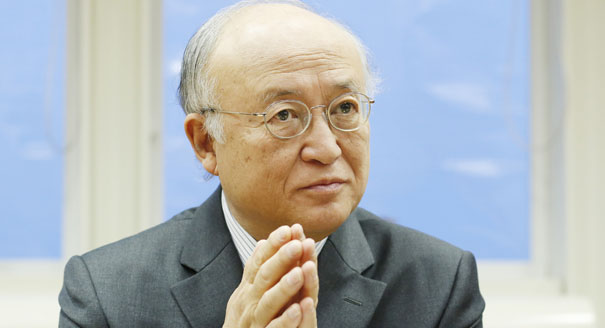
IAEA Director General Yukiya Amano on March 3 had this to say about recently-voiced Chinese concerns about Japan’s plutonium inventory:
We have drawn (the) conclusion that all nuclear materials in Japan stay in peaceful purposes… Therefore, I do not have (a) reason to have concern that this (material) … will be diverted.
At issue are 331 kilograms of weapons-grade plutonium long associated with the Fast Critical Assembly operated by the Japan Atomic Energy Agency at Tokai.Friends in the IAEA boardroom this week expressed the view that Amano’s confidence seemed informed by the IAEA having for years reached a safeguards “broader conclusion” for Japan — as Amano himself explained that concept to a general audience in 2012: “If [a country] implements the Additional Protocol, we can provide assurance that all the activities in that country [are for] peaceful purposes.” The IAEA has annually renewed its broader conclusion for Japan since it was first given in 2004.
The broader conclusion is about IAEA safeguards, not nuclear security, and Amano in his reported remarks did not refer to the nuclear security dimension of the Tokai plutonium. But he must know that security issues–not Japan’s nonproliferation credentials–have been at the heart of five years of bilateral U.S.-Japan discussions about this plutonium inventory.
Japan has agreed to remove the Tokai weapons-grade plutonium to the U.S. as part of its voluntary offer to the 2014 Nuclear Security Summit in the Netherlands later this month. This will be announced then, was more or less spelled out by Japanese media in January, but it wasn’t refered to by Amano in his answer to reporters’ questions in Vienna this week.
In addition to the Tokai weapons-grade plutonium inventory, Japan’s nuclear R&D facilities also host considerable inventories of weapons-grade uranium–perhaps 1,400 kilograms, with about 500 kg hosted by a single critical assembly installation. Given Japan’s evolving policy on its weapons-grade plutonium inventories, we might anticipate that in the future at least a portion of Japan’s uranium inventory may likewise be removed to the U.S.
Fukushima may have informed this decision making. While some media reports on U.S.-Japan interaction left open whether Japanese “balking” at repatriating the plutonium meant that Tokyo was hedging for strategic reasons, in fact Japan had argued that weapons-grade materials were needed for JAEA’s fast reactor research on sound scientific grounds. Since 2011, however, Japan’s advanced reactor vision has receded into the distance.
Before he became the Director General of the IAEA, Amano was ambassador in Japan’s Permanent Mission in Vienna, and in that capacity he offered these remarks in 2006 concerning Japan’s management of its HEU inventories:
[Japan] has used highly enriched uranium at research reactors in the past, but since the end of 1970s, it has reduced the uranium enriched level from HEU to LEU. By now, Japan has almost completed the conversion. A remaining issue is that of the transportation of highly enriched spent fuel to the United States. A considerable amount of this fuel has already been transported, with the remainder due for transportation at a later date. Reducing the use of highly enriched uranium fuel is an important issue in preventing nuclear terrorism. I hope the process of replacing it with low enriched uranium fuel will be accelerated worldwide
Why did China raise the issue of Japan’s plutonium beginning last month? (Beijing quasi-official media after Amano’s statement this week reiterated its concerns). The most readily available explanation is that a Japan bristling with weapons-grade nuclear materials fits a Chinese narrative that the Abe government intends to re-militarize and threaten Japan’s neighbors. Is China concerned about Japan’s plans to reprocess its power reactor spent fuel at Rokkasho-mura? Perhaps, but China itself is planning on embarking on commercial-scale reprocessing of its own growing spent fuel inventory.
Recent media interventions over this issue in fact look more like an us-versus-them standoff in the East China Sea and less like a discussion of Japan’s nuclear materials security. China ran the Japan plutonium issue up the flagpole in Beijing in mid-February. That was three weeks after Japanese media had already reported that Japan had agreed to U.S. wishes to give up the plutonium at Tokai. When Amano this week brushed aside Chinese concerns about the plutonium, the U.S. ambassador in Vienna in a statement reinforced Amano’s message that weapons-grade materials in Japan were of “no concern.”
That’s not the view of U.S. officials who have been discussing this issue with Japan since 2009. On less public occasions, they have pointed out that with respect to Japan’s comparative openness–the weapons-grade materials are clearly civilian and located in facilities where international research is ongoing–there is a residual security risk associated with them. The U.S. view is that removing weapons-grade nuclear materials from Japan to the U.S. would enhance their security. Japan now appears to clearly share that perspective.

Nonresident Senior Fellow, Nuclear Policy Program
Hibbs is a Germany-based nonresident senior fellow in Carnegie’s Nuclear Policy Program. His areas of expertise are nuclear verification and safeguards, multilateral nuclear trade policy, international nuclear cooperation, and nonproliferation arrangements.
Recent Work


Toby Dalton, Mark Hibbs, Nicole Grajewski, …
Mark Hibbs
Carnegie does not take institutional positions on public policy issues; the views represented herein are those of the author(s) and do not necessarily reflect the views of Carnegie, its staff, or its trustees.

China’s banking crisis in the 2000s was resolved by transferring the costs to households through financial repression—a decision that recapitalized the banks while exacerbating the structural imbalances that continue to shape the Chinese economy today.

Michael Pettis

Chinese biotech companies have been on the receiving end of U.S. economic coercion. Yet their responses have differed significantly because firm and state interests are not uniformly aligned. For Washington, treating all Chinese tech firms the same, irrespective of their actual interests, risks pushing them farther into Beijing’s corner.

Xue Gong

China’s latest energy plan explicitly calls for integrating data centers into the electricity system, particularly connecting them to green energy. It appears Beijing wants to use compute as a source of domestic demand to absorb renewables excess capacity.

Damien Ma

But their "principal to principal" model will only be as effective as the political strength of each leader back home.
Damien Ma

U.S. unpredictability has allowed China to capitalize on its positioning as the “responsible great power”. Paradoxically, the more China wins the perception game, the more likely expectations will rise for Beijing to deliver not just words but to demonstrate with its deeds.

Chong Ja Ian