• Commentary
  • Research
  • Experts
  • Events
Carnegie China logoCarnegie lettermark logo
{
  "authors": [
    "Akio Kawato"
  ],
  "type": "commentary",
  "centerAffiliationAll": "",
  "centers": [
    "Carnegie Endowment for International Peace",
    "Carnegie Russia Eurasia Center"
  ],
  "collections": [],
  "englishNewsletterAll": "",
  "nonEnglishNewsletterAll": "",
  "primaryCenter": "Carnegie Russia Eurasia Center",
  "programAffiliation": "",
  "programs": [],
  "projects": [],
  "regions": [
    "North America",
    "United States",
    "East Asia",
    "Japan",
    "Russia",
    "Eastern Europe",
    "Ukraine"
  ],
  "topics": [
    "Foreign Policy"
  ]
}

Source: Getty

Commentary
Carnegie Russia Eurasia Center

Japan Looks at Ukraine and Fears Czechoslovakia, 1948

Japan makes judgment about Ukraine in the context of her balancing game among the United States, Russia, and China. However, if Moscow sends troops to Eastern Ukraine, the Japanese political class will unanimously support serious measures to stop Russia.

Link Copied
By Akio Kawato
Published on Apr 11, 2014

When Japan and China brawl over tiny Senkaku Islands, people in the regions far from East Asia dismiss it as a needless conflict over small rocks. But in the eyes of the Japanese the current tug of war over Ukraine looks like a self-imposed confrontation between Russia and the United States. Although neither the United States nor Russia is ready to take the full burden of Ukraine, they engage in a tit-for-tat tussle, drawing in their allies and friends.

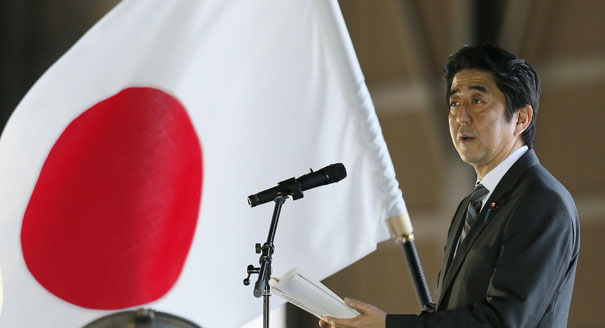
For more than a year the image of Russia in Japan has been in upswing. Feeling the pressure of China’s growing might and seeing that the U.S. security guarantee becomes increasingly nuanced, many Japanese have started to look upon Russia as an unduly neglected partner, whose geopolitical weight may serve to counterbalance China. Direct investment by Japanese companies went as far as the purchase of the majority share in AVTOVAZ car factory by Renault-Nissan. Japan today imports oil and natural gas from Russia, equivalent to slightly less than 10 percent of her total consumption. What is more, Prime Minister Shinzo Abe has built cordial relations with President Vladimir Putin, a sine qua non for addressing the long-standing issue: signing of a peace treaty. Such unusual rapprochement between the two countries drew attention of American pundits, who generally valued it positively.

At first, the situation in Ukraine was a distant issue for the Japanese. However, Russia’s annexation of Crimea became the top news, though the recent tax hike and issues involving the United States, South Korea, North Korea, and China draw more earnest attention. Now the prevailing narrative in Japan about the annexation of Crimea is that it was realized under the coercive effect of the Russian military force. Though newspapers do report about the gruesome anti-Russian activities of the Ukrainian rightists, this is something too complex for foreigners to swallow. Nevertheless, some hesitation about joining “sanctions” against Russia remains, partly because the Japanese are not yet totally convinced that this is the right step to take, and partly because it is “mottai-nai” (it is a pity) to throw away recent achievements in Russo-Japanese relations.

Japan makes judgment about Ukraine in the context of her balancing game among the United States, Russia, and China. The alliance with the United States remains, of course, the mainstay of Tokyo’s foreign policy. Japan does not like that “needless” conflicts are created in remote areas and that the U.S. government’s attention and U.S. forces are distracted elsewhere. Therefore, Japan would be willing to contribute to a quick stabilization of Ukraine.

However, if things take a fatal downward spiral in Ukraine, Japan will play it out. If Russia sends troops to Eastern Ukraine, for example, the Japanese political class will unanimously support serious measures to stop Russia. The situation in Ukraine has started to resemble very much the start of the Cold War, when Czechoslovakia in 1947-1948 was forced by the Soviet Union to reject the Marshall Plan and was drawn into Moscow’s orbit.

About the Author

Akio Kawato

Writer

Akio Kawato is a former Japanese diplomat and blogger.

Akio Kawato
Writer
Foreign PolicyNorth AmericaUnited StatesEast AsiaJapanRussiaEastern EuropeUkraine

Carnegie does not take institutional positions on public policy issues; the views represented herein are those of the author(s) and do not necessarily reflect the views of Carnegie, its staff, or its trustees.

More Work from Carnegie China

  • Robot arm with disposable test tube virus sampling in laboratory
    Commentary
    Caught in the Middle: Chinese Biotech Firms’ Divergent Responses to U.S. Sanctions

    Chinese biotech companies have been on the receiving end of U.S. economic coercion. Yet their responses have differed significantly because firm and state interests are not uniformly aligned. For Washington, treating all Chinese tech firms the same, irrespective of their actual interests, risks pushing them farther into Beijing’s corner.

      Xue Gong

  • Commentary
    Emissary
    Trump and Xi Are Angling for Three Years of Stability

    But their "principal to principal" model will only be as effective as the political strength of each leader back home.

      • Damien Ma

      Damien Ma

  • Commentary
    China Sells Stability Amid American Volatility

    U.S. unpredictability has allowed China to capitalize on its positioning as the “responsible great power”. Paradoxically, the more China wins the perception game, the more likely expectations will rise for Beijing to deliver not just words but to demonstrate with its deeds.

      Chong Ja Ian

  • Vietnam's Top Leader To Lam meets with young representatives from China and Vietnam participating in the "Red Study Tours" at the Great Hall of the People on April 15, 2026 in Beijing, China. T
    Commentary
    Why Vietnam Is Swinging in China’s Direction

    Hanoi and Beijing have long treated each other as distant cousins rather than comrades in arms. That might be changing as both sides draw closer to hedge against uncertainty and America’s erratic behavior.

      • Nguyen-khac-giang

      Nguyễn Khắc Giang

  • Commentary
    China’s Energy Security Doesn’t Run Through Hormuz but Through the Electrification of Everything

    Across Asia, China is better positioned to withstand energy shocks from the fallout of the Iran war. Its abundant coal capacity can ensure stability in the near term. Yet at the same time, the country’s energy transition away from coal will make it even less vulnerable during the next shock.


      • Damien Ma

      Damien Ma

Get more news and analysis from
Carnegie China
Carnegie China logo, white
Keck Seng Tower133 Cecil Street #10-01ASingapore, 069535Phone: +65 9650 7648
  • Research
  • About
  • Experts
  • Events
  • Contact
  • Careers
  • Privacy
  • For Media
Get more news and analysis from
Carnegie China
© 2026 Carnegie Endowment for International Peace. All rights reserved.