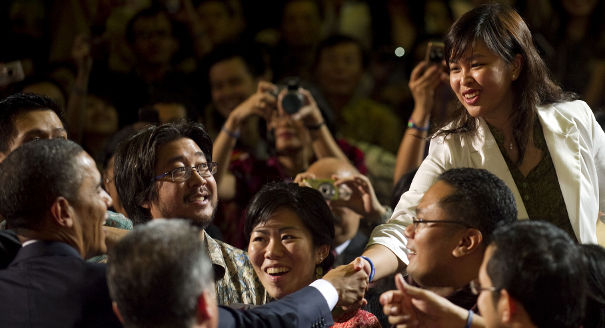
U.S. President Barack Obama is kicking off a weeklong trip to Asia on April 23. Sun Xuefeng, an associate professor and deputy dean at Tsinghua University, offers a perspective on U.S. aims with the trip and stability in the region.
What countries will Obama visit during his trip to Asia and why?
The U.S. president will visit Japan, South Korea, Malaysia, and the Philippines.
The Philippines and Malaysia both have territorial disputes with China, with the Philippines taking a strong stance and Malaysia a mild one. China established an air defense identification zone in the East China Sea in 2013, which made the United States feel it had failed to gain the upper hand when engaging China. By visiting the Philippines, Obama is highlighting his support for the country in the territorial dispute. Malaysia has sought U.S. help, and Obama is responding actively with his visit.
Japan and South Korea are both U.S. allies, but their attitudes toward China’s rise differ—Japan takes a tough stance while South Korea’s approach is mild.
With this visit, the U.S. administration wants to demonstrate its support for Japan, highlighting its security commitment to its ally and its dominant role in Asia. And it would like to ensure that Japan’s approach is in line with the U.S. plan to rebalance toward Asia. Washington should also take steps to ensure that the Diaoyudao Islands (or Senkaku Islands, in Japanese) crisis does not escalate. If the relationship between Japan and China were to spiral out of control, the United States would be significantly affected and Washington’s role in East Asia would be greatly undermined.
Obama has two primary reasons for visiting South Korea. First, he will urge Seoul to smooth out its relationship with Japan. Washington is staging a comeback to the Asia-Pacific region, so it will try to alleviate disputes among its allies. Second, the United States is seeking to shore up its relationship with Seoul at a time when South Korea and China are getting closer. This closeness was on display when South Korea returned to China the remains of Chinese volunteer soldiers who died in the Korean War.
Is the U.S. strategy to rebalance toward Asia working? Is it here to stay?
When the approach was introduced, Chinese scholars debated whether Obama proposed the strategy to win the presidential election and whether it was long term. It now seems that the shift toward the Asia-Pacific will be a long-term strategy.
While the United States has labeled it a “rebalancing,” Washington really seeks to maintain an imbalanced status quo to guarantee its supremacy in the region. In this respect, the strategy was effective from 2010 to the first half of 2012 and resulted in significant security pressure on China. But the situation has changed since September 2012 as a result of heightened tensions in the Asia-Pacific. This, coupled with China’s adjustment of its regional security policy, has meant that the results of the rebalance are not as good now as they were two years ago.
How does Obama’s trip impact China’s priorities in the countries the U.S. president is visiting?
China will inevitably need to respond to another wave of policy changes as a result of these visits. But China’s view of the United States has more influence on Beijing’s policies than the countries on Obama’s agenda do.
If Obama stands strongly behind Japan and the Philippines and drives wedges between China and South Korea, as well as Malaysia, Beijing will interpret the U.S. position as unfriendly. And it will find that the neighborhood is more unstable. If the United States can encourage Japan and the Philippines to take milder positions, China will be more confident in the stability of East Asia.
The situation in the South China Sea, meanwhile, has stabilized since Chinese President Xi Jinping and Premier Li Keqiang visited Southeast Asia in 2013. But that could change if Obama supports the Philippines too strongly or does anything that deepens regional divides when he visits Malaysia.
China would like stability to improve in its neighborhood. If regional countries demonstrate restraint and substantive developments occur, China will respond positively.
This article was published as part of the Window into China series