

Commentary
Balázs Jarábik
{
  "authors": [
    "Balázs Jarábik"
  ],
  "type": "commentary",
  "centerAffiliationAll": "",
  "centers": [
    "Carnegie Endowment for International Peace",
    "Carnegie Russia Eurasia Center"
  ],
  "collections": [],
  "englishNewsletterAll": "",
  "nonEnglishNewsletterAll": "",
  "primaryCenter": "Carnegie Endowment for International Peace",
  "programAffiliation": "",
  "programs": [],
  "projects": [],
  "regions": [
    "Russia",
    "Eastern Europe",
    "Ukraine"
  ],
  "topics": [
    "Political Reform",
    "Economy",
    "Security",
    "Military",
    "Foreign Policy"
  ]
}
Source: Getty
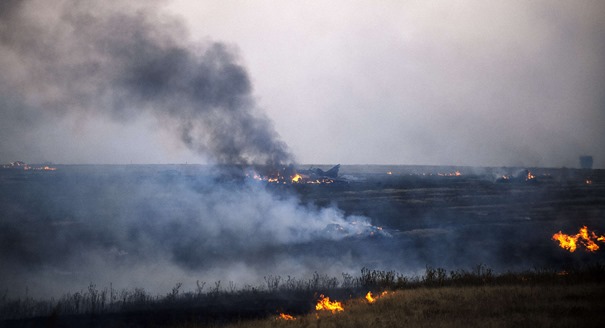
Ukraine’s political heat wave will last well into the coming fall and winter—unless Ukraine, the West, and Russia change their current course.
Ukraine is in the middle of a bona fide heat wave. Unfortunately, the country’s political heat wave will last well into the coming fall and winter—unless Ukraine, the West and Russia change their current course.
The new team in Kyiv has yet to launch much-needed reforms and seems oblivious to the consequences of their inaction and lowest common denominator, politics as usual. President Petro Poroshenko recently signed a decree that will arbitrarily cut retirement benefits for former senior officials. Figures like former President Viktor Yushchenko—but presumably not Leonid Kuchma or Leonid Kravchuk—will lose many of their perks, as will several former prime ministers, parliamentary leaders, and retired generals. This largely symbolic gesture will do little to ease social tensions, but may encourage resistance and resentment among the elite.
In the meantime social tensions are rising. The new elite looks conspicuously like the old elite, minus some of the most odious personalities, and ordinary citizens have low confidence in their new government. The third round of mobilization of army reservists has proven to be quite unpopular and undermined public support for the government. There have been protests against the move in Western Ukraine, traditionally a hotbed of Ukrainian nationalist sentiment.
In Eastern Ukraine, a bloody victory in the government’s military campaign against the rebels in Luhansk and Donetsk is likely to alienate a large number of citizens in the regions’ two largest cities. The Ukrainian army has made progress on the battlefield. Yet much of the territory it has regained had been abandoned by the rebels. Private militias fighting alongside the army are aligned with the government for now. But their loyalty to the government should not to be taken for granted. The war is radicalizing public opinion and is eroding support on all sides for national reconciliation.
Moreover, money—the locals call it bablo—is running out. State coffers are depleting. The government has not been able to sell 2, 5 and 7 years Hryvnia-denominated bonds at recent auctions. Hot water is rare in Kyiv as the government tries to save gas for the coming winter. The government, reportedly, is laying off between 30 and 50 percent of state employees. Those who remain will have their pay cut. Putting food on the table will soon be the main concern for many Ukrainians, undercutting support for the government.
Despite its promises, Russia has so far failed to secure its side of the border with Ukraine. Militants, weapons and equipment are still streaming into Donbass from Russia. But even if Russia and Ukraine wanted and could seal the border, they would have to confront the fact that smuggling has become a key source of income for many residents on both sides of the border, including local law enforcement. Russian border guards are presumably be no less corrupt than their Ukrainians counterparts. In Eastern Ukraine, military police and border guards are rumored to be running joint smuggling businesses worth millions—in conjunction with Russian colleagues.
Ukraine and Russia appear to have never been closer to an open military conflict than now. The absence of international support for Russia’s proposal to send a humanitarian mission to Eastern Ukraine at the United Nations Security Council meeting should have sent a clear signal for Moscow that this gambit won’t fly. But Russia’s isolation on this issue could also lead to further escalation. An unfolding humanitarian crisis in neighboring regions on the Russian side of the border is real. Over 285,000 people have been displaced so far with 117,000 IDPs and 168,000 seeking safety in Russia according to recent UN reporting. The number of civilian casualties has passed 1,300, and according to Human Rights Watch both the rebels and Ukrainian units have been shelling territories with unguided GRAD rockets. No doubt, Russia has caused much of this crisis, but now it is bearing its costs as well.
The recent Russian military build-up along the border has now reached 21,000 troops, but that force is unlikely to be enough for a full-scale invasion. But what bout a so-called “humanitarian” mission? A humanitarian mission by Russia without a Security Council mandate would be seen by the world as an invasion of Ukraine. But in Russia, not only the Kremlin, the vast majority of Russians might see this as a Western double standard. A nationalist fervor within the elite and body public is pushing the Kremlin to take more assertive action. A recent online poll in Moscow put separatist leader Igor Girkin (aka Igor Strelkov, or Igor the Shooter) well ahead of Putin as the leading candidate in the 2018 presidential election. No amount of Western sanctions can change this ugly public mood. If anything, sanctions only add to the pressure on Putin to stay the course. Most Russians are willing to sacrifice for the cause.
To be sure, the tragedy of MH17 also bolstered Western resolve to impose more severe sanctions on Russia. It also spurred Kyiv into more decisive military action against the rebel forces in eastern Ukraine. However, the lack of a “smoking gun” to assign responsibility for the tragedy points to certain unanswered questions about the incident, even though circumstantial evidence clearly points to the rebels. From the Kremlin’s viewpoint, internatial condemnation and the sanctions came too fast, without a proper investigation or room for face-saving steps. U.S./EU action on sanctions, an understandable reaction to the outrageous failure of rebel groups to handle the crash site and victims’ remains in a civilized fashion, only reinforced the perception of the West’s double standards and fostered siege mentality in Moscow. Cornered, Moscow is unlikely to change its Ukraine strategy because the West piles on more sanctions.
Most importantly, Western sanctions on Russia have done nothing to help Ukraine. While the policy of “punishing Putin” may give satisfaction for many in Ukraine and in the West, it highlights a core shortcoming with Western policy. Ukraine requires immediate assistance to deal with a growing nationwide economic crisis, which has roots far beyond the catastrophe in eastern Ukraine. With reforms stalling in Kyiv, the West has to hold Ukrainian government accountable to its promises. Unless there is a realistic plan and tangible progress that proves to the people of Ukraine that change is real, that the new government has not reverted to business as usual, this crisis will only get worse.

Political analyst, former Slovak diplomat, and consultant specializing in Eastern Europe
Recent Work
Balázs Jarábik
Balázs Jarábik
Carnegie does not take institutional positions on public policy issues; the views represented herein are those of the author(s) and do not necessarily reflect the views of Carnegie, its staff, or its trustees.

U.S. unpredictability has allowed China to capitalize on its positioning as the “responsible great power”. Paradoxically, the more China wins the perception game, the more likely expectations will rise for Beijing to deliver not just words but to demonstrate with its deeds.

Chong Ja Ian

Hanoi and Beijing have long treated each other as distant cousins rather than comrades in arms. That might be changing as both sides draw closer to hedge against uncertainty and America’s erratic behavior.

Nguyễn Khắc Giang

Across Asia, China is better positioned to withstand energy shocks from the fallout of the Iran war. Its abundant coal capacity can ensure stability in the near term. Yet at the same time, the country’s energy transition away from coal will make it even less vulnerable during the next shock.

Damien Ma

In the latest Five-Year Plan, the Chinese president cements the shift to an innovation-driven economy over a consumption-driven one.
Damien Ma

Malaysia’s chairmanship sought to fend off short-term challenges while laying the groundwork for minimizing ASEAN’s longer-term exposure to external stresses.

Elina Noor