

Article
Marc Pierini
{
  "authors": [
    "Marc Pierini"
  ],
  "type": "legacyinthemedia",
  "centerAffiliationAll": "dc",
  "centers": [
    "Carnegie Endowment for International Peace",
    "Carnegie Europe",
    "Malcolm H. Kerr Carnegie Middle East Center"
  ],
  "collections": [
    "Turkey’s Transformation"
  ],
  "englishNewsletterAll": "menaTransitions",
  "nonEnglishNewsletterAll": "",
  "primaryCenter": "Carnegie Europe",
  "programAffiliation": "MEP",
  "programs": [
    "Middle East",
    "Europe"
  ],
  "projects": [],
  "regions": [
    "Europe",
    "Türkiye",
    "Western Europe",
    "Iran"
  ],
  "topics": [
    "Political Reform",
    "Foreign Policy"
  ]
}
Source: Getty
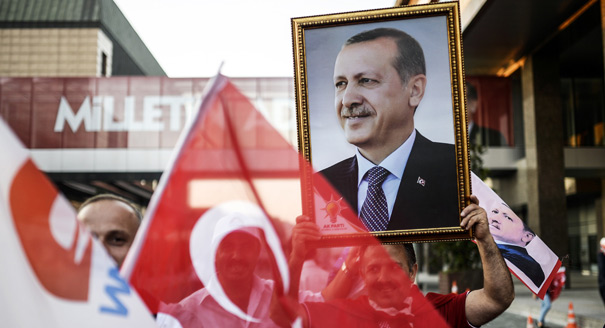
Now that Erdogan has won the Turkish Presidency, the question is how he will restore Turkey’s relationship with its allies and what the future of Turkish foreign policy will be.
Source: Hürriyet Daily News
As predicted, Recep Tayyip Erdoğan just won the first round victory and will become on Aug. 28 the first directly elected president of Turkey, crowning an uninterrupted series of electoral successes since 2002. The 51.7 percent he received is a far cry from the 57 percent triumph that Mr. Erdoğan himself referred to a few days before the election, but he will carry on. With a turnout of 73 percent, Mr. Erdoğan garnered about 1 million above his two competitors combined. Clearly, many of the 14 million absentees, who considered the race a foregone conclusion, were lost by the opposition.
Beyond the home front mix of joy and bitterness, let’s take a western view: What is the Turkish brand of democracy? Is Turkey’s foreign policy going to be a bigger headache for its allies?
Mr. Erdoğan’s election illustrates a non-Western democracy. First, his success rests on personal charisma is huge and masterful ballot box tactics whatever their political cost is. Second, the fact that corruption allegations were never answered, that a large chunk of the rule of law has been dismantled to prevent inquiries from proceeding, or that the public television and radio served mostly Mr. Erdoğan did not bother his followers in the slightest. Third, the fact that policies and positions vary widely between often inconsistent economic or foreign strategies did not affect Mr. Erdoğan’s standings: his followers essentially bet on the perpetuation of his 12 year social and economic record. Fourth, the extreme polarization of his political narrative, the frequent rude attacks on ethnic and religious groups or on journalists and competitors, or the constant recourse to conspiracy theories of another age served him well with his electorate. Fifth, Mr. Erdoğan’s biggest assets have been the inability of the main opposition parties to challenge him effectively and the blatant disillusionment of secular Turks.Anywhere in the United States or the European Union, even a few of the tactics, words or policies Mr. Erdoğan used would have disqualified a presidential contender. Not in Turkey. Western diplomats and analysts have to come to terms with the fact that, whether they like it or not, Turkey’s brand of democracy is different and, indeed, increasingly less comparable with U.S. or EU standards.
With Mr. Erdoğan’s authoritarian record, his willingness to be an executive president even if the Constitution stipulates otherwise, the media very largely in check, and the likelihood that the next prime minister will be at his beck and call, there are few reasons in Washington, Berlin or Brussels to cheer at the future of Turkey’s democracy. In particular, unless the EU were to dump its “political criteria” for realpolitik’s sake, it is hard to see a clear path for Turkey’s entry into the EU. But Mr. Erdoğan’s bet is that, with the region on fire, he will remain the West’s indispensable interlocutor.
On the diplomatic front, the Erdoğan presidency will face even bigger challenges. In recent years, Turkey’s foreign policy has been a complex mix of haste, hubris, strong religious underpinnings and a distinct tendency to forget fundamentals, such as the country’s NATO affiliation or memories of the Ottoman Empire in the region.
As a result, sharp differences between Ankara and its Western allies have cropped up on a number of subjects, such as Israel, Syria, Egypt, Armenia and NATO’s defense architecture. Ambitions of a self-standing foreign policy were frequently contradicted by hard realities. For example, Turkey’s security is nothing less than fully dependent on NATO.
The Islamic State of Iraq and the Levant’s (ISIL) proclamation on June 28 and its horrendous consequences on Turkey’s southern borders have resounded like a warning call for Ankara. Not only is Turkey threatened by “returnee jihadists” from Syria and Iraq, but it is also on the frontline of a potentially massive second refugee crisis, from Iraq this time. Effectively protecting Turkey from the ripple effects of the Middle East mayhem more than ever requires strong coordination and seamless cooperation with the U.S. and key European partners. Beyond the flamboyant “zero problems” narrative, it is high time for renewed consistency with western allies.
From a western standpoint, the question is now a simple one. Will a triumphant President Erdoğan act to restore Turkey’s relationship with its main allies and partners? In (eventually) doing so, will he see that restoring his country’s shattered rule of law also matters?
None of this is sure at this point. Only time will tell.
This article was originally published in the Hürriyet Daily News.

Senior Fellow, Carnegie Europe
Marc Pierini is a senior fellow at Carnegie Europe, where his research focuses on developments in the Middle East and Turkey from a European perspective.
Recent Work
Marc Pierini
Marc Pierini
Carnegie does not take institutional positions on public policy issues; the views represented herein are those of the author(s) and do not necessarily reflect the views of Carnegie, its staff, or its trustees.

But their "principal to principal" model will only be as effective as the political strength of each leader back home.

Damien Ma

U.S. unpredictability has allowed China to capitalize on its positioning as the “responsible great power”. Paradoxically, the more China wins the perception game, the more likely expectations will rise for Beijing to deliver not just words but to demonstrate with its deeds.

Chong Ja Ian

Hanoi and Beijing have long treated each other as distant cousins rather than comrades in arms. That might be changing as both sides draw closer to hedge against uncertainty and America’s erratic behavior.

Nguyễn Khắc Giang

Across Asia, China is better positioned to withstand energy shocks from the fallout of the Iran war. Its abundant coal capacity can ensure stability in the near term. Yet at the same time, the country’s energy transition away from coal will make it even less vulnerable during the next shock.
Damien Ma

Malaysia’s chairmanship sought to fend off short-term challenges while laying the groundwork for minimizing ASEAN’s longer-term exposure to external stresses.

Elina Noor