

Article
Thomas de Waal
{
  "authors": [
    "Thomas de Waal"
  ],
  "type": "commentary",
  "centerAffiliationAll": "",
  "centers": [
    "Carnegie Endowment for International Peace",
    "Carnegie Europe",
    "Carnegie Russia Eurasia Center"
  ],
  "collections": [],
  "englishNewsletterAll": "",
  "nonEnglishNewsletterAll": "",
  "primaryCenter": "Carnegie Europe",
  "programAffiliation": "",
  "programs": [],
  "projects": [],
  "regions": [
    "Caucasus",
    "Russia"
  ],
  "topics": [
    "Political Reform",
    "Security",
    "Civil Society"
  ]
}
Source: Getty
Today, the Islamist militants who attacked a school in Beslan in 2004 are weaker than before. But the fact that the North Caucasus has fallen out of the headlines does not mean that its problems are solved.
The school siege in Beslan ended in tragedy ten years ago, on September 3, 2004.
Beslan is one of those events that leave a black residue in the soul of anyone who had something to do with it and makes them ask, “Can humans really do something do awful?”
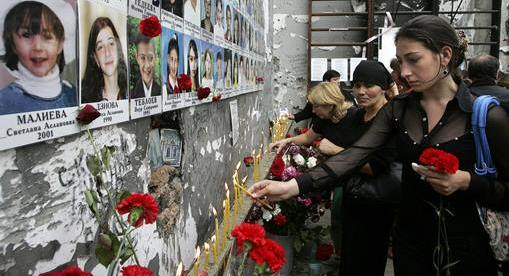
I visited the town only four months later but will never forget the forlorn sight of a cemetery in the snow lined with children’s graves, each with toys and little New Year trees placed on them. Of the official number of 334 victims in School No. 1, 156 were children.
Has anyone learned lessons from the tragedy a decade on?
Unfortunately, despite a trial and an official parliamentary investigation, a fog of misinformation pervaded the town during the siege and it never fully cleared.
But in a region where conspiracy theories are rampant, and where relatives of those inside the school were denied even basic information at the time—such as the number of hostages inside—outlandish versions of what happened were allowed to develop.
Although the main contours of what happened are in fact clear, there are still difficult unanswered questions for the Russian authorities. Why was the decision taken to end the siege on September 3 with a military-style operation that cost many lives? Were the mediation efforts of Ruslan Aushev and the offer of intervention by Chechen leader Aslan Maskhadov taken sufficiently seriously?
The tragedy swept away the leadership of North Ossetia. But there is little evidence that it changed the institutional culture of the republic. The terrorists would never have been able to reach the school in the first place, through multiple check-points, but for systemic corruption.
The North Ossetian leaders’ collective cowardice in failing to respond to the crisis—although some individuals were brave—revealed an official culture that cared more about its own political survival than the survival of its citizens.
As Valery Dzutsev, Ossetian journalist and editor who covered every hour of the siege wrote later in his remarkable essay “Life After Beslan,” “In Beslan I noticed how when the state stops meeting people’s basic needs, including the right to life, they start organizing themselves. If the authorities lie all the time, society begins to treat them as an alien organism.”
North Ossetians, who always had the reputation of being the people of the North Caucasus most loyal to Moscow, did indeed organize themselves and get angry.
Some of their anger was directed at President Vladimir Putin who came down to Beslan very briefly and did not appear in public.
Putin’s speech the day after must rank as one of the strangest and most inappropriate of his presidency. He talked about the end of the Soviet Union and about how Russia was under siege, more than about the fate of the children. The message, even to grieving parents, was only about geopolitics: that Beslan proved the need to strengthen the state, whatever the costs.
One Ossetian said to me in 2005, “I don't see any reason why it shouldn't happen again.” Of course times are different and the Islamist militants who attacked Beslan are weaker than before. But the fact that the North Caucasus has fallen out of the headlines does not mean its problems are solved. Instead it looks as though have been driven underground and are bound to re-surface sometime in the future.

Senior Fellow, Carnegie Europe
Thomas de Waal is a senior fellow at Carnegie Europe, specializing in Eastern Europe and the Caucasus.
Recent Work
Thomas de Waal
Thomas de Waal
Carnegie does not take institutional positions on public policy issues; the views represented herein are those of the author(s) and do not necessarily reflect the views of Carnegie, its staff, or its trustees.

The Thai-Cambodian conflict highlights the limits to China's peacemaker ambition and the significance of this role on Southeast Asia’s balance of power.

Pongphisoot (Paul) Busbarat

Beijing believes that Washington is overestimating its own leverage and its ability to handle the trade war’s impacts.


Rick Waters, Sheena Chestnut Greitens
Tapping our network of China experts in the region, Carnegie China offers this latest “China Through a Southeast Asian Lens” report to offer preliminary assessments of whether the U.S. effort to reshape the global trading order will lead countries in the region to tilt toward Beijing.



Selina Ho, Khin Khin Kyaw Kyee, Joseph Ching Velasco, …
Beijing is trying to navigate the overall situation regarding Ukraine, especially the substance of interactions between Washington and Moscow.


Ellen Nakashima, Zhao Long, Pavlo Klimkin, …
While China will remain a significant political and economic force in the Global South, its ambition to leverage the Global South as a counterbalance to the United States and the Global North is far from assured.

Xue Gong