

Report
- +3
James M. Acton, Alexey Arbatov, Vladimir Dvorkin, …
{
  "authors": [
    "Petr Topychkanov"
  ],
  "type": "commentary",
  "centerAffiliationAll": "",
  "centers": [
    "Carnegie Endowment for International Peace",
    "Carnegie Russia Eurasia Center"
  ],
  "collections": [],
  "englishNewsletterAll": "",
  "nonEnglishNewsletterAll": "",
  "primaryCenter": "Carnegie Russia Eurasia Center",
  "programAffiliation": "",
  "programs": [],
  "projects": [],
  "regions": [
    "South Asia",
    "India",
    "Pakistan",
    "Russia"
  ],
  "topics": [
    "Security",
    "Military",
    "Foreign Policy"
  ]
}
Source: Getty
Russia certainly seeks to further its strategic partnership with India and to continue to develop its relations with Pakistan. However, its moves will face growing mistrust in New Delhi and Islamabad if Moscow remains silent on South Asia’s hot-button issues.
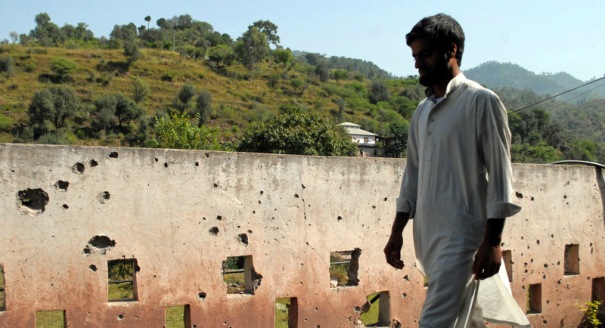
The Russian authorities did not react to the escalation of the conflict along the Line of Control between India and Pakistan. The official websites of the president, the government, and the Ministry of Foreign Affairs provide no clues as to Moscow’s position on the current crisis.
This silence can be explained in two ways. Russia may simply consider the Kashmir problem to be a question of India-Pakistan relations and see no role for itself in this regard. However, Russia could also be turning a blind eye to the events in Kashmir to mirror the positions that India and Pakistan took vis-à-vis the crisis in Ukraine.
Instead of assuring both sides of its continued neutrality and interest in the peaceful resolution of the Kashmir problem, which would suit both India and Pakistan, Russia is making them divine its actual position on this conflict. Meanwhile, Russia’s moves in South Asia may disorient India and Pakistan even more.
Russian officials’ frequent visits to Pakistan may sprout concern in New Delhi. A number of top government figures have appeared in Islamabad in recent years: the Director of the Federal Drug Control Service Victor Ivanov in March 2012 and October 2014, Deputy Energy Minister Yury Sentyurin in June 2012, the Sports Minister Vitaly Mutko in September 2012, the Foreign Minister Sergey Lavrov in October 2012, the Council of the Federation Chairperson Valentina Matvienko (the second highest-ranking official after the president, according to the Russian Constitution) in February 2013, Deputy Foreign Minister Sergey Ryabkov in August 2013, the Land Force Commander Vladimir Chirkin in August 2013, Deputy Foreign Minister Igor Morgulov in October 2014, and others. The exchange of high-level visits between Russia and Pakistan is likely to continue this year.
The visits in and of themselves should not alarm New Delhi. However, in conjunction with two rounds of joint naval exercises conducted in March and October of 2014 and the Russian authorities’ decision to reconsider their ban on selling weapons and military equipment to Pakistan, the high-level contacts point to a rapid development of Russo-Pakistani relations, including in the military sphere.
In turn, Pakistan may have its own concerns regarding the development of the ties between Russia and India. Pakistan cannot help but be alarmed by Russian participation in Indian strategic weapons projects, which include developing cruise missiles and nuclear submarines. Pravin Sawhney reports that Russia sold India five turbofan engines for use in cruise missiles, revealing the depth of the strategic partnership between Moscow and New Delhi.
Russia certainly seeks to further its strategic partnership with India and to continue to develop its relations with Pakistan. However, its moves will face growing mistrust in New Delhi and Islamabad if Moscow remains silent on South Asia’s hot-button issues. Conversely, providing Indian and Pakistani politicians, public, and military and economic circles with timely and comprehensive information on Russia’s position on regional issues, including the disagreements between India and Pakistan, will help build greater confidence in both New Delhi and Islamabad.
Former Fellow, Nonproliferation Program, Moscow Center
Topychkanov was a fellow in the Carnegie Moscow Center’s Nonproliferation Program.
Recent Work

James M. Acton, Alexey Arbatov, Vladimir Dvorkin, …
Petr Topychkanov
Carnegie does not take institutional positions on public policy issues; the views represented herein are those of the author(s) and do not necessarily reflect the views of Carnegie, its staff, or its trustees.

But their "principal to principal" model will only be as effective as the political strength of each leader back home.

Damien Ma

U.S. unpredictability has allowed China to capitalize on its positioning as the “responsible great power”. Paradoxically, the more China wins the perception game, the more likely expectations will rise for Beijing to deliver not just words but to demonstrate with its deeds.

Chong Ja Ian

Hanoi and Beijing have long treated each other as distant cousins rather than comrades in arms. That might be changing as both sides draw closer to hedge against uncertainty and America’s erratic behavior.

Nguyễn Khắc Giang

Across Asia, China is better positioned to withstand energy shocks from the fallout of the Iran war. Its abundant coal capacity can ensure stability in the near term. Yet at the same time, the country’s energy transition away from coal will make it even less vulnerable during the next shock.
Damien Ma

Malaysia’s chairmanship sought to fend off short-term challenges while laying the groundwork for minimizing ASEAN’s longer-term exposure to external stresses.

Elina Noor