• Commentary
  • Research
  • Experts
  • Events
Carnegie China logoCarnegie lettermark logo
{
  "authors": [
    "Ashley J. Tellis",
    "Robert D. Blackwill"
  ],
  "type": "other",
  "centerAffiliationAll": "dc",
  "centers": [
    "Carnegie Endowment for International Peace"
  ],
  "collections": [],
  "englishNewsletterAll": "ctw",
  "nonEnglishNewsletterAll": "",
  "primaryCenter": "Carnegie Endowment for International Peace",
  "programAffiliation": "SAP",
  "programs": [
    "South Asia"
  ],
  "projects": [],
  "regions": [
    "North America",
    "United States",
    "East Asia",
    "China"
  ],
  "topics": [
    "Foreign Policy"
  ]
}

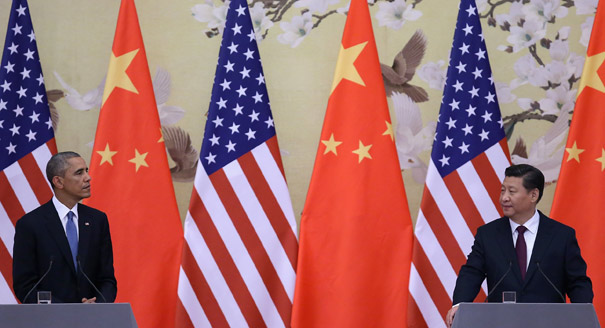
Source: Getty

Other

Revising U.S. Grand Strategy Toward China

China represents and will remain the most significant competitor to the United States for decades to come. As such, the need for a more coherent U.S. response to increasing Chinese power is long overdue

Link Copied
By Ashley J. Tellis and Robert D. Blackwill
Published on Apr 10, 2015

Source: Council on Foreign Relations

Overview

"China represents and will remain the most significant competitor to the United States for decades to come. As such, the need for a more coherent U.S. response to increasing Chinese power is long overdue," write CFR Senior Fellow Robert D. Blackwill and Carnegie Endowment for International Peace Senior Associate Ashley J. Tellis in a new Council Special Report, Revising U.S. Grand Strategy Toward China.

"Because the American effort to 'integrate' China into the liberal international order has now generated new threats to U.S. primacy in Asia—and could result in a consequential challenge to American power globally—Washington needs a new grand strategy toward China that centers on balancing the rise of Chinese power rather than continuing to assist its ascendancy."

The authors argue that such a strategy is designed to limit the dangers that China's geoeconomic and military power pose to U.S. national interests in Asia and globally, even as the United States and its allies maintain diplomatic and economic interactions with China.

Blackwill and Tellis recommend that Washington do the following:

Revitalize the U.S. economy

"Nothing would better promote the United States' strategic future and grand strategy toward China than robust economic growth…This must be the first priority of the president and Congress."

Strengthen the U.S. military

"Congress should remove sequestration caps and substantially increase the U.S. defense budget...Washington should intensify a consistent U.S. naval and air presence in the South and East China Seas," and "accelerate the U.S. ballistic-missile defense posture" in the Pacific.

Expand Asian trade networks

"U.S. grand strategy toward China will be seriously weakened without delivering on the TPP [Trans-Pacific Partnership trade agreement]. A major push by the White House for ratification should therefore begin immediately in the new Congress, including seeking trade promotion authority."

Create a technology-control regime

"Washington should pay increased attention to limiting China's access to advanced weaponry and military critical technologies." The United States should encourage its allies "to develop a coordinated approach to constrict China's access to all technologies, including dual use."

Implement effective cyber policies

Washington should "impose costs on China that are in excess of the benefits it receives from its violations in cyberspace…increase U.S. offensive cyber capabilities . . . continue improving U.S. cyber defenses," and "pass relevant legislation in Congress, such as the Cyber Information Security Protection Act."

Reinforce Indo-Pacific partnerships

"The United States cannot defend its interests in Asia without support from its allies," and "should build up the power-political capabilities of its friends and allies on China's periphery."

Energize high-level diplomacy with Beijing

The United States should work to mitigate tensions with China, and "reassure U.S. allies and friends in Asia and beyond that Washington is doing everything it can to avoid a confrontation with China . . . U.S.-China discourse should be more candid, high-level, and private than is current practice."

This special report was originally published by the Council on Foreign Relations.

About the Authors

Ashley J. Tellis

Former Senior Fellow

Ashley J. Tellis was a senior fellow at the Carnegie Endowment for International Peace.

Robert D. Blackwill

Robert D. Blackwill is Henry A. Kissinger Senior Fellow for U.S. Foreign Policy at the Council on Foreign Relations. He was U.S. Ambassador to India from 2001 to 2003 and Deputy National Security Adviser to U.S. President George W. Bush from 2003 to 2004.

Authors

Ashley J. Tellis
Former Senior Fellow
Robert D. Blackwill

Robert D. Blackwill is Henry A. Kissinger Senior Fellow for U.S. Foreign Policy at the Council on Foreign Relations. He was U.S. Ambassador to India from 2001 to 2003 and Deputy National Security Adviser to U.S. President George W. Bush from 2003 to 2004.

Foreign PolicyNorth AmericaUnited StatesEast AsiaChina

Carnegie does not take institutional positions on public policy issues; the views represented herein are those of the author(s) and do not necessarily reflect the views of Carnegie, its staff, or its trustees.

More Work from Carnegie China

  • Commentary
    Malaysia’s Year as ASEAN Chair: Managing Disorder

    Malaysia’s chairmanship sought to fend off short-term challenges while laying the groundwork for minimizing ASEAN’s longer-term exposure to external stresses.

      Elina Noor

  • Commentary
    When It Comes to Superpower Geopolitics, Malaysia Is Staunchly Nonpartisan

    For Malaysia, the conjunction that works is “and” not “or” when it comes to the United States and China.

      Elina Noor

  • Commentary
    ASEAN-China Digital Cooperation: Deeper but Clear-Eyed Engagement

    ASEAN needs to determine how to balance perpetuating the benefits of technology cooperation with China while mitigating the risks of getting caught in the crosshairs of U.S.-China gamesmanship.

      Elina Noor

  • Commentary
    Neither Comrade nor Ally: Decoding Vietnam’s First Army Drill with China

    In July 2025, Vietnam and China held their first joint army drill, a modest but symbolic move reflecting Hanoi’s strategic hedging amid U.S.–China rivalry.

      • Nguyen-khac-giang

      Nguyễn Khắc Giang

  • Commentary
    Today’s Rare Earths Conflict Echoes the 1973 Oil Crisis — But It’s Not the Same

    Regulation, not embargo, allows Beijing to shape how other countries and firms adapt to its terms.

      Alvin Camba

Get more news and analysis from
Carnegie China
Carnegie China logo, white
  • Research
  • About
  • Experts
  • Events
  • Contact
  • Careers
  • Privacy
  • For Media
Get more news and analysis from
Carnegie China
© 2026 Carnegie Endowment for International Peace. All rights reserved.