

Article
Frederic Grare
{
  "authors": [
    "Frederic Grare"
  ],
  "type": "legacyinthemedia",
  "centerAffiliationAll": "dc",
  "centers": [
    "Carnegie Endowment for International Peace"
  ],
  "collections": [],
  "englishNewsletterAll": "ctw",
  "nonEnglishNewsletterAll": "",
  "primaryCenter": "Carnegie Endowment for International Peace",
  "programAffiliation": "SAP",
  "programs": [
    "South Asia"
  ],
  "projects": [],
  "regions": [
    "South Asia",
    "India"
  ],
  "topics": [
    "Foreign Policy"
  ]
}
Source: Getty
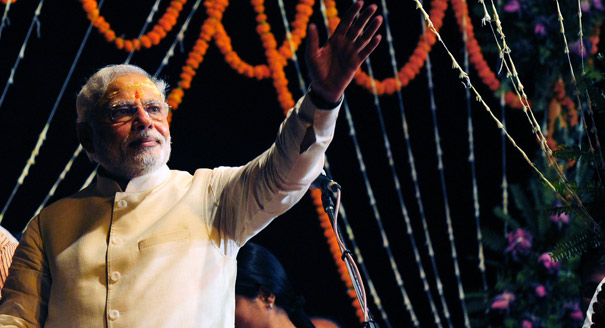
Modi’s diplomatic activism in India’s neighboring countries has generated praise, but a closer examination of his foreign policy reveals a large degree of continuity with his predecessors’ international relations.
Source: Week
The first year of Narendra Modi's foreign policy has been nothing if not flamboyant. Over the past 12 months, the Indian prime minister has travelled to 18 countries. A number of these visits, particularly to Japan, the US, and, more recently, to China, have attracted much international attention. Modi's diplomatic activism in India's neighbouring countries has also generated praise. A closer examination of his foreign policy, however, reveals a large degree of continuity with his predecessors' international relations.
The main difference in Modi's foreign affairs lies in his ability to effectively communicate. Modi has been remarkably successful in changing the narrative in situations where achieving his goals has proven difficult and he has effectively projected an image of a pragmatic India, ready to assert itself on the international scene and willing to do business with the rest of the world.
Ultimately, however, the success of his foreign policy, as measured by India's influence in Asia and its global standing, will depend on his capacity to reform the Indian economy and transform India into a truly attractive market and preferred destination for foreign direct investment. Such economic reforms will provide the foundation for international power and diplomatic success. After a year in office, and despite all of Modi's campaign promises, his success on this aspect remains a question mark.It is difficult to find significant differences between the foreign policies of Modi and Manmohan Singh. Both have understood India's interest in developing closer ties with the US in order to secure necessary technological transfers and investments, and modernise the Indian economy. Both have sought to develop a security partnership with the US that could leverage China while simultaneously maintaining India's autonomy in strategic decisions.
In Asia, Modi and Singh have conducted the same policy of asserting India's presence and engaging China, including in military matters, while at the same time trying to counter Beijing's influence wherever possible. Though the styles of the two prime ministers differ, and Modi's foreign policy is perceived to be more muscular than Singh's was, India's posture has at most shifted from being assertively cautious to cautiously assertive. Any differences are essentially tactical.
Ironically, the most substantial results of Modi's diplomacy are the result of policies begun by the previous administration, which were, at the time, often opposed by Modi's own party. The border agreement recently concluded with Bangladesh is one such example. In other cases, like the India-Australia civil nuclear deal, the Modi government signed an agreement which had been entirely negotiated by the previous administration.
Despite his close personal relationships with many leaders, Modi—for understandable reasons—is yet to gain more than his predecessors. The civil nuclear deal with Japan remains unresolved, and the border issue with China, or even the demarcation of the Line of Actual Control, has not progressed by an inch. True, Modi is rightly credited with reaching the so-called “breakthrough” that supposedly enabled the implementation of the 2008 civil nuclear cooperation deal. The agreement had been jeopardised by the Nuclear Liability Act, which was passed in 2010 by the Indian Parliament and enacted unlimited legal liability not only on operators, but also on component suppliers in case of an accident. The agreement reached during Barack Obama's visit to Delhi in January 2015 is, undeniably, a political success, but in practical terms, it does not fully restore the possible scope of nuclear cooperation that existed before passing the act.
Paradoxically, the most significant difference between Modi and his predecessors lies in the domestic dimensions of his foreign policy. Modi has been able to transform the narrative of India's international policy, masking what is essentially an anxious attempt to catch up with China as an assertion of India's power in Asia and globally, and he has effectively used national pride to achieve pragmatic objectives. By doing so, Modi has been able to successfully sell his foreign policy to the public—in particular, selling his US policy to the Indian electorate only a few weeks after the Khobragade affair was a remarkable achievement. Perhaps, more importantly, Modi has effectively sold his foreign policy to his own party, which has allowed him to sign agreements that the BJP had opposed or even sabotaged while it was in the minority.
Similarly, Modi understands that a strong economy is the driver of an effective foreign policy, and he has performed remarkably well in selling the India brand internationally. Modi clearly understands that without foreign investment, he is unlikely to significantly change the course of the Indian economy. However, while his advertising has been successful on this count, his performance has been less impressive. A significant part of his international success rests on his pledge to make India a truly attractive destination for foreign investment, a promise made credible by his own economic success as Gujarat chief minister. Yet, Modi has, thus far, been remarkably cautious regarding the structural reforms necessary to improve the Indian economy.
Hard economic decisions are still to come. Unless Modi increases the pace and scope of reform, he is unlikely to obtain the much-needed foreign investment and the accompanying technological transfers that would turn India into an economic power. There lies the key to India's regional and international standing. Ultimately, every foreign policy starts and finishes at home.
Former Nonresident Senior Fellow, South Asia Program
Frédéric Grare was a nonresident senior fellow at the Carnegie Endowment for International Peace, where his research focuses on Indo-Pacific dynamics, the search for a security architecture, and South Asia Security issues.
Recent Work
Frederic Grare
Frederic Grare
Carnegie does not take institutional positions on public policy issues; the views represented herein are those of the author(s) and do not necessarily reflect the views of Carnegie, its staff, or its trustees.

But their "principal to principal" model will only be as effective as the political strength of each leader back home.

Damien Ma

U.S. unpredictability has allowed China to capitalize on its positioning as the “responsible great power”. Paradoxically, the more China wins the perception game, the more likely expectations will rise for Beijing to deliver not just words but to demonstrate with its deeds.

Chong Ja Ian

Hanoi and Beijing have long treated each other as distant cousins rather than comrades in arms. That might be changing as both sides draw closer to hedge against uncertainty and America’s erratic behavior.

Nguyễn Khắc Giang

Across Asia, China is better positioned to withstand energy shocks from the fallout of the Iran war. Its abundant coal capacity can ensure stability in the near term. Yet at the same time, the country’s energy transition away from coal will make it even less vulnerable during the next shock.
Damien Ma

Malaysia’s chairmanship sought to fend off short-term challenges while laying the groundwork for minimizing ASEAN’s longer-term exposure to external stresses.

Elina Noor