

Malaysia’s chairmanship sought to fend off short-term challenges while laying the groundwork for minimizing ASEAN’s longer-term exposure to external stresses.
Elina Noor
{
"authors": [
"Milan Vaishnav",
"Sadanand Dhume"
],
"type": "legacyinthemedia",
"centerAffiliationAll": "dc",
"centers": [
"Carnegie Endowment for International Peace"
],
"collections": [],
"englishNewsletterAll": "",
"nonEnglishNewsletterAll": "",
"primaryCenter": "Carnegie Endowment for International Peace",
"programAffiliation": "SAP",
"programs": [
"South Asia"
],
"projects": [],
"regions": [
"South Asia",
"India"
],
"topics": [
"Political Reform",
"Economy",
"Foreign Policy"
]
}Source: Getty
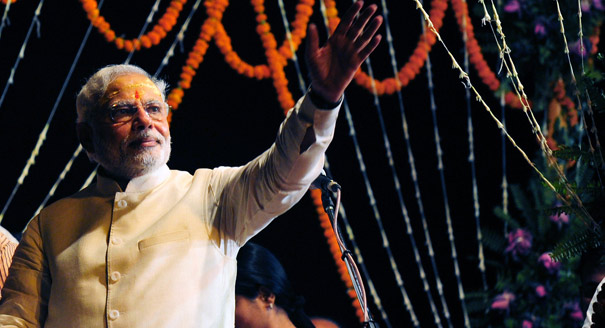
On the eve of Modi’s second visit to the United States, what are the outcomes of the U.S.-India Strategic and Commercial Dialogue and what is the status of the bilateral relationship?
Source: Bloomberg TV India
On the eve of Modi’s second visit to the United States, Carnegie’s Milan Vaishnav and Sandanand Dhune from the American Enterprise Institute discussed the outcomes of the U.S.-India Strategic and Commercial Dialogue, the BJP’s reform agenda, and the impact of upcoming state elections in Bihar. On U.S.-India cooperation, Vaishnav noted an increasingly convergent position regarding Pakistan. He also spoke of China, saying that whether or not the text of the joint statement has anything to say about China, the People’s Republic nonetheless looms large in the subtext of the U.S.-India relationship. On the economy, Vaishnav contended that India is trending in the right direction compared to other emerging markets, but not improving with the speed that most people hoped it would. A lot of reform, Vaishnav concluded, still needs to be done.
Director and Senior Fellow, South Asia Program
Milan Vaishnav is a senior fellow and director of the South Asia Program and the host of the Grand Tamasha podcast at the Carnegie Endowment for International Peace. His primary research focus is the political economy of India, and he examines issues such as corruption and governance, state capacity, distributive politics, and electoral behavior. He also conducts research on the Indian diaspora.
Sadanand Dhume
American Enterprise Institute
Carnegie does not take institutional positions on public policy issues; the views represented herein are those of the author(s) and do not necessarily reflect the views of Carnegie, its staff, or its trustees.
Malaysia’s chairmanship sought to fend off short-term challenges while laying the groundwork for minimizing ASEAN’s longer-term exposure to external stresses.
Elina Noor
For Malaysia, the conjunction that works is “and” not “or” when it comes to the United States and China.
Elina Noor
In July 2025, Vietnam and China held their first joint army drill, a modest but symbolic move reflecting Hanoi’s strategic hedging amid U.S.–China rivalry.
Nguyễn Khắc Giang
Rather than climate ambitions, compatibility with investment and exports is why China supports both green and high-emission technologies.
Mathias Larsen
“Involution” is a new word for an old problem, and without a very different set of policies to rein it in, it is a problem that is likely to persist.
Michael Pettis





