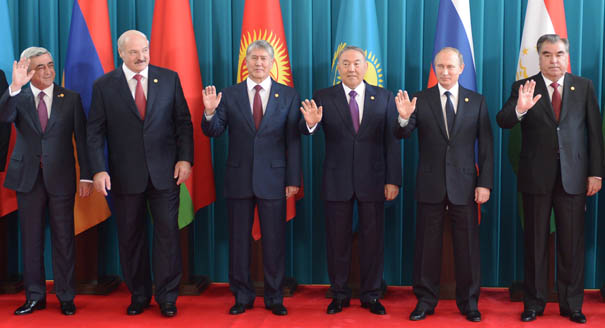
A month after Russia began its intervention in Syria, other post-Soviet leaders are conspicuous mainly by their silence on the military operation there.
The Commonwealth of Independent States summit that took place in Kazakhstan earlier this month went by without a single expression of public support for President Vladimir Putin. The only person who spoke out in favor, Kyrgyz President Almazbek Atambayev, did so only during a post-summit interview to a Russian television channel.
The silence reflects the fact that the ruling elites of the other post-Soviet states are less than thrilled by Russia’s recent foreign policy actions. They see Russia’s behavior in Ukraine as a threat to their sovereignty and territorial integrity. The most that the Kremlin can count on from them is a recognition of the reality that Crimea is now de facto part of Russian territory.
Kazakhstan in particular has been alarmed by the noisy and often aggressive stream of publications and pronouncements in Russia predicting that Northern Kazakhstan, with its millions of Russian speakers, might follow Donbas as a place where the “Russian world” needs to be protected.
Ironically, it was Kazakhstan’s turn to host this year’s CIS summit, in the resort town of Burabay north of Astana. For the first time it was a completely closed meeting. Previously, only presidents’ meetings at the summit were off limits to the press. This time, outsiders were excluded even from sessions with full delegations, even though these were protocol occasions, featuring speeches made by all of the presidents, without follow-up discussions.
Vladimir Putin’s speech was made available only on the Kremlin’s press service site. The same was true of the speeches of the presidents of Azerbaijan and Uzbekistan, Ilham Aliev and Islam Karimov. So it was only later that we learned that Karimov had made a cutting speech, criticizing the agenda of the summit for being “divorced from reality.”
Most of Putin’s speech was devoted to the fight against terrorism and efforts to “coordinate a joint foreign policy.” He stated that Russia was acting fully within international law on the basis of an official request from President Assad and that the operation would last for a limited time-span.
Judging by the media coverage of the summit, none of the other presidents responded to this call for solidarity over Syria. Indeed, no one else appeared to mention Syria at all.
Perhaps the only exception was Almazbek Atambayev, the president of Kyrgyzstan, who later gave a lengthy interview to the Russian television channel RTR in which he agreed with the assertion that Russian troops in Syria are fighting “also for Kyrgyzstan” and said that “the guys who are fighting for ISIS today and are being trained in Syria will later be sent to build the Khorasan Caliphate in Central Asia, including Kyrgyzstan.”
This was probably as good as it got for Putin. The Belarusian leader Alexander Lukashenko let slip that the private discussion among the presidents was “heated.”
It’s possible that the “heated” exchanges also concerned Afghanistan, where a series of different extremist groups have become more active in the north of the country in the past few weeks.
Recently, President Nursultan Nazarbayev caused a small diplomatic scandal by mentioning violent incidents on the Turkmen-Afghan border. The Turkmen government relayed its “resolute protest” to Astana, urging the “brotherly” state to “be guided by more objective information.”
Turkmen President Gurbanguly Berdymukhamedov pointedly chose not to come to Burabay, sending only his deputy prime minister there instead. Moreover, he dispatched his Foreign Minister Rashid Meredov for talks in Washington at the same time.
What lies behind this diplomatic gambit? Evidently, Russia’s missile launch against Syria from the Caspian Sea—not far from Turkmenistan—unnerved the Turkmen leadership.
Turkmenistan and Russia have had an uneasy relationship since the August 2008 war in Georgia. At the time, Ashgabat was involved in a diplomatic tussle with Moscow over the status of thousands of Turkmens who held dual Russian-Turkmen citizenship. The Turkmen government took Moscow’s military intervention in South Ossetia, ostensibly to protect Russian citizens, as a warning. In response it hastily staged military exercises on the eastern shore of the Caspian Sea to demonstrate its resolve to defend itself.
Sources in Turkmenistan say that their foreign minister raised the issue of security guarantees in Washington.
The two other Caspian Sea littoral states, Kazakhstan and Azerbaijan, are bound to be concerned by Russia’s military activity there—even though Nazarbayev and Aliev were almost certainly informed about the launch of the 26 cruise missiles. It is likely that Aliev was told about the impending strike during an October 7 telephone call in which, according to the Azerbaijani presidential press service, the Azerbaijani leader congratulated Putin on his birthday.
Russia’s missile launch helps to explain why, since the early 2000s, it has been stalling on an initiative by the four other Caspian Sea states to demilitarize the region. The demilitarization of the Caspian Basin remains one pre-condition for an agreement on the legal status and delimitation of the Caspian Sea. Azerbaijan, Kazakhstan, and Turkmenistan have reason to believe that Teheran and Moscow are deliberately dragging their feet on these issues in order to maintain the control they had over the Caspian in Soviet days.
They received an unwelcome reminder of that era on October 18, when a flotilla of three Iranian warships sailed across the Caspian on a “friendly visit” to the Russian port of Astrakhan. The captain of the flotilla made a point of noting that the voyage had been planned well in advance.
Arkady Dubnov is a political analyst and expert on Central Asia.