

Q&A
- +1
Sheena Chestnut Greitens, Oriana Skylar Mastro, Yukon Huang, …
{
  "authors": [
    "Yukon Huang"
  ],
  "type": "legacyinthemedia",
  "centerAffiliationAll": "dc",
  "centers": [
    "Carnegie Endowment for International Peace"
  ],
  "collections": [],
  "englishNewsletterAll": "asia",
  "nonEnglishNewsletterAll": "",
  "primaryCenter": "Carnegie Endowment for International Peace",
  "programAffiliation": "AP",
  "programs": [
    "Asia"
  ],
  "projects": [],
  "regions": [
    "East Asia",
    "China"
  ],
  "topics": [
    "Economy"
  ]
}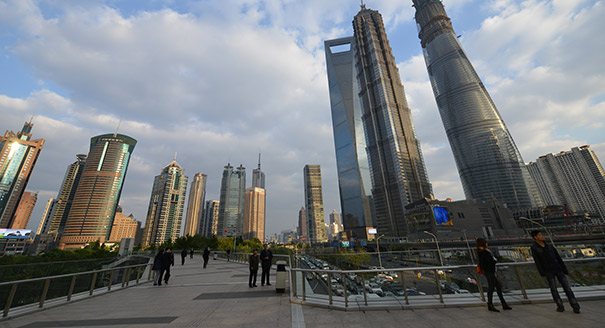
Source: Getty
China’s model for growth has been enormously successful, but it comes with some unresolved risks.
Source: Asia and the Pacific Society
The generally accepted view is that well-functioning institutions and a less interventionist involvement of the state are essential to promoting efficiency and growth. But if so, how does one explain why China—with its weak governance structures and seemingly overbearing presence of the state—was able to grow at double-digit rates for more than three decades before its current economic slowdown?
The answer is that China’s success has been due to the unique role played by the state in shaping incentives and fostering competition, but the way the system has evolved in recent years has introduced some unresolved risks.The standard framework for understanding the workings of a market-driven economy is based on the theory of the firm operating in competitive markets, unencumbered by government-driven distortions. Growth depends on a country’s resource endowments, the quality of its institutions, and supportive government policies. The “proper” role of the state is usually depicted as a regulator and facilitator of activity, not as a direct producer except for “public goods and services.”
That the state has played a major role in driving China’s economy is well recognised through its allocation of resources stipulated in the five-year plans and prominence of its state-owned enterprises in production.
Less well understood and appreciated is the unique role that centralized Party directives and personnel processes have played in incentivizing the administrative system. This has helped China to avoid the problems of distorted signals and “soft budget constraints” that emerged in other centrally-driven economies as in the former Soviet Union.
Key to understanding the Chinese state is the role of guided regional competition from the county up to provincial levels. The Party apparatus in Beijing sets economic goals, prioritises policies, directs the local administrative units and appoints senior officials who are typically from outside the jurisdictions that they are asked to govern.
In this system, local authorities are highly motivated to promote growth. Efficiency comes from having different jurisdictions at equivalent levels compete against each other for their relative positions. They also compete to build the new institutions that China needs as it moves towards becoming a more market-oriented economy.
Two elements in this system incentivize competition—a promotion process linked to performance and a local tax base linked to commercial activities that officials have substantial powers to influence. The consequences of these incentives can be either positive or negative for the economy as a whole. When the state and the market complement each other, the results of competition can have a dramatic impact on productivity and living standards, although this can come at the expense of environmental degradation.
Since the onset of the Global Financial Crisis (GFC) in 2008, however, a combination of events began to distort the role of the state in driving the economy. Local authorities became more directly involved in commercial activities through the creation of local government financing vehicles (LGFVs). These are legally classified as state-owned enterprises but intrinsically a branch of the local government created with the explicit purpose of generating more revenues for them.
While local governments are prohibited from borrowing, LGFVs as enterprises can borrow using land as collateral to undertake commercial activities. Localities were drawn into this process by the emergence of land as a tradable commodity after housing was privatized and land auctions were sanctioned in 2004. This occurred at a time when the central government was pressuring local governments to provide more public services for their constituents but did not give them the necessary budgetary resources to do so.
The emergence of LGFVs put local governments into direct competition with existing firms in property-related commercial activities. They were able to compete because of their preferential access to land and financing from state-owned banks, which also enlarged the opportunities for rent seeking activities. At the same time, the government launched a huge stimulus program of $600 billion in 2008, channeling loans through the financial system to state-owned enterprises and local authorities which made such activities easier to do.
Until restrictions on LGFVs borrowings were recently imposed, revenues from land development provided up to a third of the revenues for provincial authorities in the post-GFC period. Much of this was used to build up infrastructure and social services. But these investments eventually led to excessive property development and an unsustainable debt buildup. This is the major reason why the current growth slowdown has not yet bottomed out.
China’s governance structure does not fit the usual analytical frameworks. The state is neither a monolith nor a collection of chaotic entities. The system consists of a hierarchy of interwoven, multi-tiered regional governments and firms—state-owned and private—operating under the aegis of centrally-administered directives.
When it functions well the result can be spectacular, as evidenced by the rapid transformation of the economy and the lifting of some 600 million out of poverty. But when incentives are misaligned, the outcomes can include unsustainable environmental degradation, surging corruption, and financial instability.
Addressing these challenges will determine the success or failure of President Xi Jinping’s term and the future of the Communist Party of China. In principle, the new leadership has proposed a greater role for market-driven institutions over the coming years. But it is unlikely that China will adopt the same solutions that the West would recommend, and this partly explains why there is such a wide variation in views about China’s economic prospects.
This article was originally published by the Asia and the Pacific Society.

Senior Fellow, Asia Program
Huang is a senior fellow in the Carnegie Asia Program where his research focuses on China’s economy and its regional and global impact.
Recent Work


Sheena Chestnut Greitens, Oriana Skylar Mastro, Yukon Huang, …


Yukon Huang, Isaac B. Kardon, Matt Sheehan
China’s political future will be shaped between now and next October. As the Communist Party enters its intense “campaign season” to prepare for a major political transition in 2027, reading Beijing's actions and responses may become more difficult as domestic politics weigh on its behavior more than usual.

Damien Ma
China has showcased its engineering prowess with small modular reactor demonstration projects. But turning these technological achievements into commercial success will be a greater challenge.

Tong Zhao

The Plaza Accord was not an externally imposed punishment of Japan but part of a broader restructuring that Japanese economists and policymakers themselves recognized was necessary. Its effects were undermined, however, when Tokyo responded to the resulting slowdown with policies that exacerbated investment, credit expansion, and the very imbalances the adjustment was intended to resolve.

Michael Pettis
The nuclear relationship between China and the United States is increasingly shaped by widening perception gaps rather than deliberate strategic design.
Tong Zhao
China’s banking crisis in the 2000s was resolved by transferring the costs to households through financial repression—a decision that recapitalized the banks while exacerbating the structural imbalances that continue to shape the Chinese economy today.
Michael Pettis