

• Commentary
  • Research
  • Experts
  • Events
Carnegie China logoCarnegie lettermark logo
{
  "authors": [
    "David Livingston",
    "Deborah Gordon",
    "Rob Barnett",
    "Brandon Barnes",
    "Cheryl Wilson"
  ],
  "type": "other",
  "centerAffiliationAll": "dc",
  "centers": [
    "Carnegie Endowment for International Peace"
  ],
  "collections": [],
  "englishNewsletterAll": "ctw",
  "nonEnglishNewsletterAll": "",
  "primaryCenter": "Carnegie Endowment for International Peace",
  "programAffiliation": "SCP",
  "programs": [
    "Sustainability, Climate, and Geopolitics"
  ],
  "projects": [],
  "regions": [
    "North America",
    "United States",
    "East Asia",
    "China",
    "Western Europe"
  ],
  "topics": [
    "Climate Change"
  ]
}

Source: Getty

Other

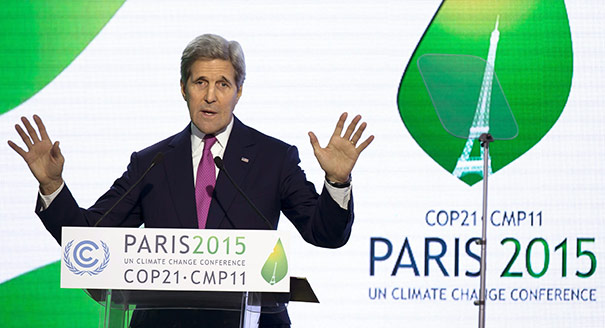
Energy Policy and Politics After Paris

An analysis of the outcomes of the Paris climate talks, as well as the opportunities and challenges ahead for addressing emissions.

Link Copied
By David Livingston, Deborah Gordon, Rob Barnett, Brandon Barnes, Cheryl Wilson
Published on Dec 15, 2015

Source: Bloomberg Intelligence Webinar

In the run-up to international climate talks being held in Paris, lawmakers from various countries put their chips on the table. Rather than a top down approach, each country offered its unique approach for tackling greenhouse gas emissions. In the United States, for instance, the Clean Power Plan is the cornerstone for cutting emissions from the power sector. And the Chinese government recently announced plans for a cap-and-trade program that will begin in 2017.

After the Paris talks conclude, experts from Bloomberg Intelligence and the Carnegie Endowment came together to discuss:

  • Overview of the Paris climate agreement
  • Expectations for policy evolution in 2016 and beyond
  • Overview of legal challenges to U.S. climate polices
  • Climate and the 2016 U.S. election
  • Implications for oil & gas producers
  • Implications for electric utilities

This webinar was hosted by Bloomberg Intelligence.

About the Authors

David Livingston

Former Associate Fellow, Energy and Climate Program

Livingston was an associate fellow in Carnegie’s Energy and Climate Program, where his research focuses on emerging markets, technologies, and risks.

Deborah Gordon

Former Director and Senior Fellow, Energy and Climate Program

Gordon was director of Carnegie’s Energy and Climate Program, where her research focuses on oil and climate change issues in North America and globally.

Rob Barnett

Bloomberg Intelligence

Rob Barnett is a senior energy economist with Bloomberg Government, specializes in energy-sector economics, environmental policy and strategy, and EPA regulations.

Brandon Barnes

Bloomberg Intelligence

Cheryl Wilson

Bloomberg Intelligence

Authors

David Livingston
Former Associate Fellow, Energy and Climate Program
Deborah Gordon
Former Director and Senior Fellow, Energy and Climate Program
Deborah Gordon
Rob Barnett
Bloomberg Intelligence
Brandon Barnes
Bloomberg Intelligence
Cheryl Wilson
Bloomberg Intelligence
Climate ChangeNorth AmericaUnited StatesEast AsiaChinaWestern Europe

Carnegie does not take institutional positions on public policy issues; the views represented herein are those of the author(s) and do not necessarily reflect the views of Carnegie, its staff, or its trustees.

More Work from Carnegie China

  • Commentary
    China’s Energy Security Doesn’t Run Through Hormuz but Through the Electrification of Everything

    Across Asia, China is better positioned to withstand energy shocks from the fallout of the Iran war. Its abundant coal capacity can ensure stability in the near term. Yet at the same time, the country’s energy transition away from coal will make it even less vulnerable during the next shock.


      • Damien Ma

      Damien Ma

  • Xi walking into a room with people standing and applauding around him
    Commentary
    Emissary
    The Xi Doctrine Zeros in on “High-Quality Development” for China’s Economic Future

    In the latest Five-Year Plan, the Chinese president cements the shift to an innovation-driven economy over a consumption-driven one.

      • Damien Ma

      Damien Ma

  • Commentary
    When It Comes to Superpower Geopolitics, Malaysia Is Staunchly Nonpartisan

    For Malaysia, the conjunction that works is “and” not “or” when it comes to the United States and China.

      Elina Noor

  • Commentary
    ASEAN-China Digital Cooperation: Deeper but Clear-Eyed Engagement

    ASEAN needs to determine how to balance perpetuating the benefits of technology cooperation with China while mitigating the risks of getting caught in the crosshairs of U.S.-China gamesmanship.

      Elina Noor

  • Commentary
    Neither Comrade nor Ally: Decoding Vietnam’s First Army Drill with China

    In July 2025, Vietnam and China held their first joint army drill, a modest but symbolic move reflecting Hanoi’s strategic hedging amid U.S.–China rivalry.

      • Nguyen-khac-giang

      Nguyễn Khắc Giang

Get more news and analysis from
Carnegie China
Carnegie China logo, white
Keck Seng Tower133 Cecil Street #10-01ASingapore, 069535Phone: +65 9650 7648
  • Research
  • About
  • Experts
  • Events
  • Contact
  • Careers
  • Privacy
  • For Media
Get more news and analysis from
Carnegie China
© 2026 Carnegie Endowment for International Peace. All rights reserved.





