

Commentary
But their "principal to principal" model will only be as effective as the political strength of each leader back home.
Damien Ma
{
  "authors": [
    "Richard Sokolsky",
    "Gordon Adams"
  ],
  "type": "legacyinthemedia",
  "centerAffiliationAll": "",
  "centers": [
    "Carnegie Endowment for International Peace"
  ],
  "collections": [],
  "englishNewsletterAll": "",
  "nonEnglishNewsletterAll": "",
  "primaryCenter": "Carnegie Endowment for International Peace",
  "programAffiliation": "",
  "programs": [],
  "projects": [],
  "regions": [
    "North America",
    "United States"
  ],
  "topics": [
    "Foreign Policy",
    "Nuclear Policy",
    "Arms Control"
  ]
}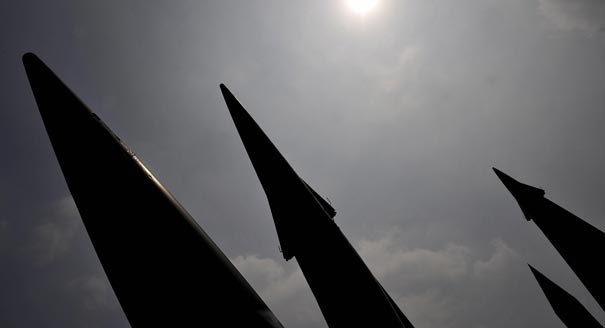
Source: Getty
The United States can deter any country from using nuclear weapons against America and its treaty allies with a nuclear force that is far smaller, less destabilizing, and less expensive than the one the Pentagon is planning to build.
Source: Defense One
The United States is on the cusp of launching an unnecessary, expensive, and potentially dangerous plan to modernize its strategic nuclear forces, helping stimulate what is being called a “new nuclear arms race.” Before Washington starts down this path, it needs to step back and ask, “How much is enough?” or, as the Cold War adage went, “How high do we need to make the rubble bounce?" The United States can deter any country from using nuclear weapons against America and its treaty allies with a nuclear force that is far smaller, less destabilizing, and less expensive than the one the Pentagon is planning to build.
This October will mark the 30th anniversary of the Reykjavik Summit, where President Ronald Reagan and then-Soviet leader Mikhail Gorbachev came close to abolishing nuclear weapons. Six years ago, President Barack Obama made the same commitment. But today, a quarter-century after the dissolution of the Soviet Union and the end of the Cold War, the United States is planning to spend $1 trillion over the next three decades to replace or upgrade virtually all of its strategic nuclear weapons. At the same time, Russia also has undertaken ambitious plans to upgrade its strategic nuclear forces with new multi-warhead missiles, aircraft, submarines, and even a rumored nuclear underwater drone.
Former Defense Secretary William Perry, who lived through the last nuclear build-up, argues that the resumption of strategic nuclear competition will waste vast sums of money; worse, it will not only fail to provide greater security for either country, but also exacerbate growing tensions between them and make their relationship less stable.The only credible and legitimate mission for nuclear weapons is to deter a nuclear attack on the United States or on treaty allies (“extended deterrence’). For these missions, the United States, as President Obama declared in 2013, only needs to maintain a force of 1,000 deployed strategic warheads, instead of the 1,550 it is allowed under New START.
The president’s nuclear math is fine—the mistake he made was deciding to maintain a smaller force by modernizing every leg of the nuclear triad for the next 30 years: a next-generation strategic bomber, a new generation of nuclear submarines armed with Trident missiles, and an upgrade of land-based ICBMs, along with modernization of the air-delivered B-61 bomb and development of a new nuclear cruise missile for the strategic bomber force.
Instead, to produce greater stability, lower the risks of an arms race, and conserve resources, the Pentagon should immediately retire the 500 land-based ICBMs. As fixed targets, they are vulnerable to attack and therefore only useful if launched first. They add only 500 reentry vehicles to the U.S.strategic force.
Whether to repurpose the strategic bomber force for exclusively conventional missions is a more difficult issue. Bombers, some analysts argue, give the triad flexibility, as they provide an opportunity to signal resolve in a crisis and additional targeting options. However, that very flexibility may actually weaken deterrence, causing a reaction by the adversary that leads to a first strike or a direct attack on the bombers themselves. In addition, the accuracy today of high explosive conventional weapons on a bomber may make nuclearization unnecessary. At the very least, a decision should be made to defer spending $10 billion to add strategic nuclear capabilities to the next-generation bomber, since the current bomber fleet provides adequate capability.
The United States would get more usable bang for the buck if the entire strategic bomber force were gradually converted for conventional missions over the next decade. It is neither necessary nor economical to invest in a new long-range strategic bomber when the fleet of B-52s can operate effectively for at least another 20 years. The Pentagon should also scrap plans to modernize the B-61 nuclear bomb and develop a new nuclear cruise missile for the strategic bombers. The older but refurbished B61 models are more than adequate, and nuclear cruise missiles, because they are indistinguishable from conventionally armed cruise missiles, could actually lower the threshold for nuclear use.
The most expensive but most stable leg of the nuclear triad is the fleet of stealthy and highly survivable ballistic missile submarines, which provides the National Command Authority with a great deal of targeting flexibility. However, the Navy’s plan to build 12 new SSBNs exceeds the needs of deterrence. Each new sub will carry 16 missiles that can be loaded with up to 8 independently targetable warheads for a maximum total capability of 1,500 nuclear warheads. Some experts worry that relying exclusively on SSBNs for nuclear deterrence will cause a loss of redundancy in the force if there is an across the board failure in both warheads for the Trident missiles or a catastrophic breakthrough in Russian anti-submarine warfare capabilities. But the risk of these developments is extremely remote in light of the heavy investment the United States makes in its nuclear stockpile stewardship program and in preventing Russian breakthroughs—and certainly not high enough to justify the additional expenditures.
There are multiple reasons to cut back on the existing modernization plan. Eight or nine submarines, plus several thousand strategic warheads in reserve, are more than adequate for the deterrence mission. Eliminating the ICBMand ultimately the nuclear bomber forces could free up as much as $60 billion over the next ten years, savings that could be applied to buying the forces appropriate to our real defense challenges. At minimal risk to U.S. security, it could offer an opportunity to open conversations with the Russians about mutual restraint and a renewed effort to reduce the two largest strategic nuclear forces in the world.
The administration’s nuclear plan is a serious walk-back on the president’s original commitment. It would keep strategic warheads within the New START limits, but at an unnecessarily high cost and with an increased risk of strategic instability. This White House has caved to the nuclear priesthood in the bureaucracy. Instead of staying on nuclear autopilot, the next administration needs to fundamentally rethink the role of nuclear weapons in U.S. national security strategy, the costs of implementing the current strategic force modernization program, and the alternatives that could provide greater stability and less risk of nuclear conflict at a much lower cost.

Nonresident Senior Fellow, Russia and Eurasia Program
Richard Sokolsky is a nonresident senior fellow in Carnegie’s Russia and Eurasia Program. His work focuses on U.S. policy toward Russia in the wake of the Ukraine crisis.
Gordon Adams
Carnegie does not take institutional positions on public policy issues; the views represented herein are those of the author(s) and do not necessarily reflect the views of Carnegie, its staff, or its trustees.

But their "principal to principal" model will only be as effective as the political strength of each leader back home.

Damien Ma

U.S. unpredictability has allowed China to capitalize on its positioning as the “responsible great power”. Paradoxically, the more China wins the perception game, the more likely expectations will rise for Beijing to deliver not just words but to demonstrate with its deeds.

Chong Ja Ian

Hanoi and Beijing have long treated each other as distant cousins rather than comrades in arms. That might be changing as both sides draw closer to hedge against uncertainty and America’s erratic behavior.

Nguyễn Khắc Giang

Across Asia, China is better positioned to withstand energy shocks from the fallout of the Iran war. Its abundant coal capacity can ensure stability in the near term. Yet at the same time, the country’s energy transition away from coal will make it even less vulnerable during the next shock.
Damien Ma

Malaysia’s chairmanship sought to fend off short-term challenges while laying the groundwork for minimizing ASEAN’s longer-term exposure to external stresses.

Elina Noor