

Paper
James L. Schoff, Douglas E. Rake, Joshua Levy
{
  "authors": [
    "James L. Schoff"
  ],
  "type": "legacyinthemedia",
  "centerAffiliationAll": "dc",
  "centers": [
    "Carnegie Endowment for International Peace",
    "Carnegie China"
  ],
  "collections": [
    "The United States and Japan in Asia"
  ],
  "englishNewsletterAll": "asia",
  "nonEnglishNewsletterAll": "",
  "primaryCenter": "Carnegie China",
  "programAffiliation": "AP",
  "programs": [
    "Asia"
  ],
  "projects": [],
  "regions": [
    "North America",
    "United States",
    "East Asia",
    "Japan",
    "China"
  ],
  "topics": [
    "Security",
    "Technology",
    "Foreign Policy"
  ]
}
Source: Getty
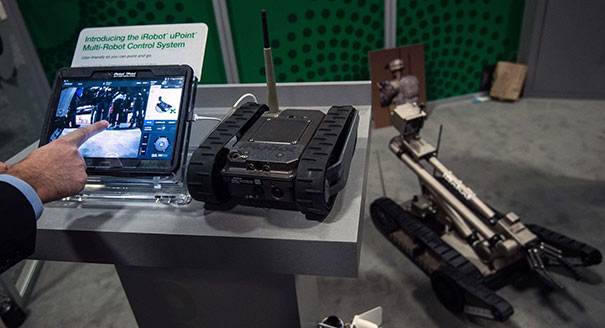
The United States and Japan are both seeking help from private industries to develop high-tech robots that can perform both civilian and military functions.
Source: Diplomat
The U.S. Defense Department announced in late 2014 an initiative to reinvigorate American military technology innovation known as the “Third Offset Strategy,” and after a year of classified investigation and secret deliberation some early components of this strategy are being revealed. Initial reviews of the approach have highlighted the futuristic (almost sci-fi) vision for next-generation U.S. weapons programs – robots, swarming drones, “Iron Man” suits and the like – but equally noteworthy are new aspects of the concept for how these systems might be developed and deployed more efficiently. Key changes include proactively tapping non-defense high-tech companies for targeted contributions and deepening collaboration with trusted allies like Japan to help catalyze breakthrough applications, but these new concepts face many hurdles.
Tucked inside the 2017 U.S. defense budget request (announced in February) is about $15 billion to place relatively small research bets on over-the-horizon technologies that can help the United States military maintain a leading edge over any competitor over the long term. Close allies like Japan have an interest in seeing this effort succeed. Priority investments range from energy production and storage to so-called lethal endgame technologies, including lasers or directed energy weapons, but a particularly intriguing focus is the broad arena of robotics, autonomous systems, and artificial intelligence.
Of course, the Pentagon has been experimenting with many of these autonomous technologies for several years, but the level of outreach recently to U.S. tech hubs in Silicon Valley (where Google and others are developing self-driving cars, among other gadgets) and with potential Japanese contributors has risen considerably. The effort to work with new partners, however, is challenged by concern on the part of many firms about becoming associated too closely with military programs and adversely affecting their reputations with average consumers.This “reputation risk” dynamic was clearly evident at a robotics challenge event organized by the U.S. Defense Advanced Research Projects Agency (DARPA) from 2012 to 2015, but the sponsors and participants were at times able to transcend such inhibitions, which could open doors for collaboration in the future. At the start, the U.S. Defense Department sought to facilitate cooperation with new partners in Japan, negotiating its first ever terms of reference agreements with the Japan Ministry of Economy, Trade, and Industry and the Ministry of Education, Culture, Sports, Science, & Technology. The key was to focus on robotics applications for humanitarian assistance and disaster recovery and to limit cooperative projects to dual-use technology....

Former Senior Fellow, Asia Program
James L. Schoff was a senior fellow in the Carnegie Asia Program. His research focuses on U.S.-Japan relations and regional engagement, Japanese technology innovation, and regional trade and security dynamics.
Recent Work
James L. Schoff, Douglas E. Rake, Joshua Levy
James L. Schoff
Carnegie does not take institutional positions on public policy issues; the views represented herein are those of the author(s) and do not necessarily reflect the views of Carnegie, its staff, or its trustees.

The Plaza Accord was not an externally imposed punishment of Japan but part of a broader restructuring that Japanese economists and policymakers themselves recognized was necessary. Its effects were undermined, however, when Tokyo responded to the resulting slowdown with policies that exacerbated investment, credit expansion, and the very imbalances the adjustment was intended to resolve.

Michael Pettis

The nuclear relationship between China and the United States is increasingly shaped by widening perception gaps rather than deliberate strategic design.

Tong Zhao
China’s banking crisis in the 2000s was resolved by transferring the costs to households through financial repression—a decision that recapitalized the banks while exacerbating the structural imbalances that continue to shape the Chinese economy today.
Michael Pettis

Chinese biotech companies have been on the receiving end of U.S. economic coercion. Yet their responses have differed significantly because firm and state interests are not uniformly aligned. For Washington, treating all Chinese tech firms the same, irrespective of their actual interests, risks pushing them farther into Beijing’s corner.

Xue Gong

China’s latest energy plan explicitly calls for integrating data centers into the electricity system, particularly connecting them to green energy. It appears Beijing wants to use compute as a source of domestic demand to absorb renewables excess capacity.

Damien Ma