

Commentary
Dmitri Trenin
{
  "authors": [
    "Dmitri Trenin"
  ],
  "type": "legacyinthemedia",
  "centerAffiliationAll": "",
  "centers": [
    "Carnegie Endowment for International Peace",
    "Carnegie China",
    "Carnegie Russia Eurasia Center"
  ],
  "collections": [
    "China’s Foreign Relations"
  ],
  "englishNewsletterAll": "",
  "nonEnglishNewsletterAll": "",
  "primaryCenter": "Carnegie Russia Eurasia Center",
  "programAffiliation": "",
  "programs": [],
  "projects": [],
  "regions": [
    "South Asia",
    "India",
    "Pakistan",
    "East Asia",
    "China",
    "Russia"
  ],
  "topics": [
    "Foreign Policy",
    "Economy"
  ]
}
Source: Getty
Before India and Pakistan enter the SCO, Russia and China should make an effort to help them prevent future conflicts. Failing to help manage the relationship now carries a serious risk for the entire SCO project started by Beijing and Moscow 15 years ago. So, China and Russia owe it to themselves to begin defusing tensions between their partners.
Source: Global Times
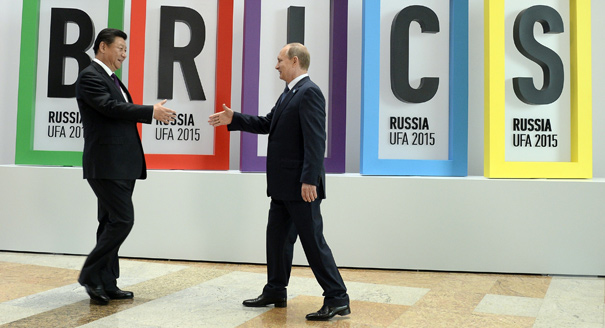
This year’s BRICS Summit at Goa, India, will be held amid heightened Indo-Pakistani tensions in Kashmir and fears of a war between the nuclear powers. Earlier in September, 19 Indian soldiers died as a result of a terrorist attack which Delhi blamed on groups supported by Islamabad and India killed two Pakistani soldiers with “surgical strikes.” It also led a successful boycott of a regional summit of South Asian nations that was meant to be held in Pakistan.
India sees Pakistan as its historical adversary, and China as Pakistan’s traditional ally. From Delhi's perspective, Islamabad is merely a regional competitor, while Beijing is a strategic rival. This is hardly propitious environment for the expansion of the Shanghai Cooperation Organization (SCO), which both Delhi and Islamabad are set to join in 2017.Interestingly, Russia, a long-time friend of India during the Cold War, is now taking a more balanced approach toward the region. To the consternation of many in Delhi, the recent surge of violence in Kashmir did not lead Moscow to cancel, or even postpone its first-ever military exercise with Pakistan, which has just been completed. Russia’s behavior clears away the last remnants of the Cold War-era geopolitical set-up, in which the Moscow-Delhi axis opposed the Beijing-Islamabad one.
Recent developments highlight the fact that BRICS, SCO and RIC (Russia-India-China, an informal gathering of the three) are not only clubs of like-minded non-Western nations seeking to advance a multipolar world order, but also groups of countries which cooperate as well as compete among themselves. To make credible their claim to a larger role in global governance, these countries need first to learn to manage their own differences and prevent conflicts.
Sino-Russian relations are a good example of two major neighboring powers having de facto accepted a formula of “never being against each other, but not necessarily always with each other.” This formula squarely puts a premium on a solid partnership between Moscow and Beijing where their interests meet, eschews conflicts where they don’t, and allows a lot of flexibility where interests overlap only partially. Russia and China will probably never become full allies; the important thing is that they abhor mutual hostility, and have mastered their differences.
Indo-Russian relations remain essentially warm and friendly even as they have lost their long-time exclusivity for both partners: another sign of maturity. Both countries have diversified their foreign policies away from focusing too much on each other. Delhi has reached out to Washington, Moscow has warmed to Islamabad. Yet, India and Russia have stayed close partners. The principal issue in that relationship remains its chronically weak economic foundation.
In recent years, China and India have managed to repair their ties, primarily by expanding bilateral economic relations. Yet, the relationship remains asymmetrical and laden with mistrust. At the back of their minds, many members of the Indian political class view China with suspicion, even fear. This state of affairs is unhealthy, and requires patient treatment by both Delhi and Beijing. Otherwise, both countries will be seeking to check each other's rise rather than profiting from it.
Before India and Pakistan enter the SCO, Russia and China should make an effort to help them prevent future conflicts. This is not going to be easy, and any direct interference in the Kashmir issue should be avoided from the start. Yet, failing to help manage the relationship now carries a serious risk for the entire SCO project started by Beijing and Moscow 15 years ago. So, China and Russia owe it to themselves to begin defusing tensions between their partners.
Russia has experience with peacemaking in South Asia. 50 years ago, in January 1966, Soviet prime minister Alexei Kosygin successfully mediated between India' and Pakistan to end the second Indo-Pakistani war. In the 21st century, with both India and Pakistan as nuclear powers, stopping a war between them is no longer an option: Wars should be prevented.
BRICS and RIC summits are opportunities for multilateral diplomacy. The focus of the leaders’ efforts should be not just global governance but also improved relations among leading non-Western powers. De facto, Russia, India and China bear the prime responsibility for peace, stability and prosperity in Continental Asia. They should rise to the occasion.
Former Director, Carnegie Moscow Center
Trenin was director of the Carnegie Moscow Center from 2008 to early 2022.
Recent Work
Dmitri Trenin
Dmitri Trenin
Carnegie does not take institutional positions on public policy issues; the views represented herein are those of the author(s) and do not necessarily reflect the views of Carnegie, its staff, or its trustees.

China’s political future will be shaped between now and next October. As the Communist Party enters its intense “campaign season” to prepare for a major political transition in 2027, reading Beijing's actions and responses may become more difficult as domestic politics weigh on its behavior more than usual.

Damien Ma

China has showcased its engineering prowess with small modular reactor demonstration projects. But turning these technological achievements into commercial success will be a greater challenge.

Tong Zhao

The Plaza Accord was not an externally imposed punishment of Japan but part of a broader restructuring that Japanese economists and policymakers themselves recognized was necessary. Its effects were undermined, however, when Tokyo responded to the resulting slowdown with policies that exacerbated investment, credit expansion, and the very imbalances the adjustment was intended to resolve.

Michael Pettis

The nuclear relationship between China and the United States is increasingly shaped by widening perception gaps rather than deliberate strategic design.
Tong Zhao
China’s banking crisis in the 2000s was resolved by transferring the costs to households through financial repression—a decision that recapitalized the banks while exacerbating the structural imbalances that continue to shape the Chinese economy today.
Michael Pettis