

Article
C. Raja Mohan, Darshana M. Baruah
{
  "authors": [
    "C. Raja Mohan"
  ],
  "type": "legacyinthemedia",
  "centerAffiliationAll": "dc",
  "centers": [
    "Carnegie Endowment for International Peace",
    "Carnegie India"
  ],
  "collections": [],
  "englishNewsletterAll": "ctw",
  "nonEnglishNewsletterAll": "",
  "primaryCenter": "Carnegie India",
  "programAffiliation": "SAP",
  "programs": [
    "South Asia"
  ],
  "projects": [],
  "regions": [
    "South Asia",
    "India",
    "Bangladesh"
  ],
  "topics": [
    "Foreign Policy"
  ]
}
Source: Getty
Bangladesh, which now has settled land and maritime borders with India, is well positioned to play a larger regional and international role that is commensurate with its growing economic weight.
Source: Indian Express
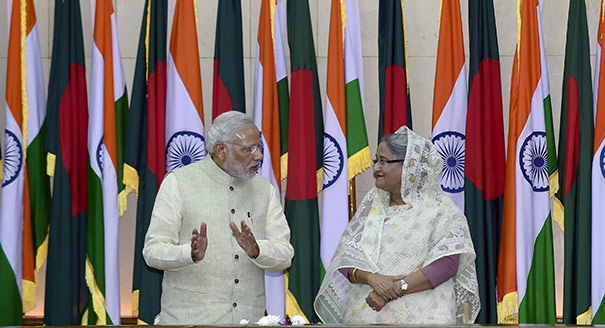
The idea that India-Bangladesh relations can be changed, root and branch, took hold seven years ago when Prime Minister Sheikh Hasina came to Delhi. Manmohan Singh agreed with her that India can and must urgently resolve long-standing disputes, expand areas of cooperation and develop a shared vision for regional peace and prosperity. This week, Prime Minister Narendra Modi and Sheikh Hasina have an opportunity to take some big steps to advance that agenda.
Although Singh began well, the stumbles on the Indian side prevented a genuine transformation. The UPA government did well to open up the Indian market for goods produced in Bangladesh, extend economic assistance to developmental projects, negotiate an agreement on sharing the waters of the Teesta river and wrap up a long-pending boundary settlement. Dhaka, in turn, offered substantive cooperation on counter-terrorism and embraced the opportunity to integrate the regional economies.
Resistance from the Chief Minister of West Bengal, Mamata Banerjee, prevented Singh from signing the Teesta agreement when he went to Dhaka in September 2011. While he did sign the boundary agreement, the UPA government could not get it ratified by the Indian Parliament.
Modi, who took charge in May 2014, boldly discarded the BJP’s earlier opposition and pushed for an early ratification of the boundary agreement. Modi also signed off on the award of an international tribunal on resolving the maritime boundary dispute between India and Bangladesh.
Yet some big political obstacles remain. On the Indian side, Mamata has been reluctant to endorse the Teesta waters agreement that has become the touchstone for India’s good faith in Bangladesh. Meanwhile, many in Bangladesh are nervous that Dhaka under Sheikh Hasina might be drawing too close to India. They are especially concerned about the prospects for expanding defence cooperation between the two countries. Some others see Delhi trying to limit or constrain the unfolding strategic partnership between China and Bangladesh.
Three sets of issues are at the root of the residual political opposition in both countries that Modi and Hasina need to overcome. The first relates to the question of size and significance. From the Indian side, the problem has always been Delhi’s insufficient strategic appreciation of the importance of Bangladesh. Dhaka, in turn, has found it hard to stop seeing itself as a small country facing a large and insensitive neighbour.
But Bangladesh is not a small country. With a population of nearly 170 million, Bangladesh is the eighth largest in the world. Even more important, it is one of the world’s fastest growing economies and has been called the “miracle in the east”. In the international economic hierarchy, the only way for Bangladesh is up.
What this suggests is the urgent need for a political reframing of the relationship. Delhi needs to acknowledge and address the opportunities in Bangladesh in a more sustained and purposeful manner. Dhaka must demonstrate greater self-assurance in engaging India for enlightened self-interest. In any event, the time is now for Delhi and Dhaka to get out of the “big-brother-small-neighbour” syndrome.
Second, with a border of nearly 4,060 km — India’s longest with any country — Delhi has no reason to see itself in competition with Beijing in Bangladesh. That China has become a major partner for Bangladesh is in part about Beijing’s emergence as the world’s second largest economy. But it is mostly about Delhi’s past neglect of neighbours. That brings us to the larger questions about the geographic imperative between Delhi and Dhaka.
The partition of the subcontinent and the inward economic orientation of India and Bangladesh meant the two sides were working against the logic of geography than with it. The political effort in the last few years has been to find harmony between the two sovereignties, construct a responsible approach to dealing with the consequences of the partition for the management of the shared river waters, make the boundary tranquil, and restore the lost trans-frontier economic connectivities.
There is no doubt that the UPA government saw the urgency of transforming the policies to the neighbourhood. But it did not have the political will or clout to overcome the internal opposition. The expectations from Modi today are very high in Dhaka because of his capability to persuade all stakeholders in India, including Mamata, to see the merits of reconnecting Sonar Bangla, not only for the benefit of the two Bengals but also India’s Northeast. For, geography has put Bangladesh at the heart of this vast region.
That, in turn, brings us to the third set of issues relating to Bangladesh’s leadership role in the subcontinent and beyond. It is Bangladesh that took the lead in promoting South Asian regionalism. Dhaka also has the central role in shaping the future of sub-regional cooperation with Bhutan, Burma, India and Nepal. It is also a land bridge to East Asia and the fulcrum of a future Bay of Bengal community.
Bangladesh, which now has settled land and maritime borders with India, is well positioned to play a larger regional and international role that is commensurate with its growing economic weight. Expanding security cooperation with India could only enhance Dhaka’s global leverage. For India, a strong partnership with Bangladesh will help boost the prospects of peace and prosperity in the eastern subcontinent.
Finally, growing mutual trust and political comfort between Delhi and Dhaka, backed by Kolkata, will have one long-term consequence. It will restore the centrality of Bengal and its hinterlands that once decisively shaped the history of Asia and the Indian Ocean.
This article was originally published in the Indian Express.
Former Nonresident Senior Fellow, Carnegie India
A leading analyst of India’s foreign policy, Mohan is also an expert on South Asian security, great-power relations in Asia, and arms control.
Recent Work

C. Raja Mohan, Darshana M. Baruah


Alexander Gabuev, Paul Haenle, C. Raja Mohan, …
Carnegie does not take institutional positions on public policy issues; the views represented herein are those of the author(s) and do not necessarily reflect the views of Carnegie, its staff, or its trustees.

But their "principal to principal" model will only be as effective as the political strength of each leader back home.

Damien Ma

U.S. unpredictability has allowed China to capitalize on its positioning as the “responsible great power”. Paradoxically, the more China wins the perception game, the more likely expectations will rise for Beijing to deliver not just words but to demonstrate with its deeds.

Chong Ja Ian

Hanoi and Beijing have long treated each other as distant cousins rather than comrades in arms. That might be changing as both sides draw closer to hedge against uncertainty and America’s erratic behavior.

Nguyễn Khắc Giang

Across Asia, China is better positioned to withstand energy shocks from the fallout of the Iran war. Its abundant coal capacity can ensure stability in the near term. Yet at the same time, the country’s energy transition away from coal will make it even less vulnerable during the next shock.
Damien Ma

Malaysia’s chairmanship sought to fend off short-term challenges while laying the groundwork for minimizing ASEAN’s longer-term exposure to external stresses.

Elina Noor