

Article
C. Raja Mohan, Darshana M. Baruah
{
  "authors": [
    "C. Raja Mohan"
  ],
  "type": "legacyinthemedia",
  "centerAffiliationAll": "dc",
  "centers": [
    "Carnegie Endowment for International Peace",
    "Carnegie India"
  ],
  "collections": [],
  "englishNewsletterAll": "ctw",
  "nonEnglishNewsletterAll": "",
  "primaryCenter": "Carnegie India",
  "programAffiliation": "SAP",
  "programs": [
    "South Asia"
  ],
  "projects": [],
  "regions": [
    "United States",
    "South Asia",
    "India",
    "North America",
    "East Asia",
    "China",
    "Russia",
    "Western Europe",
    "United Kingdom",
    "France",
    "Germany"
  ],
  "topics": [
    "Foreign Policy"
  ]
}
Source: Getty
As Russia moves closer to China and the United States faces an unpredictable administration, European alliances are becoming valuable and inviting for India.
Source: Indian Express
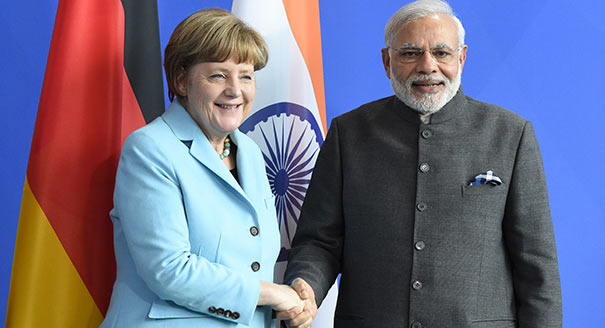
Prime Minister Narendra Modi’s travels this week to Russia, France, Germany and Spain provide an opportunity to recalibrate India’s approach to European geopolitics. The current uncertainty in the relations between America, China and Russia demands that India move closer to the European middle powers — France and Germany. Delhi must also devote more attention to other parts of the continent, from Spain to Sweden and Portugal to Poland, that have so much to offer India. Modi’s two tasks on this trip are somewhat contradictory.
He needs to arrest the growing drift in relations with Russia, which is privileging the China partnership over that with India, and intensify the engagement with Europe. If the best days of the Russian romance are behind us, an enduring European liaison has become an urgent Indian priority.Although Indian resources contributed massively to the victory of the allied forces in the First and Second World Wars, India and Europe found themselves marginal to each other in the second half of the 20th century. India’s domestic political confusion in dealing with the Second World War, the Partition of the Subcontinent and the Cold War put India and Europe on opposite sides of the great political divide. Delhi aligned with the Soviet Union and Europe was divided into Russian and American spheres of influence.
After the Cold War, and the historic rapprochement between the West and Russia, India did announce the intent to construct bilateral strategic partnerships with Germany and France and collectively with the European Union. Although these partnerships have grown, they have hardly flourished. Europe has been preoccupied with its own integration, India on its neighbourhood and the major powers. Europe and India have remained loveless after the Cold War. Can Modi change that? As the world enters a period of geopolitical convulsion, India and Europe need each other more than ever before.
In the old continent, the facile talk of a “Common European Home” has given way to renewed tensions between Russia and the West. If Russia was miffed by NATO’s eastward expansion, Europe has been taken aback by the Russian annexation of Crimea, its powerplay in eastern Ukraine and political assertion across the old continent. If the political understandings negotiated during 1989-91 between the West and Russia have broken down, no European fix appears round the corner.
Meanwhile, India’s long-standing faith in Russia as the most reliable international partner has been shaken by Moscow’s deepening alliance with Beijing and its political flirtation with Pakistan. It is not that Russia has turned adversarial to India. Not at all. Russia’s contradictions with the West have meant Moscow has decided to put a special emphasis on ties with China. Delhi should not let its sentimentalism towards Russia obfuscate the fact that Moscow’s political preferences have evolved over time. While the PM must try and preserve what we must and expand what we can in India’s engagement with Russia, he needs to recognise that Delhi is no longer at the top of Moscow’s pecking order. Beijing is.
Delhi could fudge this as long as India’s ties with China seemed stable. With Beijing increasingly constraining India’s regional and global space, the fragility of the Delhi-Moscow bond has become exposed. As Russia turns to China and vacates a key position in India’s strategic matrix, Delhi must begin to explore the European option. Making the European embrace more urgent is the strange seizure that has gripped the Anglo-American powers today.
After Brexit, “Great Britain” is in danger of turning into “Little England”. President Donald Trump’s “America First” policies promise great uncertainty in Washington’s engagement with Eurasia. Making matters worse are potential wild oscillations in US policy towards Russia and China.
The Europeans fear that Trump might abandon them in favour of a deal with Russia at precisely the moment Moscow is viewed as a threat in European capitals. India, Japan and other Asian nations are apprehensive that the American quest for a special relationship with China will leave them out in the cold. Not all these fears might come to pass. Yet, there is no avoiding the importance of insuring against the flux in US-China relations. India’s deepening ties with Japan and Australia are indeed part of that Asian hedge.
During his trip to Europe, Modi can take the first steps towards the construction of a similar middle power coalition on the western edge of the Eurasian landmass. Berlin seems ready. After Trump’s recent tour of Europe, Chancellor Angela Merkel warned the German people that the days of depending on Anglo-Americans for European security might be over.
“We Europeans truly have to take our fate into our own hands,” she said. France has never lost its geopolitical tradition and was the original proponent of the case for a multipolar Eurasia.
After nearly three centuries of global dominance, the Anglo-Americans are gazing at their navel. The Slavs are aligning with the Hans to construct a powerful Eurasian coalition. If Modi looks beyond the love-hate relationship with the Anglo-Americans and stops clinging to the Slavs, he might find the European alliances at once valuable and inviting.
Former Nonresident Senior Fellow, Carnegie India
A leading analyst of India’s foreign policy, Mohan is also an expert on South Asian security, great-power relations in Asia, and arms control.
Recent Work

C. Raja Mohan, Darshana M. Baruah


Alexander Gabuev, Paul Haenle, C. Raja Mohan, …
Carnegie does not take institutional positions on public policy issues; the views represented herein are those of the author(s) and do not necessarily reflect the views of Carnegie, its staff, or its trustees.

China’s banking crisis in the 2000s was resolved by transferring the costs to households through financial repression—a decision that recapitalized the banks while exacerbating the structural imbalances that continue to shape the Chinese economy today.

Michael Pettis

Chinese biotech companies have been on the receiving end of U.S. economic coercion. Yet their responses have differed significantly because firm and state interests are not uniformly aligned. For Washington, treating all Chinese tech firms the same, irrespective of their actual interests, risks pushing them farther into Beijing’s corner.

Xue Gong
China’s latest energy plan explicitly calls for integrating data centers into the electricity system, particularly connecting them to green energy. It appears Beijing wants to use compute as a source of domestic demand to absorb renewables excess capacity.

Damien Ma

But their "principal to principal" model will only be as effective as the political strength of each leader back home.
Damien Ma

U.S. unpredictability has allowed China to capitalize on its positioning as the “responsible great power”. Paradoxically, the more China wins the perception game, the more likely expectations will rise for Beijing to deliver not just words but to demonstrate with its deeds.

Chong Ja Ian