

Research
- +4
Milan Vaishnav, Rahul Verma, Rukmini S., …
{
  "authors": [
    "Christophe Jaffrelot"
  ],
  "type": "legacyinthemedia",
  "centerAffiliationAll": "dc",
  "centers": [
    "Carnegie Endowment for International Peace"
  ],
  "collections": [],
  "englishNewsletterAll": "ctw",
  "nonEnglishNewsletterAll": "",
  "primaryCenter": "Carnegie Endowment for International Peace",
  "programAffiliation": "SAP",
  "programs": [
    "South Asia"
  ],
  "projects": [],
  "regions": [
    "South Asia",
    "India",
    "East Asia",
    "China"
  ],
  "topics": [
    "Security",
    "Military",
    "Foreign Policy"
  ]
}
Source: Getty
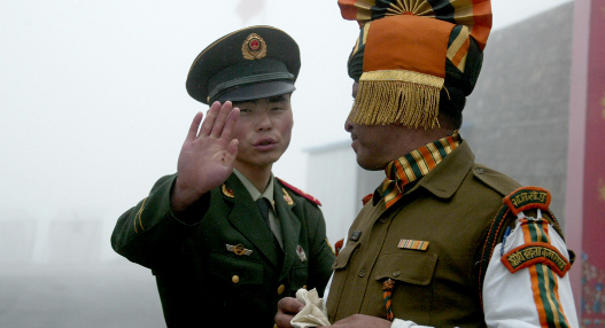
The recent stand-off in Doklam must be viewed from a long-term, strategic perspective that accounts for the challenges and opportunities posed to India by China, Russia, the United States, and its other Asian neighbors.
Source: Indian Express
Several lessons can be drawn from the stand-off between India and China in Doklam. First, it was the first time that India deployed troops — even in the hundreds — on the Chinese border after a third party asked for help. Second, while such stand-offs have multiplied recently, it was by far the longest one — about 10 weeks — suggesting that there was much at stake on both sides and that the mechanisms of border dispute resolution were not as effective as they used to be, or not even relevant in such a case. Third, India can claim that it has forced China to withdraw by showing determination-cum-restraint, a mix that has impressed other South Asian countries which are under Chinese pressure and may turn to India for preserving their sovereignty.
This rosy picture needs to be qualified, though, on two grounds, pertaining to Bhutan and China. Bhutan asked India for help despite the fact that Doklam was not as strategic for Thimphu as for New Delhi, whose leaders worried about the security of the “chicken neck”, a vulnerable set of plains and valleys that a part of Bhutan (including the Doklam plateau) overlooks. Under what conditions will Bhutan continue to side with India, is a key question. Beijing will use both the carrot and stick to influence the Himalayan kingdom that Chinese tourists are already visiting in large numbers. What can India offer in exchange? For security, a credible military force may be mobilised.
But what about economic development? The Bhutanese appreciate India’s soft power in cultural and societal terms, but the cooperation of the countries in the domain of hydropower that represents 25-30 per cent of Bhutan’s GDP is far from satisfactory. India will have to deliver more effectively on that front to retain Bhutanese trust.
These issues will be debated in the campaign for the 2018 elections in Bhutan. Some observers have already emphasised that Bhutan should not alienate China and take the risk of breaking the dialogue between the two countries. Both countries have no diplomatic relations but they have talked since 1984 and have even signed the Agreement on the Maintenance of Border and Tranquillity in 1998. They were supposed to meet before August for the 25th round of talks regarding the border dispute but the Chinese have postponed this round of negotiation sine die.
While Bhutan’s attitude is important, the Chinese strategy is key. After bulldozers started to build a road in Doklam in mid-June between Dokola and Jampheri — where Bhutan has a military camp — Beijing has explained that Doklam, which the Chinese call Donglang, “has been part of China since ancient times”. This claim will not go away. In late August, the PLA troops withdrew mostly because China was hosting the BRICS summit in early September and feared an Indian boycott. If Narendra Modi had not taken part in the Xiamen meeting, the international image of Xi Jinping would have been badly affected, something he could hardly afford a few weeks before the meeting of the Communist Party of China where he is supposed to be re-elected for a second term.
But China may stage a comeback in Doklam. Already, when Beijing withdrew its troops on August 28, the move was justified by weather conditions “and other factors”. More importantly, the Chinese authorities announced that the PLA will continue to patrol in the area. Xi’s ability to control the expansionist agenda of the PLA after his re-election will have to be scrutinised. But even if he is in a position to further assert his power, bones of contention are bound to remain, ranging from the Chinese territorial claim over Arunachal Pradesh to Beijing’s opposition to India’s entry to the Nuclear Suppliers Group.
Certainly, in Xiamen, Xi has agreed to designate as “terrorist” Pakistan-based Islamist groups including the LeT, the Haqqani network, the TTP and Jaish-e-Mohammed, but China may continue to veto a similar move targeting the Jaish leader, Masood Azhar, in the UN. In any case, China will not let down Pakistan while the CPEC is gaining momentum as one of the major components of Xi’s Belt and Road Initiative (BRI).
In this context, what can India do? It is already getting closer to the US. But this strategy is not unproblematic, not just because of Trump’s erratic behaviour and protectionist — even isolationist — policies, but also because such a rapprochement will further distance India from China and even Russia. In fact, the first collateral casualty of these developments seems to be the BRICS grouping itself. Referring to Doklam and the BRI, columnist Samir Saran has pointed out that “These events make it clear that we must shed the romantic notion that ideological convergence is possible within BRICS. Each member must see the group for what it is — a twenty-first century ‘limited purpose partnership’ among states to achieve specific sets of outcomes.” India’s scepticism vis-à-vis BRICS is reinforced by the way Russia tries to use the organisation against the West and keeps “acquiescing to Chinese leadership”, to use Saran’s words.
Besides the US, India is also turning to Japan. On July 31, Narendra Modi launched the Asia-Africa Growth Corridor, a project New Delhi and Tokyo have conceived together. Shinzo Abe, while inaugurating the line of the Ahmedabad-Mumbai bullet train on September 14, will probably reassert Japan’s will to build an ambitious strategic partnership with India. This partnership could be the cornerstone of a larger coalition that may include other countries eager to resist China’s “string of pearls” in the Asia-Pacific region.
The first major problem India may face in its attempt to resist China is economic: China is not only the first trade partner of India (where half of the mobile phones are made in China) but a large investor too: Chinese entrepreneurs are among those who are more than happy to “Make in India”. The fact that Indian ministers continue to invite them to do so is somewhat puzzling in the present context. Secondly, New Delhi cannot mobilise as many resources as Beijing to make inroads in third countries. Sri Lanka is a case in point: China could acquire 70 per cent of the Hambantota deep sea port in July, in addition to many other strategic locations, including Gwadar, because of a financial strike force India cannot compete with.
This article was originally published in the Indian Express.

Former Nonresident Scholar, South Asia Program
Jaffrelot’s core research focuses on theories of nationalism and democracy, mobilization of the lower castes and Dalits (ex-untouchables) in India, the Hindu nationalist movement, and ethnic conflicts in Pakistan.
Recent Work


Milan Vaishnav, Rahul Verma, Rukmini S., …
Christophe Jaffrelot
Carnegie does not take institutional positions on public policy issues; the views represented herein are those of the author(s) and do not necessarily reflect the views of Carnegie, its staff, or its trustees.

China’s banking crisis in the 2000s was resolved by transferring the costs to households through financial repression—a decision that recapitalized the banks while exacerbating the structural imbalances that continue to shape the Chinese economy today.

Michael Pettis

Chinese biotech companies have been on the receiving end of U.S. economic coercion. Yet their responses have differed significantly because firm and state interests are not uniformly aligned. For Washington, treating all Chinese tech firms the same, irrespective of their actual interests, risks pushing them farther into Beijing’s corner.

Xue Gong

China’s latest energy plan explicitly calls for integrating data centers into the electricity system, particularly connecting them to green energy. It appears Beijing wants to use compute as a source of domestic demand to absorb renewables excess capacity.

Damien Ma

But their "principal to principal" model will only be as effective as the political strength of each leader back home.
Damien Ma

U.S. unpredictability has allowed China to capitalize on its positioning as the “responsible great power”. Paradoxically, the more China wins the perception game, the more likely expectations will rise for Beijing to deliver not just words but to demonstrate with its deeds.

Chong Ja Ian