

Article
China has showcased its engineering prowess with small modular reactor demonstration projects. But turning these technological achievements into commercial success will be a greater challenge.
Tong Zhao
{
  "authors": [
    "Konstantin Gaaze"
  ],
  "type": "commentary",
  "centerAffiliationAll": "",
  "centers": [
    "Carnegie Endowment for International Peace",
    "Carnegie Russia Eurasia Center"
  ],
  "collections": [
    "Inside Russia"
  ],
  "englishNewsletterAll": "",
  "nonEnglishNewsletterAll": "",
  "primaryCenter": "Carnegie Russia Eurasia Center",
  "programAffiliation": "",
  "programs": [],
  "projects": [],
  "regions": [],
  "topics": [
    "Economy"
  ]
}
Source: Getty
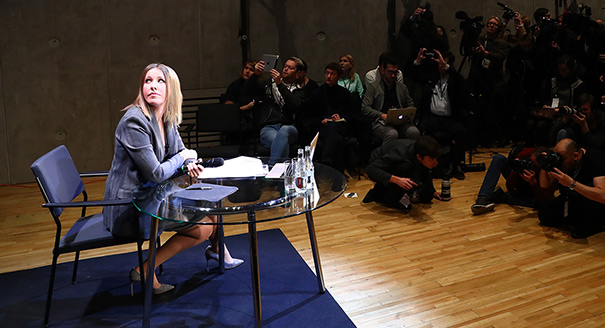
Ksenia Sobchak’s run for the Russian presidency is not meant to siphon votes away from Alexei Navalny. The Kremlin’s aim is to create a pseudo-opposition, which will channel the discontents of the liberal urban electorate.
It’s almost Wednesday on the night train to the town of Konakov, north of Moscow. Ksenia Sobchak’s voice can be heard in two places in the nearly empty train car. Two young Russians are separately watching her in interviews and press conferences on their smartphones, unafraid to leave the sound on so other passengers can hear.
According to the Russian Public Opinion Center (VTsIOM), 95 percent of Russians know who Ksenia Sobchak is. Now she combines being a celebrity with making a bid to run for president in March 2018.
The general presumption is that her planned run for the presidency was agreed on in the Kremlin, given her long-standing connections to President Vladimir Putin from the time he worked with her father when he was mayor of St. Petersburg in the 1990s.
Given this, two important questions still hang over Sobchak’s unexpected candidacy. The first is, what role should she play in the campaign? Which section of the electorate is she supposed to be winning over, and how? The second, broader question, which goes beyond the elections themselves and relates to the future of Putin’s rule, is, what does the appearance of this figure mean for Russian politics in general?
It is difficult to get a reliable version of how Sobchak’s candidacy came about. All we know for certain is that Sobchak herself declared her intention to run after meeting Putin. She made the first move. The president, reportedly, did not love the idea, but he also did not reject it outright.
In September, Kremlin officials dropped awkward hints to the media that it would be desirable to have a female candidate. The suggestion was that Sobchak was being invited to continue the dance she had started, but also that she was an opposition candidate from within the system—a role which Sobchak made clear she was not happy with.
Later in September, Kremlin deputy chief of staff Sergei Kiriyenko fervently supported Sobchak at several staff meetings where the upcoming campaign was discussed. He made several arguments that the president already knew. Her candidacy would give the campaign a positive image, opening it up to young people and a wider social class and giving it greater political legitimacy.
In October, Sobchak and Putin met again. Some sources say they began discussing the details of her campaign, but there is no way of knowing if this is true. On October 18, she formally announced that she would run for president. Putin himself has not yet officially confirmed that he is running.
The Sobchak campaign fits within Kiriyenko’s strategy to make the presidential campaign and Putin’s expected reelection more dynamic and engaging for voters.
Kiriyenko was worried that “establishment liberals” in the presidential administration, government, and influential organizations felt they had no stake in the current regime and were quietly threatening to sabotage various reformist projects that were important to the president.
He wanted the Kremlin to reach out to young people, in other words, to switch attention from those who were tired of Putin to those who were not yet tired of Putin. He also wanted to give this liberal establishment back their voice. Sobchak, a socialite with ties to both Putin’s inner circle and the liberal elite, would play that role.
We are of course not talking here about the real discontented opposition consisting of grassroots supporters who back Alexei Navalny. Rather, Sobchak stands for a collection of famous names from the elite who resent the growing influence of the security services and the Orthodox Church and the ideological consensus the Kremlin imposed over the last few years. It is this elite group that will support Sobchak’s candidacy.
So, Sobchak is not meant to be a substitute for Navalny who will siphon away votes in March 2018. The aim is to create a whole pseudo-opposition, which will capture the discontent of the urban electorate, distract them from real political issues, and keep them at a safe distance not just for the next six months but for the next six years.
The traditional opponents of Putin, such as Gennady Zyuganov and Vladimir Zhirinovsky, who have run in every presidential election for more than twenty years and have been allowed to establish themselves as a non-threatening opposition in parliament, are said to be unhappy. They see that Sobchak is a silver bullet aimed at them, not at Navalny.
Former president and current prime minister Dmitry Medvedev is also said to be dead set against Sobchak. After all, her candidacy could break up the political base that he relies on. Currently, it is Medvedev and his circle who are supposed to help and protect progressive causes within the establishment, and Sobchak’s candidacy creates a new Kremlin-aligned nexus that can connect with the progressive establishment and democratically oriented representatives of the elite.
Sobchak’s candidacy can therefore be seen as a complex and expensive campaign show. It will be a kind of enclave within Putin’s campaign with a different tempo, different structure, and different kind of political rhetoric. It will give the contest something Putin does not want to lend it himself: a certain sharpness, energy, and performance.
Faced with this scenario, the job of the opposition is quite simple. It should not allow this show to distract the nation from the acute and possibly terminal crisis that is beginning to envelop the Russian state.
Konstantin Gaaze
Konstantin Gaaze is a sociologist, and a journalist.
Carnegie does not take institutional positions on public policy issues; the views represented herein are those of the author(s) and do not necessarily reflect the views of Carnegie, its staff, or its trustees.

China has showcased its engineering prowess with small modular reactor demonstration projects. But turning these technological achievements into commercial success will be a greater challenge.

Tong Zhao

The Plaza Accord was not an externally imposed punishment of Japan but part of a broader restructuring that Japanese economists and policymakers themselves recognized was necessary. Its effects were undermined, however, when Tokyo responded to the resulting slowdown with policies that exacerbated investment, credit expansion, and the very imbalances the adjustment was intended to resolve.

Michael Pettis
China’s banking crisis in the 2000s was resolved by transferring the costs to households through financial repression—a decision that recapitalized the banks while exacerbating the structural imbalances that continue to shape the Chinese economy today.
Michael Pettis

In the latest Five-Year Plan, the Chinese president cements the shift to an innovation-driven economy over a consumption-driven one.

Damien Ma

Rather than climate ambitions, compatibility with investment and exports is why China supports both green and high-emission technologies.

Mathias Larsen