

Commentary
But their "principal to principal" model will only be as effective as the political strength of each leader back home.
Damien Ma
{
  "authors": [
    "Richard Sokolsky",
    "Aaron David Miller"
  ],
  "type": "legacyinthemedia",
  "centerAffiliationAll": "",
  "centers": [
    "Carnegie Endowment for International Peace",
    "Malcolm H. Kerr Carnegie Middle East Center"
  ],
  "collections": [],
  "englishNewsletterAll": "",
  "nonEnglishNewsletterAll": "",
  "primaryCenter": "Carnegie Endowment for International Peace",
  "programAffiliation": "",
  "programs": [],
  "projects": [],
  "regions": [
    "North America",
    "United States",
    "Middle East",
    "Syria",
    "Levant"
  ],
  "topics": [
    "Security",
    "Military",
    "Foreign Policy"
  ]
}
Source: Getty
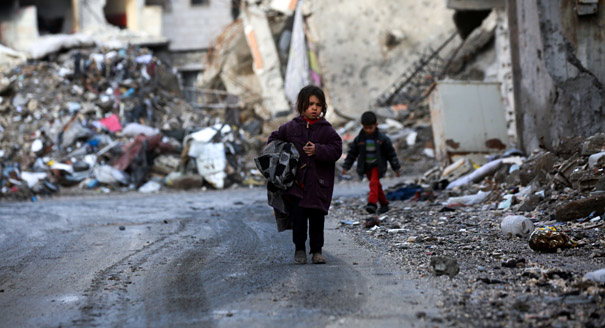
U.S. President Donald Trump has no intentions of getting stuck in Syria’s civil war.
Source: USA Today
Friday night’s U.S., British and French missile strikes against three sites associated with Syrian chemical weapons will not change the battlefield balance in Syria, bring us closer to ending Syria’s violence, or perhaps even deter Bashar Assad over time from using chemical weapons.
What was the logic of the strikes then, particularly in view of the hype and buildup leading up to the attacks. What were they designed to accomplish? And are we now locked into a forever war in Syria?
Here are our preliminary takeaways:
Perhaps the most important takeaway was that in Trumpland, Secretary of Defense Jim Mattis still dominates the decision-making process on the use of military force. If reports that some were pushing for more comprehensive strikes are accurate, then Mattis won this round. No doubt the military participation of the British and French — both of whom were looking for a tough but narrow response that would not trigger Russian and Iranian escalation or drag them into Syria’s civil war, helped strengthen Mattis’ hand. But the secretary was clearly worried about a set of targets that might have triggered Russian and Iranian retaliation. And despite tweets warning Russian leader Vladimir Putin about smart missiles headed his way, Trump took Mattis' counsel.
The attack was designed to achieve two limited purposes: First, to punish Assad for his use of chemical weapons against innocent civilians and, second, to deter Assad from launching new chemical weapon attacks by degrading his capacity to conduct such operations. The president and his advisers likely considered a broad range of goals for U.S military response — everything from dealing a crippling blow to the Assad regime’s broader military capabilities, attacking Russian and Iranian forces to fundamentally alter the balance of forces on the ground to change the course of the Syrian civil war, and increasing U.S. leverage to negotiate a comprehensive peace settlement that would force Assad from power. In the end, these ambitious — and riskier — objectives, which would have more deeply enmeshed the United States in Syria’s civil war, were rejected in favor of a more prudent and restrained response that, while larger and more destructive than the U.S. strike a year ago, was focused exclusively on crippling Syria’s chemical weapons infrastructure.
It remains to be seen whether the strike will deter Assad from future chemical weapons use, but it is premature to declare, as the president tweeted this morning, “mission accomplished.” The U.S. military retaliation almost a year ago to Assad’s use of chemical weapons in the city of Khan Sheikhoun did not deter the regime from conducting multiple chlorine gas attacks over the past year. The damage from that attack against aircraft used to deliver such weapons, however, was limited and the targets that were successfully destroyed Friday night — research, development and storage facilities — were central to Assad’s chemical production capabilities. That said, Assad believes he is in an existential struggle for his survival and the survival of his regime, and he is determined to reassert the government’s control over all of Syrian territory. As Trump often says, “We’ll have to see what happens.”
It’s not clear from the Defense Department briefings whether additional U.S. strikes would be used only if Assad uses chemicals again; whether that applies only to the use of certain agents like sarin or to chlorine, which America has largely ignored; and whether the United States might strike pre-emptively if it discovers either preparation for a chemical weapons attack or if intelligence exists on new stockpiles of chemical agents. The logic appears to be that these strikes will set back the Syrian chemical program; that Assad won’t use them again; and that the Russians will pressure him not to do so. None of these assumptions can possibly be substantiated now. And there’s a strong possibility that America may need to “mow the grass” again if/when Assad deploys chemicals again.
Critics of this administration and its predecessor have argued that the United States needs a comprehensive policy to end Syria’s civil war, and that Washington must play a leading role in this effort. The reality is that this administration has a policy, but it’s minimalist and is largely focused on two basic objectives: defeating the Islamic State terrorist organization, and deterring Assad from using chemical weapons. We pay lip service to a diplomatic settlement to remove Assad and rebuilding the country. But the inconvenient truths are Assad and his allies have won the war; America lacks the leverage to alter the dynamics of war and peace in Syria; our interest in Syria is not nearly as vital as Assad’s, Russia’s or Iran’s; and the United States is unwilling to take ownership of putting the broken land of Syria back together again.
The bottom line, while far from perfect: The Trump administration's response is better than the alternatives in the land of lousy options. This administration, like the last one, has no intention of getting stuck with the check for Syria.
Nonresident Senior Fellow, Russia and Eurasia Program
Richard Sokolsky is a nonresident senior fellow in Carnegie’s Russia and Eurasia Program. His work focuses on U.S. policy toward Russia in the wake of the Ukraine crisis.

Senior Fellow, American Statecraft Program
Aaron David Miller is a senior fellow at the Carnegie Endowment for International Peace, focusing on U.S. foreign policy.
Carnegie does not take institutional positions on public policy issues; the views represented herein are those of the author(s) and do not necessarily reflect the views of Carnegie, its staff, or its trustees.

But their "principal to principal" model will only be as effective as the political strength of each leader back home.

Damien Ma

U.S. unpredictability has allowed China to capitalize on its positioning as the “responsible great power”. Paradoxically, the more China wins the perception game, the more likely expectations will rise for Beijing to deliver not just words but to demonstrate with its deeds.

Chong Ja Ian

Hanoi and Beijing have long treated each other as distant cousins rather than comrades in arms. That might be changing as both sides draw closer to hedge against uncertainty and America’s erratic behavior.

Nguyễn Khắc Giang

Across Asia, China is better positioned to withstand energy shocks from the fallout of the Iran war. Its abundant coal capacity can ensure stability in the near term. Yet at the same time, the country’s energy transition away from coal will make it even less vulnerable during the next shock.
Damien Ma

Malaysia’s chairmanship sought to fend off short-term challenges while laying the groundwork for minimizing ASEAN’s longer-term exposure to external stresses.

Elina Noor