

Paper
Ariel (Eli) Levite, Toby Dalton
{
  "authors": [
    "Ariel (Eli) Levite"
  ],
  "type": "legacyinthemedia",
  "centerAffiliationAll": "dc",
  "centers": [
    "Carnegie Endowment for International Peace",
    "Malcolm H. Kerr Carnegie Middle East Center"
  ],
  "collections": [
    "U.S. Nuclear Policy"
  ],
  "englishNewsletterAll": "ctw",
  "nonEnglishNewsletterAll": "",
  "primaryCenter": "Carnegie Endowment for International Peace",
  "programAffiliation": "NPP",
  "programs": [
    "Nuclear Policy"
  ],
  "projects": [],
  "regions": [
    "North America",
    "United States",
    "Middle East",
    "Iran"
  ],
  "topics": [
    "Political Reform",
    "Nuclear Policy",
    "Global Governance"
  ]
}
Source: Getty
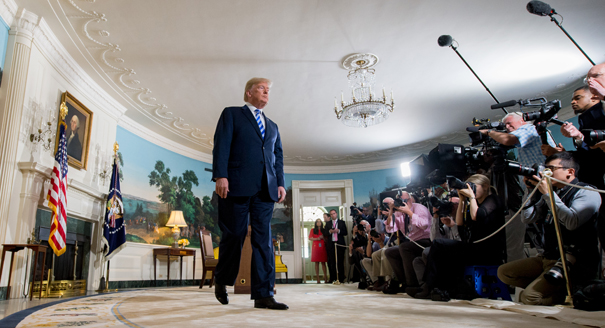
The negative consequences of pulling out of the JCPOA could be diminished by aligning the goals announced by the Trump administration into an operational, strategic agenda.
Source: National Interest
The most negative consequences of casting the JCPOA aside could still be mitigated by converting the lofty goals announced by the administration into a far more pragmatic operational agenda. To succeed, three requirements stand out. First, to define realistic red lines that Iran's nuclear, missile, and regional activity must not be allowed to cross, indefinitely, regardless whether a new deal is in place. The credibility of U.S. deterrence against crossing them would be greatly enhanced by making these more modest than the goals envisaged by Secretary Pompeo, which in turn would enhance the chances of building broader international support for them. All of these would also make compliance with such red lines somewhat easier for Iran to contemplate. Second, Trump must resuscitate an international coalition that is far broader than the Gulf States and Israel. He must include the transatlantic alliance by refraining from imposing broad secondary sanctions on allies' companies, while also seeking complementary quiet understandings with China. Third, he should seize on some positive signals from the Kremlin about seriously exploring the possibility of building a partnership with Russian to significantly narrow the permissible scope for Iran's nuclear, missile, and Syria activities.
Ultimately, though, much would also depend on explicit U.S. willingness to walk away from the goal of actively promoting regime change. The pursuit of regime change will only stiffen the resistance of all elements of Iranian society (including those who otherwise despise clerical rule). Finally, the threat of American-forced regime change will also enhance Iran’s interest in nuclear weapons as an insurance policy. We should not abandon the hope of a fundamental transformation in the orientation of the Iranian regime, but this development should come from the inside.
This article was originally published in the National Interest.

Senior Fellow, Nuclear Policy Program, Technology and International Affairs Program
Levite was the principal deputy director general for policy at the Israeli Atomic Energy Commission from 2002 to 2007.
Recent Work

Ariel (Eli) Levite, Toby Dalton
Ariel (Eli) Levite, Toby Dalton
Carnegie does not take institutional positions on public policy issues; the views represented herein are those of the author(s) and do not necessarily reflect the views of Carnegie, its staff, or its trustees.

China’s political future will be shaped between now and next October. As the Communist Party enters its intense “campaign season” to prepare for a major political transition in 2027, reading Beijing's actions and responses may become more difficult as domestic politics weigh on its behavior more than usual.

Damien Ma

China has showcased its engineering prowess with small modular reactor demonstration projects. But turning these technological achievements into commercial success will be a greater challenge.

Tong Zhao

The nuclear relationship between China and the United States is increasingly shaped by widening perception gaps rather than deliberate strategic design.
Tong Zhao

But their "principal to principal" model will only be as effective as the political strength of each leader back home.
Damien Ma

U.S. unpredictability has allowed China to capitalize on its positioning as the “responsible great power”. Paradoxically, the more China wins the perception game, the more likely expectations will rise for Beijing to deliver not just words but to demonstrate with its deeds.

Chong Ja Ian