

Article
C. Raja Mohan, Darshana M. Baruah
{
  "authors": [
    "C. Raja Mohan"
  ],
  "type": "legacyinthemedia",
  "centerAffiliationAll": "",
  "centers": [
    "Carnegie Endowment for International Peace",
    "Carnegie India"
  ],
  "collections": [],
  "englishNewsletterAll": "",
  "nonEnglishNewsletterAll": "",
  "primaryCenter": "Carnegie India",
  "programAffiliation": "",
  "programs": [],
  "projects": [],
  "regions": [
    "United States",
    "Russia",
    "North America",
    "Middle East",
    "South Asia",
    "India"
  ],
  "topics": [
    "Foreign Policy"
  ]
}
Source: Getty
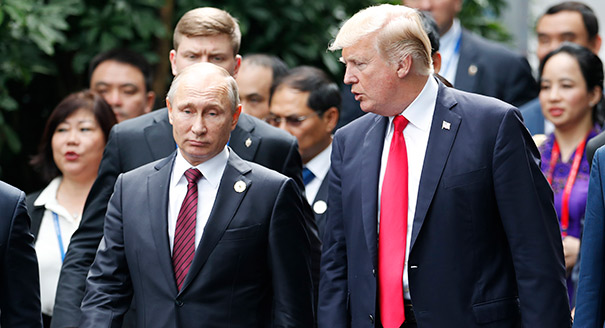
The promise and peril of the Helsinki summit comes from the fact that the U.S. president is ready to discard the conventional wisdom—not just on Russia, but on America’s role in Eurasia and its relations with its allies.
Source: Indian Express
Foreign policy establishments across the Atlantic turned apoplectic at US President Donald Trump’s encounter with Chairman Kim Jong-un and its likely consequences for America’s Asian alliances. They are now getting the vapours from the US president’s engagement with Russian leader Vladimir Putin at Helsinki later this month. They fear that Trump, with some help from Putin, would begin to dismantle the Eurasian geopolitical order America built after World War II and drive a stake through the heart of what we have come to know as “the West”.
Trump is not the first American president to sit down with a Russian counterpart. What generates such political dread within the Atlantic chancelleries are Trump’s persona and worldview. For them, Trump’s apparent love for Russia is bad enough. When combined with his denunciation of the holiest of the Western institutions — the NATO, G-7, EU and the WTO — the fears of the Atlantic establishments become a lot easier to understand.
In a paradox, the punditry in Europe and North America is afraid of a “successful” summit between Trump and Putin. For most of them, a failure at Helsinki would be a good outcome. Given the steady deterioration of US-Russia relations over the last two decades, it is not going to be easy to fix it. Trump’s two immediate predecessors, Barack Obama and George W Bush, sought to pursue a modest agenda with Russia, without much success.
There is enough blame to be shared between Washington and Moscow. America’s post-Cold War triumphalism and insensitivity to Moscow’s national interests were compounded by an under-estimation of Russia’s resilience. Moscow’s legitimate quest for retaining its great power role was marred by the claims for strategic parity with America. Russia’s geopolitical over-reach has put Moscow at odds with neighbouring Europeans as well as the United States.
The promise and peril of the Helsinki summit comes from the fact that the US president is ready to discard the conventional wisdom — not just on Russia, but on America’s role in Eurasia and its relations with its allies. If unconventional thinking opens up new possibilities, it has put the White House in an unprecedented confrontation with the entire American foreign policy establishment.
While Putin has a strong hand at home, the internal resistance to Trump’s Russia policy is intense. The American deep state believes Trump might have been compromised by the Russian intelligence and can’t be trusted to defend US interests vis a vis Moscow.
The leaders of the Democratic Party are convinced that it was Russian interference that propelled him into the White House in the 2016 elections. They have been hoping that the FBI investigations into Russian links with the Trump campaign team will find enough evidence to impeach the president. But Trump is not backing off. He is betting that, much in the manner that the American people have supported his Korean diplomacy, they would back his outreach to Russia.
Three themes are likely to dominate the Helsinki summit. One is the question of non-intervention in each other’s internal affairs. Both Russia and the West have grievances on this count and mutual assurances might help calm nervousness about a US-Russian rapprochement.
Second is potential cooperation on regional issues in Central Europe, the Middle East and Asia. A deal on Ukraine would begin to reverse the deepening tensions in the principal arena of conflict between Russia and America — Central Europe. That would open the pathway for the reintegration of Russia into such forums as G-7 and NATO. In the Middle East, US-Russia cooperation could help stabilise the region rocked by the rise of violent religious extremism and proxy wars between Iran and Saudi Arabia. Trump and Putin could also find some common ground on the Korean Peninsula and other Asian security issues.
Third, beyond the regional questions, Trump and Putin would want to address old issues of nuclear and conventional arms control as well as new ones such as regulating cyber warfare. It is certainly possible that the Helsinki summit would produce a statement of general principles. But to start a sustainable process of engagement, both sides will need some immediate visible gains. Putin would like some movement on lifting sanctions and Trump has to demonstrate that Moscow is helping the US achieve its political objectives. But the devil, as always, is in the detail.
What makes the summit pregnant with possibilities is Trump’s “America First” approach. The post-war American grand strategy was about exercising global leadership and maintaining order in Eurasia. Trump argues that the costs of leading the liberal international order have been too high for the American people. He wants America to focus on its own interests, stop subsidising the security of its rich European and Asian allies, demand equitable trade relations, avoid prolonged foreign military interventions and find reasonable accommodation with other powers.
If Trump’s heresies survive the hostility of the Atlantic foreign policy establishments, key Eurasian actors, including India, will have to take much larger responsibility for shaping the regional order. That, in turn, would mean managing Eurasia’s deep internal contradictions that have been smothered by America’s heavy hand since the Second World War. If the idea of a coherent political and economic West becomes unsustainable under Trump, there is much trouble ahead for alliances designed to “defend” the West and coalitions built to “defy” it.
This article was originally published in the Indian Express.
Former Nonresident Senior Fellow, Carnegie India
A leading analyst of India’s foreign policy, Mohan is also an expert on South Asian security, great-power relations in Asia, and arms control.
Recent Work

C. Raja Mohan, Darshana M. Baruah


Alexander Gabuev, Paul Haenle, C. Raja Mohan, …
Carnegie does not take institutional positions on public policy issues; the views represented herein are those of the author(s) and do not necessarily reflect the views of Carnegie, its staff, or its trustees.

But their "principal to principal" model will only be as effective as the political strength of each leader back home.

Damien Ma

U.S. unpredictability has allowed China to capitalize on its positioning as the “responsible great power”. Paradoxically, the more China wins the perception game, the more likely expectations will rise for Beijing to deliver not just words but to demonstrate with its deeds.

Chong Ja Ian

Hanoi and Beijing have long treated each other as distant cousins rather than comrades in arms. That might be changing as both sides draw closer to hedge against uncertainty and America’s erratic behavior.

Nguyễn Khắc Giang

Across Asia, China is better positioned to withstand energy shocks from the fallout of the Iran war. Its abundant coal capacity can ensure stability in the near term. Yet at the same time, the country’s energy transition away from coal will make it even less vulnerable during the next shock.
Damien Ma

Malaysia’s chairmanship sought to fend off short-term challenges while laying the groundwork for minimizing ASEAN’s longer-term exposure to external stresses.

Elina Noor