

Commentary
Yukon Huang, Isaac B. Kardon, Matt Sheehan
{
  "authors": [
    "Yukon Huang"
  ],
  "type": "legacyinthemedia",
  "centerAffiliationAll": "dc",
  "centers": [
    "Carnegie Endowment for International Peace"
  ],
  "collections": [],
  "englishNewsletterAll": "asia",
  "nonEnglishNewsletterAll": "",
  "primaryCenter": "Carnegie Endowment for International Peace",
  "programAffiliation": "AP",
  "programs": [
    "Asia"
  ],
  "projects": [],
  "regions": [
    "North America",
    "United States",
    "East Asia",
    "China"
  ],
  "topics": [
    "Economy",
    "Trade",
    "Foreign Policy"
  ]
}
Source: Getty
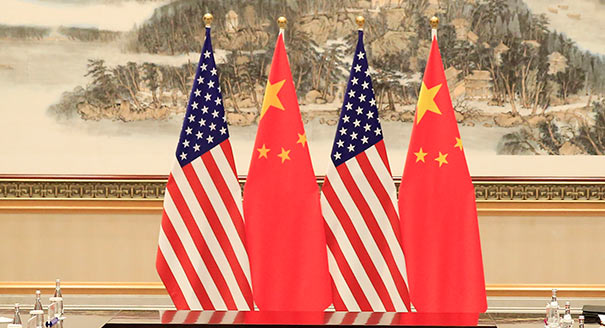
Some White House advisors see trade deficits as a threat to growth and security. But no one wins in a trade war, certainly not U.S. and Chinese consumers who will have to pay higher prices.
Source: CGTN America
This trade war is unnecessary. No one wins in a trade war, certainly not American and Chinese consumers who have to pay higher prices and certainly not their respective companies that will have a hard time finding alternative and comparably priced inputs for their globalized production chains.
Some White House advisors see trade deficits as a threat to growth, jobs and security with China bearing the blame. But this concern is misguided. The key to strengthening America’s competitiveness lies not in protectionist measures but in increasing the productivity of its workforce through supportive infrastructure investments and foreign investment policies that build on the country’s strengths in high value services. Rather than focusing on trade frictions, America’s interests should be on resolving conflicting views on foreign investment policies by negotiating a bilateral investment treaty (BIT) with China. This might appear to conflict with an “America First” agenda, but such an agreement would promote more U.S. investment abroad.
It is understandable why the White House obsession with trade deficits has popular appeal. But a negative trade balance does not imply slower economic growth or a weaker job market. The United States has been running trade deficits for 40 consecutive years regardless of whether the economy was doing well or poorly. Moreover, contrary to popular opinions, there is no direct link between China’s trade surpluses and America’s trade deficits.
In fact, America’s trade deficit in manufactured goods with East Asia has been roughly constant since the mid-1990s. What has changed is that China became the final assembly point for most goods that used to be shipped directly to America by other East Asian economies. The appearance that China is the source of these exports to the U.S. masks the fact that most of the higher value added components are manufactured elsewhere in Asia and that China’s hi-tech exports are being managed largely by foreign and not Chinese firms. Thus America’s trade deficit with China neither explains the size of America’s overall deficit nor which country benefits more from the bilateral trading relationship. As many experts have noted, America’s trade deficit is largely determined by its low savings rates arising from its huge federal budget deficits, a problem which has little to do with China.
If there is a problem with China’s external policies, it lies in its overly restrictive foreign investment regime. A bilateral investment treaty that opens China’s market to more U.S. investment would generate the profits and linkages needed to create more jobs at home. It is these restrictions that generate a sense in the foreign business community that China’s economic policies are “unfair” even if they technically do not violate WTO guidelines or other globally acceptable rules. Liberalizing market access in services such as financial, communications, information technology, entertainment and education and not trade-related issues is the highest priority for U.S. firms operating in China. For firms operating in the services sector, China is an especially attractive investment opportunity that would allow them to expand their global presence and ultimately enhance America’s economic security.
Doing so would also be good for China by putting more pressure on its own companies to become more competitive, especially since they now have the capacity to stand on their own. This is why China has recently reaffirmed its intention to respond positively to such concerns but doing so in the midst of a trade war is simply untenable.
Going the other way, there can be legitimate security concerns about Chinese state-owned firms investing in the United States. But much of the recent Chinese investment in the United States has been private, and any security concerns can be handled by the interagency Committee on Foreign Investment in the United States. Rather than fighting trade wars, a BIT between the United States and China should be the highest priority as suggested by the U.S.-China Business Council. Regrettably, this part of the White House’s policy agenda has been given less attention in favor of protectionist sentiments.

Senior Fellow, Asia Program
Huang is a senior fellow in the Carnegie Asia Program where his research focuses on China’s economy and its regional and global impact.
Recent Work


Yukon Huang, Isaac B. Kardon, Matt Sheehan
Yukon Huang, Genevieve Slosberg
Carnegie does not take institutional positions on public policy issues; the views represented herein are those of the author(s) and do not necessarily reflect the views of Carnegie, its staff, or its trustees.

China’s banking crisis in the 2000s was resolved by transferring the costs to households through financial repression—a decision that recapitalized the banks while exacerbating the structural imbalances that continue to shape the Chinese economy today.

Michael Pettis

Chinese biotech companies have been on the receiving end of U.S. economic coercion. Yet their responses have differed significantly because firm and state interests are not uniformly aligned. For Washington, treating all Chinese tech firms the same, irrespective of their actual interests, risks pushing them farther into Beijing’s corner.

Xue Gong

China’s latest energy plan explicitly calls for integrating data centers into the electricity system, particularly connecting them to green energy. It appears Beijing wants to use compute as a source of domestic demand to absorb renewables excess capacity.

Damien Ma

But their "principal to principal" model will only be as effective as the political strength of each leader back home.
Damien Ma

U.S. unpredictability has allowed China to capitalize on its positioning as the “responsible great power”. Paradoxically, the more China wins the perception game, the more likely expectations will rise for Beijing to deliver not just words but to demonstrate with its deeds.

Chong Ja Ian