

Commentary
Judy Dempsey
{
  "authors": [
    "Judy Dempsey"
  ],
  "type": "legacyinthemedia",
  "centerAffiliationAll": "dc",
  "centers": [
    "Carnegie Endowment for International Peace",
    "Carnegie Europe"
  ],
  "collections": [
    "Transatlantic Cooperation"
  ],
  "englishNewsletterAll": "ctw",
  "nonEnglishNewsletterAll": "",
  "primaryCenter": "Carnegie Europe",
  "programAffiliation": "EP",
  "programs": [
    "Europe"
  ],
  "projects": [],
  "regions": [
    "Europe",
    "North America",
    "United States",
    "Western Europe",
    "Iran"
  ],
  "topics": [
    "Foreign Policy",
    "Security"
  ]
}
Source: Getty
Putin can only delight in how Trump is doing the Kremlin’s work by sowing discord in the West. Who would have imagined that an American president would have done Russia’s bidding?
Source: Washington Post
During his news conference with the Russian President Vladimir Putin, the president of the United States doubled down on his determination to completely change the language and narrative of the post-1945 world order.
It was part of a worrying trend. In President Trump’s recent tweets and speeches, there is no mention of multilateralism. No mention of shared values. No mention of solidarity. No mention of historical commitments. No mention of the ideals of the West.Trump has walked away from the Paris climate change accord and discarded important trade deals such as the Trans-Pacific Partnership. He has turned his back on the Iran nuclear deal. And he wants to renegotiate the North American Free Trade Agreement (NAFTA) forged between the United States, Canada and Mexico.
On values, Trump has been highly selective. He has ignored violations of human rights in Russia, China, Turkey and North Korea. But Iran and Cuba have been in his sights. That’s because he didn’t like the deals struck with these nations by his predecessor.
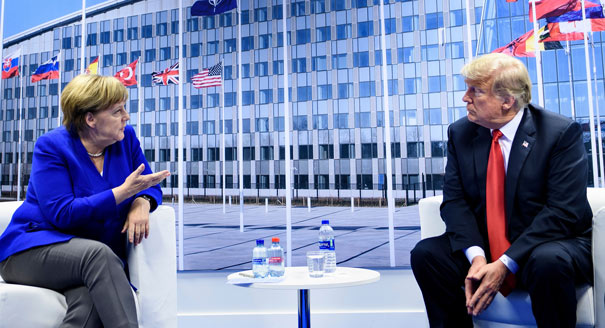
On solidarity with the European Union, he has set out to divide, not unify. He has lambasted German Chancellor Angela Merkel and British Prime Minister Theresa May. During last week’s NATO summit, Trump dumbfounded his critics when he accused Germany of being controlled by Russia.
As for May, on the very day he began his visit to Britain, he ruled out any bilateral trade deal with Britain because May had already set out her guidelines for a deal with the E.U. What a way to weaken May and give the advantage to the pro-Brexit camp. Trump has consistently praised Brexit, clearly implying that it would weaken if not break up the E.U. True to form, he has had only praise for the populist leaders in Hungary and Poland precisely because they weaken European solidarity and they conform to Trump’s anti-immigrant views.
On collective defense, during the NATO summit Trump spent most of the time haranguing the other 28 member states. Money was the issue, not protecting shared values; not projecting security; not deepening solidarity in an alliance that the United States founded.
But for Trump, the past gets in the way. The past seems irrelevant to Trump.
Instead, Trump’s narrative is about “getting along” with different leaders. Human rights, values, the cumbersome structure of multilateral organizations get in the way. For Trump, it’s about winners and losers. As he said during his news conference just after the NATO summit ended, Putin is “a competitor.”
This is Trumpian disingenuous manipulation of a high order.
Germany is a competitor because it makes good cars that Americans like to buy, runs a trade surplus, and is the strongest country in Europe, with a leader who doesn’t flatter Trump. France and other European countries are competitors, too.
But the difference is that Merkel and French President Emmanuel Macron speak about values, about democracy, about solidarity, about the rules of the international system. These rules were embedded in the post-1945 institutions that the United States and Western Europe built together. They are built on consensus, on compromises, on dialogue. For Trump, they are a hindrance.
That is why meeting nondemocratic leaders is so much easier for Trump. The scripts are value-free and past-free. The space for competition without rules is wide open. The Europeans had better get used to it.
The big question is how the Europeans can respond. They should start by quickly forging trade deals with like-minded nations — Australia, New Zealand and countries in Africa and South America. Those deals are about strengthening an international rules-based system. The E.U. recently clinched deals with Japan and Canada, countries that Trump is arguing with over trade and other foreign policy issues.
Second, the Europeans should have no illusions about Trump’s commitment to NATO. “It is not written in stone that the trans-Atlantic bond will survive forever,” NATO Secretary General Jens Stoltenberg said recently.
In the meantime, Europeans should stop deluding themselves. They need their own strong security and defense policy. They have the means and the money. What they lack is the political will.
In the meantime, Putin can only delight in how Trump is doing the Kremlin’s work by sowing discord in the E.U. and NATO. Who would have imagined that an American president would have done Russia’s bidding?

Nonresident Senior Fellow, Carnegie Europe
Judy Dempsey is a nonresident senior fellow at Carnegie Europe
Recent Work
Judy Dempsey
Judy Dempsey
Carnegie does not take institutional positions on public policy issues; the views represented herein are those of the author(s) and do not necessarily reflect the views of Carnegie, its staff, or its trustees.

The nuclear relationship between China and the United States is increasingly shaped by widening perception gaps rather than deliberate strategic design.

Tong Zhao

But their "principal to principal" model will only be as effective as the political strength of each leader back home.

Damien Ma

U.S. unpredictability has allowed China to capitalize on its positioning as the “responsible great power”. Paradoxically, the more China wins the perception game, the more likely expectations will rise for Beijing to deliver not just words but to demonstrate with its deeds.

Chong Ja Ian

Hanoi and Beijing have long treated each other as distant cousins rather than comrades in arms. That might be changing as both sides draw closer to hedge against uncertainty and America’s erratic behavior.

Nguyễn Khắc Giang

Across Asia, China is better positioned to withstand energy shocks from the fallout of the Iran war. Its abundant coal capacity can ensure stability in the near term. Yet at the same time, the country’s energy transition away from coal will make it even less vulnerable during the next shock.
Damien Ma