

Article
C. Raja Mohan, Darshana M. Baruah
{
  "authors": [
    "C. Raja Mohan"
  ],
  "type": "legacyinthemedia",
  "centerAffiliationAll": "",
  "centers": [
    "Carnegie Endowment for International Peace",
    "Carnegie India"
  ],
  "collections": [],
  "englishNewsletterAll": "",
  "nonEnglishNewsletterAll": "",
  "primaryCenter": "Carnegie India",
  "programAffiliation": "",
  "programs": [],
  "projects": [],
  "regions": [
    "South Asia",
    "Pakistan",
    "India"
  ],
  "topics": [
    "Foreign Policy"
  ]
}
Source: Getty
New Delhi’s messy relationship with Islamabad will continue to draw headlines in the Subcontinent at the expense of India’s other engagements at the UN.
Source: Indian Express
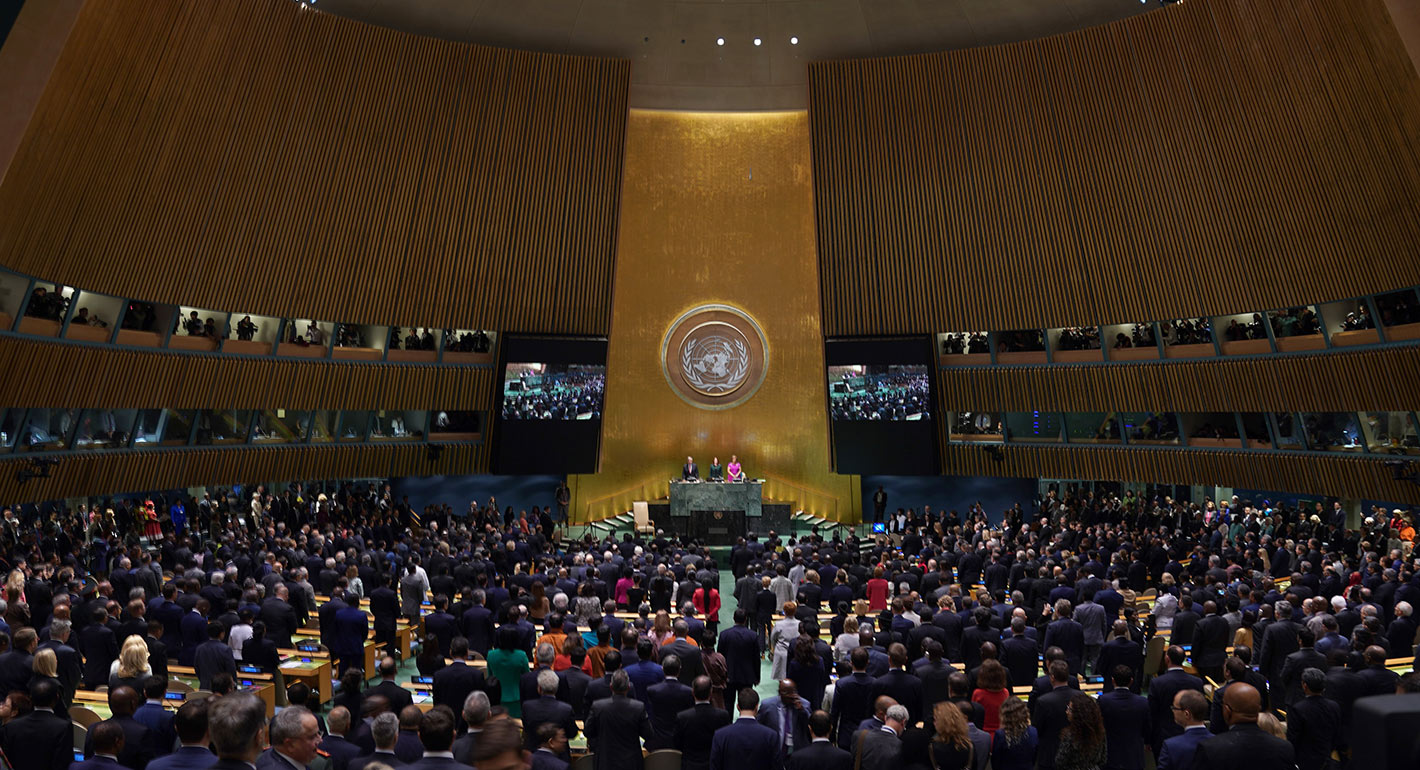
India may have decided against talking to Pakistan on the margins of the United Nations General Assembly that is convening this month for its annual session in New York. But Delhi’s messy relationship with Islamabad will continue to draw headlines in the Subcontinent at the expense of India’s other engagements at the UN.
If the past is any guide, the foreign ministers of the two countries, India’s Sushma Swaraj and Pakistan’s Shah Mohammed Qureshi will trade barbs on issues relating to terrorism and Kashmir. Expect the two delegations to exercise of the “right to reply” and “reply to reply”. Few other delegations will be interested in this awful spectacle.
The exception is provided by the media representatives from India and Pakistan. The story line will focus on the following questions. Will Swaraj attend the customary meeting of the South Asian foreign ministers, and if she does, will she shake hands with Qureshi? Might they chat for a couple of moments?
For more than two decades now, the only question that seems to animate the Indian public interest in multilateral gatherings — from non-aligned summits to the ASEAN Regional Forum and UNGA to SAARC gatherings — is the prospect of a diplomatic encounter between India and Pakistan. One unfortunate casualty of this war of words has been the deepening inability of the two countries to engage with the larger global issues.
There was a time when the voices of both Pakistan and India mattered on the world stage. Pakistan was a key member of the Western alliance system in Asia. Islamabad rightly saw itself as a pragmatic Islamic nation capable of exercising influence in the Middle East and acting as a bridge between America and China, which did not have diplomatic relations with each other. Today, Pakistan’s diminished diplomacy plods on about the Kashmir issue and revels in provoking India into a public argument.
India’s situation is even more tragic. India’s political voice mattered a lot at the UN, many moons ago, when its economic weight was rather limited. Today, despite its growing economic salience and expanding global footprint, India seems obsessed with a few issues rather than engage with the unfolding structural changes in the international system.
For one, Delhi persists with the futile quest for a permanent seat at the UN Security Council, when all indications are that it is unlikely to happen. Delhi has also devoted far too much energy in the pursuit of the international convention against terrorism that is unlikely to do very much in addressing India’s security challenges. After all, UN resolutions are honoured by nations more in breach than in observance. What has benefited India are key partnerships on counter-terrorism — for example with the US and Arab Gulf partners — rather than the endorsement of general principles under multilateralism.
If Swaraj looks beyond Pakistan, terrorism and a seat at the UNSC, she will find much to discuss and reflect upon with India’s partners. Three issues stand out.
One is the question of sovereignty and multilateralism. If defending sovereignty was the theme song of India’s UN diplomacy since the end of the Cold War, it is President Donald Trump who has appropriated it now. The essence of Trump’s “America First” has been the promise to liberate US from the “globalist trap” that it had been boxed in for decades. In his address to the UNGA last year, Trump had used the term “sovereignty” 21 times. He insists that he will not let multilateral organisations restrain America’s pursuit of its national interests.
According to previews of this year’s speech to be delivered on Tuesday, sovereignty will once again be the dominant theme. Since he took charge, Trump has walked out of the Paris agreement on climate change, withdrew from the United Nations Scientific and Cultural Organisation, the UN Human Rights Council, and threatened the International Criminal Court with punitive actions. As the US permanent representative to the UN, Nikki Haley put it last week, Washington is “not saying multilateralism can’t work. But it’s saying sovereignty is a priority over all of that”.
A second important theme is global trade. While India’s rhetoric at the UN remains steeped in the old verities of the so-called “global South”, Trump is threatening to pull out of the World Trading Organisation and choking its dispute-settlement mechanism, again in the name of sovereignty. Key trading nations are already beginning to respond with proposals for reform. If it does not change, the WTO may not survive the Trump era.
Finally, Trump is making big moves in the Middle East that breaks away from the conventional thinking on the region. He has junked the 2015 nuclear agreement with Iran negotiated by the Obama administration. He is promising to press for a change in “regime behaviour” in Tehran, trying to construct a new Middle East Security Alliance of Arab nations threatened by Iran.
For India, this is not a question of taking formal positions on these issues. What should matter for India is the fact that the geopolitics of the Gulf region — where India has massive economic and political stakes — is undergoing unprecedented change. So is the world trading system and the nature of multilateralism. India’s diplomatic engagements at the UN this year should be about crafting a new strategy to address these challenges. The last thing India needs in New York is wrestling in the mud with Pakistan.
This article was originally published by the Indian Express.
Former Nonresident Senior Fellow, Carnegie India
A leading analyst of India’s foreign policy, Mohan is also an expert on South Asian security, great-power relations in Asia, and arms control.
Recent Work

C. Raja Mohan, Darshana M. Baruah


Alexander Gabuev, Paul Haenle, C. Raja Mohan, …
Carnegie does not take institutional positions on public policy issues; the views represented herein are those of the author(s) and do not necessarily reflect the views of Carnegie, its staff, or its trustees.

But their "principal to principal" model will only be as effective as the political strength of each leader back home.

Damien Ma

U.S. unpredictability has allowed China to capitalize on its positioning as the “responsible great power”. Paradoxically, the more China wins the perception game, the more likely expectations will rise for Beijing to deliver not just words but to demonstrate with its deeds.

Chong Ja Ian

Hanoi and Beijing have long treated each other as distant cousins rather than comrades in arms. That might be changing as both sides draw closer to hedge against uncertainty and America’s erratic behavior.

Nguyễn Khắc Giang

Across Asia, China is better positioned to withstand energy shocks from the fallout of the Iran war. Its abundant coal capacity can ensure stability in the near term. Yet at the same time, the country’s energy transition away from coal will make it even less vulnerable during the next shock.
Damien Ma

Malaysia’s chairmanship sought to fend off short-term challenges while laying the groundwork for minimizing ASEAN’s longer-term exposure to external stresses.

Elina Noor