

Article
C. Raja Mohan, Darshana M. Baruah
{
  "authors": [
    "C. Raja Mohan"
  ],
  "type": "legacyinthemedia",
  "centerAffiliationAll": "",
  "centers": [
    "Carnegie Endowment for International Peace",
    "Carnegie India"
  ],
  "collections": [],
  "englishNewsletterAll": "",
  "nonEnglishNewsletterAll": "",
  "primaryCenter": "Carnegie India",
  "programAffiliation": "",
  "programs": [],
  "projects": [
    "Technology and Society"
  ],
  "regions": [
    "Asia",
    "India",
    "East Asia",
    "China"
  ],
  "topics": [
    "Foreign Policy",
    "Technology"
  ]
}
Source: Getty
Unlike in the traditional Belt and Road projects, India has significant capabilities in the space and digital domains.
Source: Indian Express
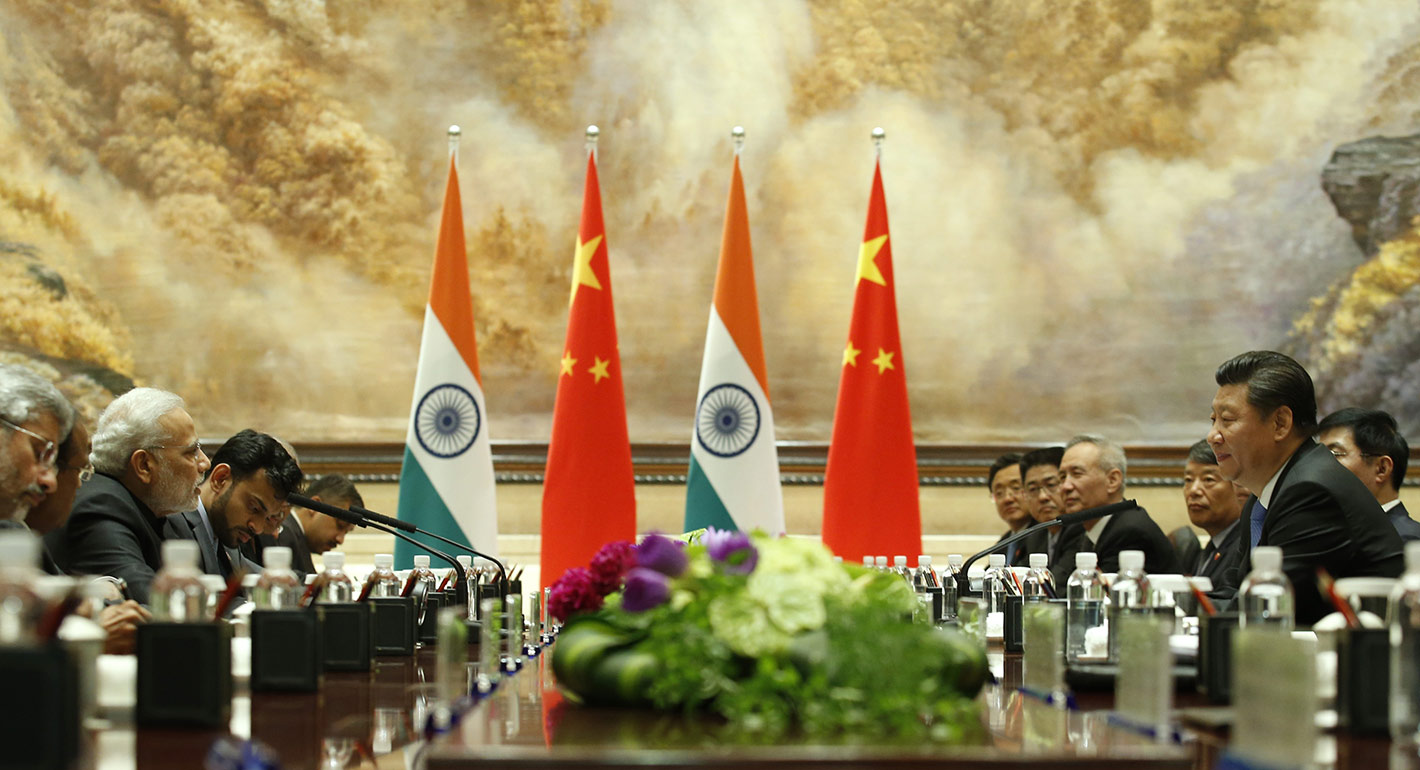
As the second iteration of China’s Belt and Road Forum convenes this week in Beijing, India has a strange karma to cope with. Profound concerns about the impact of the Belt and Road Initiative on India’s territorial sovereignty and the geopolitics of its immediate neighbourhood compel India to resist its apparent charms. Delhi, which stayed away from the launch of the Forum in 2017 despite considerable pressure from Beijing, has announced that it will sit out again.
Yet, even as it shuns the BRI, India has no choice but to emulate China on connectivity of all kinds. Although India has adopted the mantra of connectivity more than a decade ago, China’s BRI has pressed Delhi to get its act together on regional connectivity. The scale of the challenge has also encouraged India to shed its traditional “lone-ranger” mentality and consider working with others, especially Japan, Australia and the United States, in promoting regional connectivity in the Indo-Pacific.
Meanwhile, India is coming to terms with the fact that the BRI is more than two-dimensional. Under the BRI, the “belt” was about overland connectivity and the “road” (in a peculiar twist) referred to the maritime corridors spreading out from China’s eastern seaboard. The additional and inter-related dimensions of BRI are about connectivity in outer space and the digital domain.
Unlike the land and sea corridors, for India, it is not just a question of supporting or rejecting the space and digital silk roads. Delhi finds itself already tied into these initiatives, one way or another. India’s deep dependence on Chinese telecom giants is now a reality. So is the growing reliance of India’s neighbours — including Pakistan, Nepal and Sri Lanka — on China’s space services. The challenge for Delhi is to expand shall we say, India’s “strategic autonomy” in a market that Beijing is poised to dominate.
At the heart of China’s space silk road is the BeiDou satellite navigation system. Over the weekend, China launched a satellite for the BeiDou system that is expected to rival the American Global Positioning System (GPS), the Russian GLONASS and the European Galileo. BeiDou will consist of a number of satellites in the geostationary and intermediate earth orbits. The third generation BeiDou system will be operational by next year and is expected to provide better accuracy than the current Western and Russian systems.
Although the first BeiDou system goes back to 2000, it is now being presented as an important component of the Belt and Road Initiative that was launched in 2013. Some analysts have called BeiDou the digital glue that holds the BRI together. By connecting industries and infrastructure projects along the BRI, China’s satellite navigation and communication system hopes to dominate the new digital infrastructure in the BRI space. As new ideas for space-based internet services emerge, China is well ahead of the curve. Google, Amazon and SpaceX are all developing projects to provide broadband services around the world through networks of satellites numbering hundreds.
At the end of 2018, China launched the first of its planned constellation 320 satellites in the low-earth orbit. By the end of this year, a network of nine satellites is expected to demonstrate the possibilities for space based internet services. The entire fleet of 320 satellites under the Hongyan project is expected to be operational by 2025.
According to media reports, China is putting up a facility in Tianjin to assemble 130 Hongyan satellites annually. The Hongyan mega-constellation is designed to facilitate two-way communications at all times across all terrain, providing a wide range of civilian services such as ground data collection and exchange, ship identification and tracking, mobile broadcasting and navigation signal enhancement.
China has also launched a Big Earth Data initiative that will develop the generation of massive remote-sensing data and commercial products based on it for use across the entire spectrum of sustainable development — from agriculture to disaster management. China is not only into providing space-based services, but is also in the business of exporting satellites to a large number of countries, seeding space-related infrastructure and training space personnel. While China presents these dramatic advances as part of its effort to promote space and digital connectivity through international cooperation, there is no mistaking its geopolitical implications — especially in expanding Beijing’s global surveillance and intelligence capabilities, upgrading the PLA’s military effectiveness, and a big say in shaping the digital infrastructure of developing nations.
India’s space programme too has grown by focusing on modernising national telecommunication, application of remote sensing data for national development and more recently on developing assets for national security. India has a satellite navigation system of its own, the GAGAN. India’s remote sensing capability too is impressive. If India has missed a trick it is in the expansive scale that China has brought to its space programme.
While the origin and development of both space programmes was led by state entities, China has more recently opened up room for the participation of non-state entities and encouraged private innovators.
As the commercial and geopolitical stakes in outer space grow rapidly, the next government in Delhi has its task cut out: To reform India’s space sector to allow private corporations to play a larger role, promote space startups, and rejuvenate India’s international space collaboration, both civilian and military — with friends and allies.
Unlike in the traditional Belt and Road projects, India has significant capabilities in the space and digital domains. With policies that will lend them the necessary political support, commercial ambition and organisational scale, Delhi can surely shape the future of space and digital connectivity.
This article was originally published by the Indian Express.
Former Nonresident Senior Fellow, Carnegie India
A leading analyst of India’s foreign policy, Mohan is also an expert on South Asian security, great-power relations in Asia, and arms control.
Recent Work

C. Raja Mohan, Darshana M. Baruah


Alexander Gabuev, Paul Haenle, C. Raja Mohan, …
Carnegie does not take institutional positions on public policy issues; the views represented herein are those of the author(s) and do not necessarily reflect the views of Carnegie, its staff, or its trustees.

The Plaza Accord was not an externally imposed punishment of Japan but part of a broader restructuring that Japanese economists and policymakers themselves recognized was necessary. Its effects were undermined, however, when Tokyo responded to the resulting slowdown with policies that exacerbated investment, credit expansion, and the very imbalances the adjustment was intended to resolve.

Michael Pettis

The nuclear relationship between China and the United States is increasingly shaped by widening perception gaps rather than deliberate strategic design.

Tong Zhao
China’s banking crisis in the 2000s was resolved by transferring the costs to households through financial repression—a decision that recapitalized the banks while exacerbating the structural imbalances that continue to shape the Chinese economy today.
Michael Pettis

Chinese biotech companies have been on the receiving end of U.S. economic coercion. Yet their responses have differed significantly because firm and state interests are not uniformly aligned. For Washington, treating all Chinese tech firms the same, irrespective of their actual interests, risks pushing them farther into Beijing’s corner.

Xue Gong
China’s latest energy plan explicitly calls for integrating data centers into the electricity system, particularly connecting them to green energy. It appears Beijing wants to use compute as a source of domestic demand to absorb renewables excess capacity.

Damien Ma