
• Commentary
  • Research
  • Experts
  • Events
Carnegie China logoCarnegie lettermark logo
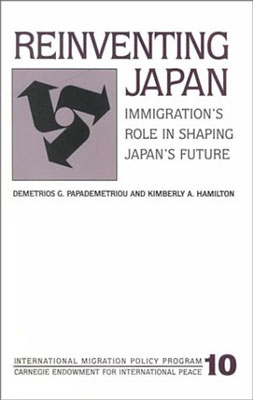
Reinventing Japan: Immigration's Role in Shaping Japan's Future
Book

Reinventing Japan: Immigration's Role in Shaping Japan's Future

Much attention has been given to Japan's need to restructure its economy and its bureaucracy, but little critical analysis has addressed the necessary role of immigration policy in Japan's reform process. A series of economic, demographic, and political factors are converging to require that Japan adopt a more open policy toward immigration if it is to ensure its place as a global leader.

Link Copied
By Dr. Demetrios Papademetriou and Kimberly Hamilton
Published on Sep 13, 2000

Additional Links

Chapter OneTable of ContentsPaperback - $12.00

Source: Washington

Much attention has been given to Japan's need to restructure its economy and its bureaucracy, but little critical analysis has addressed the necessary role of immigration policy in Japan's reform process. Japan does not have a history of substantial immigration, and Japanese attitudes toward foreigners have traditionally been very closed. Even today, immigration to Japan is very low compared to other industrialized countries, primarily because of Japanese policies aimed at restricting immigration. In this monograph, Papademetriou and Hamilton argue that this restrictionist approach is ripe for change. A series of economic, demographic, and political factors are converging to require that Japan adopt a more open policy toward immigration if it is to ensure its place as a global leader.

About the Authors
Demetrios G. Papademetriou was a senior associate and co-director of the International Migration Policy Program at the Carnegie Endowment.

Kimberly A. Hamilton is a senior international program officer at Alcoa Foundation.

About the Authors

Dr. Demetrios Papademetriou

Former Senior Associate

Kimberly Hamilton

Authors

Dr. Demetrios Papademetriou
Former Senior Associate
Kimberly Hamilton
East AsiaJapanEconomyTrade

Carnegie does not take institutional positions on public policy issues; the views represented herein are those of the author(s) and do not necessarily reflect the views of Carnegie, its staff, or its trustees.

More Work from Carnegie China

  • Commentary
    Today’s Rare Earths Conflict Echoes the 1973 Oil Crisis — But It’s Not the Same

    Regulation, not embargo, allows Beijing to shape how other countries and firms adapt to its terms.

      Alvin Camba

  • Commentary
    How China’s Growth Model Determines Its Climate Performance

    Rather than climate ambitions, compatibility with investment and exports is why China supports both green and high-emission technologies.

      Mathias Larsen

  • Overproduction in China
    Commentary
    What’s New about Involution?

    “Involution” is a new word for an old problem, and without a very different set of policies to rein it in, it is a problem that is likely to persist.

      Michael Pettis

  • Commentary
    The Chinese Investment Riddle: What Cities Reveal

    While China's investment story seems contradictory from the outside, the real answers to Beijing's high-quality growth ambitions are hiding in plain sight across the nation's cities.

      Yuhan Zhang

  • Commentary
    Using China’s Central Government Balance Sheet to “Clean up” Local Government Debt Is a Bad Idea

    China's stimulus addiction cannot go on forever. Beijing still has policy space to clean up the country's massive debt issue, but time is running short.

      Michael Pettis

Get more news and analysis from
Carnegie China
Carnegie China logo, white
  • Research
  • About
  • Experts
  • Events
  • Contact
  • Careers
  • Privacy
  • For Media
Get more news and analysis from
Carnegie China
© 2026 Carnegie Endowment for International Peace. All rights reserved.






