

Article
Frederic Grare
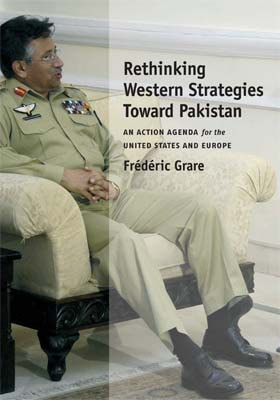
Pakistan’s military is complicit in the worsening security situation in Afghanistan—including the resurgence of the Taliban, terrorism in Kashmir, and the growth of jihadi extremism and capabilities. Current Western policies reinforce Pakistan’s political weakness and contribute to regional instability by allowing Pakistan to trade democratization for its cooperation on terrorism.
Source: Carnegie Endowment

Pakistan’s military is complicit in the worsening security situation in Afghanistan—including the resurgence of the Taliban, terrorism in Kashmir, and the growth of jihadi extremism and capabilities, says a new report from the Carnegie Endowment. Furthermore, current Western policies reinforce Pakistan’s political weakness and contribute to regional instability by allowing Pakistan to trade democratization for its cooperation on terrorism.
In Rethinking Western Strategies Toward Pakistan: An Action Agenda for the United States and Europe, visiting scholar Frederic Grare analyzes the cost of continued military rule in Pakistan and presents new guidelines for Western policies. Grare argues that while Pakistan may partially cooperate with the West against international terrorism, without democratization Pakistan will continue its policies, resulting in continued regional instability.
Key Conclusions:
• Pakistan’s army has inflated the threat of religious sectarianism and jihadi extremism outside its borders, particularly in Afghanistan and Kashmir, for its own self-interest. Faced with this seeming instability and a perceived lack of alternatives, the West adopted a more lenient attitude toward Pakistan’s military regime as a moderate stalwart against Islamic extremism.
• Restoring stable civilian rule would lessen Pakistan’s obsession with the threat posed by India and focus Pakistan’s energy on its own economic development.
• Of approximately $10 billion in assistance given to Pakistan since September 11, 2001, only $900 million has gone to development—the bulk being channeled to the military.
U.S. and European Policy Recommendations:
• The West should insist that: General Musharraf cease violating the constitution by holding the position of both president and the chief of the army staff; free and fair elections be held with international monitoring; Pakistani infiltration into Kashmir and Afghanistan cease; and all terrorist infrastructure within the country be disbanded.
• U.S. financial assistance should be explicitly directed towards any shortcomings that impede Pakistan’s cooperation in combating terrorism, and remain dependent on results.
• Policies, and if necessary, sanctions, should be directed towards the military and Pakistan’s small elite. The general population should, as much as possible, be shielded from affects of withholding assistance.
• The United States should cease its campaign against political Islam in Pakistan. It has proven counterproductive and made U.S. policy dependent on Pakistan’s military, which claims to be the strongest rampart against religious extremism.
“This report proposes a middle way,” writes Grare. “It addresses some of the challenges that the Pakistani military regime’s regional policies create for the international community, arguing that none can be resolved in isolation from the others. Arguing that the nature of the regime is the main source of trouble for the region, it urges a return to a civilian government according to Pakistan’s own constitution.”
Click on one of the link above for the full text of this Carnegie report.
A limited number of print copies are available.
Request a copy
About the Author
Frederic Grare is a visiting scholar with the Carnegie Endowment. He is a leading expert and writer on South Asia, having served most recently in the French Embassy in Pakistan and, from 1999 to 2003, in New Delhi as director of the Centre for Social Sciences and Humanities.

Former Nonresident Senior Fellow, South Asia Program
Frédéric Grare was a nonresident senior fellow at the Carnegie Endowment for International Peace, where his research focuses on Indo-Pacific dynamics, the search for a security architecture, and South Asia Security issues.
Recent Work
Frederic Grare
Frederic Grare
Carnegie does not take institutional positions on public policy issues; the views represented herein are those of the author(s) and do not necessarily reflect the views of Carnegie, its staff, or its trustees.

But their "principal to principal" model will only be as effective as the political strength of each leader back home.

Damien Ma

U.S. unpredictability has allowed China to capitalize on its positioning as the “responsible great power”. Paradoxically, the more China wins the perception game, the more likely expectations will rise for Beijing to deliver not just words but to demonstrate with its deeds.

Chong Ja Ian

Hanoi and Beijing have long treated each other as distant cousins rather than comrades in arms. That might be changing as both sides draw closer to hedge against uncertainty and America’s erratic behavior.

Nguyễn Khắc Giang

Across Asia, China is better positioned to withstand energy shocks from the fallout of the Iran war. Its abundant coal capacity can ensure stability in the near term. Yet at the same time, the country’s energy transition away from coal will make it even less vulnerable during the next shock.
Damien Ma

Malaysia’s chairmanship sought to fend off short-term challenges while laying the groundwork for minimizing ASEAN’s longer-term exposure to external stresses.

Elina Noor