
Malaysia’s chairmanship sought to fend off short-term challenges while laying the groundwork for minimizing ASEAN’s longer-term exposure to external stresses.
Elina Noor
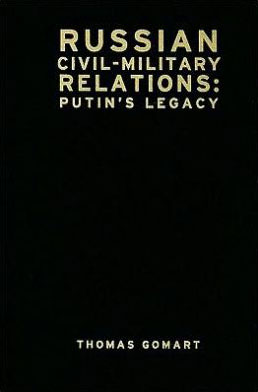
Russian Civil-Military Relations provides crucial analysis of the nature and evolution of the balance between civilian and military institutions. These relations will continue to influence regime development, security policy, and societal attitudes that build from Putin’s Russia, to Medvedev’s administration, and into the future.
Source: Washington

Russian Civil-Military Relations provides crucial analysis of the nature and evolution of the balance between civilian and military institutions. These relations will continue to influence regime development, security policy, and societal attitudes that build from Putin’s Russia, to Medvedev’s administration, and into the future.
About the Author
Thomas Gomart is director of the Russia/NIS Center at the French Institute for International Relations (IFRI) in Paris and lectures on international affairs and geopolitics at the Special Military School of Saint-Cyr Coëtquidan. He has been Lavoisier Fellow at the Moscow State Institute for International Relations, Visiting Fellow at the Institute for Security Studies, Paris, and Marie Curie Fellow at Department of War Studies, King’s College, London.
“This perceptive and well-informed study highlights the continuity of the Russian (civilian and military) security community’s distrust of the outside world, fueled by NATO enlargement. Communism may be dead in Russia, but the obsession with ‘threats’ continues, rallying the population and keeping security elites in power. This makes Russia an uncomfortable world player to live with. A must read.”
—Beatrice Heuser, professor and chair of International Relations, School of Politics and International Relations, University of Reading, UK
“It is my pleasure to recommend this book by Thomas Gomart to all those who are interested in the transformation of Russia and which remains an important factor not only for Russia’s direct neighbors, but to the international system more broadly. The Russian army, which for decades opposed the West, merits sustained attention. As the old saying goes, it is never as strong as it wants to look, but is never as feeble as it at times appears.”
—From the foreword by Dmitri Trenin, deputy director of the Carnegie Moscow Center and senior associate at the Carnegie Endowment for International Peace
Thomas Gomart
Carnegie does not take institutional positions on public policy issues; the views represented herein are those of the author(s) and do not necessarily reflect the views of Carnegie, its staff, or its trustees.
Malaysia’s chairmanship sought to fend off short-term challenges while laying the groundwork for minimizing ASEAN’s longer-term exposure to external stresses.
Elina Noor
For Malaysia, the conjunction that works is “and” not “or” when it comes to the United States and China.
Elina Noor
In July 2025, Vietnam and China held their first joint army drill, a modest but symbolic move reflecting Hanoi’s strategic hedging amid U.S.–China rivalry.
Nguyễn Khắc Giang
The Thai-Cambodian conflict highlights the limits to China's peacemaker ambition and the significance of this role on Southeast Asia’s balance of power.
Pongphisoot (Paul) Busbarat
Beijing believes that Washington is overestimating its own leverage and its ability to handle the trade war’s impacts.
Rick Waters, Sheena Chestnut Greitens







