

Paper
Alejandro Foxley, Fernando Sossdorf
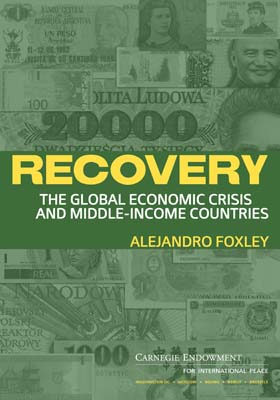
There is no single solution to the financial crisis for middle-income countries, but fundamental labor markets reforms that create high-paying jobs are key to restarting economic growth.
There is no single solution to the effects of the financial crisis on middle-income countries, but introducing fundamental labor markets reforms to create high-paying jobs will be the key to restarting economic growth, according to a report by Alejandro Foxley, the former foreign and finance minister of Chile.
Labor reform is always politically contentious, but the current crisis, by illustrating the dangers of ignoring necessary long-term reforms, has made it easier to reach consensus on the need for action. If policy makers undertake the right reforms, middle-income countries could achieve higher growth, better standards of living, and more effective government.
Key points:
Foxley concludes:
“There are no magic formulas, no shortcuts, no miracles, and no ‘models’ as far as development is concerned. Economic growth and development is a several-decades-long proposition that requires consistent policies, persistence in moving in a certain direction, and adaptability to shocks and changes and the opportune correction of policy mistakes.”
Former Senior Associate, International Economics Program
Foxley was previously minister of foreign affairs, senator, and minister of finance of the Republic of Chile. While minister of finance he concurrently served as a governor of the Inter-American Development Bank and the World Bank.
Recent Work
Alejandro Foxley, Fernando Sossdorf
Alejandro Foxley
Carnegie does not take institutional positions on public policy issues; the views represented herein are those of the author(s) and do not necessarily reflect the views of Carnegie, its staff, or its trustees.

China’s banking crisis in the 2000s was resolved by transferring the costs to households through financial repression—a decision that recapitalized the banks while exacerbating the structural imbalances that continue to shape the Chinese economy today.

Michael Pettis

Chinese biotech companies have been on the receiving end of U.S. economic coercion. Yet their responses have differed significantly because firm and state interests are not uniformly aligned. For Washington, treating all Chinese tech firms the same, irrespective of their actual interests, risks pushing them farther into Beijing’s corner.

Xue Gong

U.S. unpredictability has allowed China to capitalize on its positioning as the “responsible great power”. Paradoxically, the more China wins the perception game, the more likely expectations will rise for Beijing to deliver not just words but to demonstrate with its deeds.

Chong Ja Ian

Hanoi and Beijing have long treated each other as distant cousins rather than comrades in arms. That might be changing as both sides draw closer to hedge against uncertainty and America’s erratic behavior.

Nguyễn Khắc Giang

Across Asia, China is better positioned to withstand energy shocks from the fallout of the Iran war. Its abundant coal capacity can ensure stability in the near term. Yet at the same time, the country’s energy transition away from coal will make it even less vulnerable during the next shock.

Damien Ma