

Paper
Yezid Sayigh
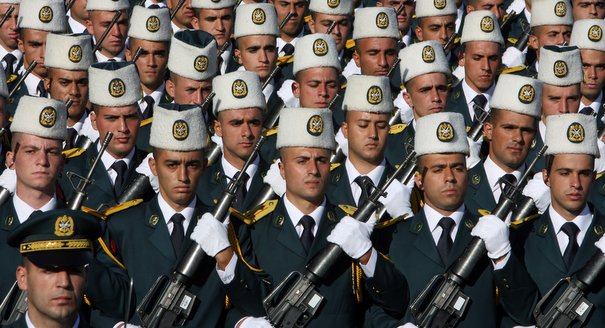
Source: Getty
The bulk of development security sector aid in Palestine, Lebanon, and Yemen has consisted of military training and equipment. The West should adopt a comprehensive approach to aid where security reform is only one part of a broader reform strategy.
Although important, development assistance aimed at reforming the security sectors in Palestine, Lebanon, and Yemen has achieved only limited results. The bulk of such aid has consisted of military training and equipment, which does nothing to ensure that security forces answer to legitimate civilian leaders.
Whether by design or default, the United States and European countries have a narrow focus on counterterrorism in Palestine, Lebanon, and Yemen—all countries with weak and quasi-democratic governments. Without an integrated approach that includes support for democracy and the rule of law, security sector reforms are not sustainable and can reinforce local power struggles.
Five Lessons for the United States and Europe:
“To enable real reform, the West must adopt a comprehensive approach which treats security reform as only one part of a broader political strategy, and encourage governments and security commanders in Palestine, Lebanon, and Yemen to buy into such a strategy,” says Sayigh. “Pursuing counterterrorism in the absence of the rule of law perpetuates the undemocratic governance of the security sector and undermines state building and post-conflict reconstruction.”

Senior Fellow, Malcolm H. Kerr Carnegie Middle East Center
Yezid Sayigh is a senior fellow at the Malcolm H. Kerr Carnegie Middle East Center in Beirut, where he leads the program on Civil-Military Relations in Arab States (CMRAS). His work focuses on the comparative political and economic roles of Arab armed forces, the impact of war on states and societies, the politics of postconflict reconstruction and security sector transformation in Arab transitions, and authoritarian resurgence.
Recent Work
Yezid Sayigh
Yezid Sayigh
Carnegie does not take institutional positions on public policy issues; the views represented herein are those of the author(s) and do not necessarily reflect the views of Carnegie, its staff, or its trustees.

The nuclear relationship between China and the United States is increasingly shaped by widening perception gaps rather than deliberate strategic design.

Tong Zhao

But their "principal to principal" model will only be as effective as the political strength of each leader back home.

Damien Ma

U.S. unpredictability has allowed China to capitalize on its positioning as the “responsible great power”. Paradoxically, the more China wins the perception game, the more likely expectations will rise for Beijing to deliver not just words but to demonstrate with its deeds.

Chong Ja Ian

Hanoi and Beijing have long treated each other as distant cousins rather than comrades in arms. That might be changing as both sides draw closer to hedge against uncertainty and America’s erratic behavior.

Nguyễn Khắc Giang

Across Asia, China is better positioned to withstand energy shocks from the fallout of the Iran war. Its abundant coal capacity can ensure stability in the near term. Yet at the same time, the country’s energy transition away from coal will make it even less vulnerable during the next shock.
Damien Ma