

Commentary
Sergei Aleksashenko, Mikhail Krutikhin, Yuval Weber
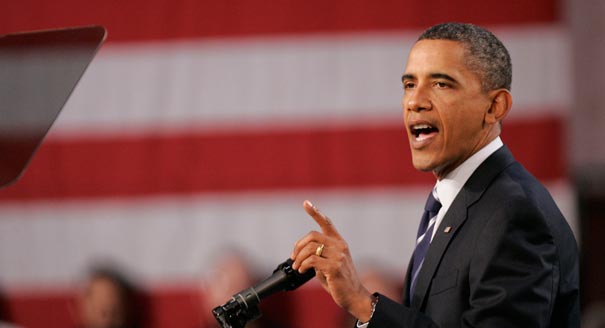
Source: Getty
Obama is trying to position himself as the ‘president of all Americans,’ to modernize the United States, and to resolve pressing problems such as unemployment, health care, and the budget deficit.
“Where there’s a will, there’s a way”: That could be the slogan of president Obama’s second year in office, said economist and Carnegie Moscow Center expert Sergei Aleksashenko following Barack Obama’s first State of the Union Address to the U.S. Congress.
“Obama is not feeding anyone illusions or trying to calm people down by saying that the crisis has passed. He admitted that the United States is once again undergoing a test of its stability, and he expressed his hope that, under his leadership, the nation will pass that test. His address clearly demonstrates that he is trying to resolve the United States’ most pressing problems, including unemployment, heath care, and the budget deficit. But he’s also talking about ‘American modernization,’ about the need to maintain American leadership in technology and clean energy, the need to increase and support exports, to support Americans’ efforts to get an education.
“In particularly, I would note that Obama is once again trying to position himself as the ‘president of all Americans,’ and he dedicated a significant portion of his address to the issue of bi-partisanship. He proposed joint commissions on an equal footing with the Republicans, despite the Democrats’ majority, to review and reduce the budget obligations. He is prepared to support the ideas of any lawmaker who has a solution to the problems that have accumulated in the healthcare system. Lastly, he says openly that Washington – that the American political elite – faces a problem of trust, which can easily be lost in a crisis. Trust can only be maintained if partisan rancor is softened and if consensus is found in the search for answers to the challenges of the age.”
Former Scholar in Residence, Economic Policy Program, Moscow Center
Aleksashenko, former deputy minister of finance of the Russian Federation and former deputy governor of the Russian central bank, was a scholar-in-residence in the Carnegie Moscow Center’s Economic Policy Program.
Recent Work
Sergei Aleksashenko, Mikhail Krutikhin, Yuval Weber
Sergei Aleksashenko
Carnegie does not take institutional positions on public policy issues; the views represented herein are those of the author(s) and do not necessarily reflect the views of Carnegie, its staff, or its trustees.