

Paper
Alejandro Foxley, Fernando Sossdorf
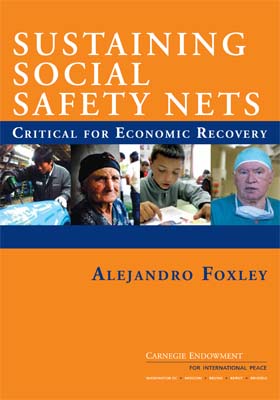
As middle-income countries recovering from the global financial crisis face high unemployment and growing government deficits, existing social services will become stressed. Maintaining these safety nets is a vital part of recovery.
The coverage and quality of basic social services—from unemployment insurance to health care and social security—will likely suffer as middle-income countries recover from the global financial crisis. Faced with high unemployment and growing government deficits, existing social services will become stressed. Yet maintaining these safety nets is a vital part of recovery without which significant segments of the middle class may slip into poverty, concludes a paper by Alejandro Foxley, former foreign and finance minister of Chile.
Foxley analyzes the provision of social services in Eastern Europe, East Asia, and Latin America and makes recommendations for how safety nets need to be restructured to protect vulnerable groups.
“The aftermath of the current global financial crisis will make it obvious that an active role for the state is unavoidable to cover the most vulnerable groups of the population and to mend existing social safety nets in terms of cost and accessibility,” writes Foxley.
Former Senior Associate, International Economics Program
Foxley was previously minister of foreign affairs, senator, and minister of finance of the Republic of Chile. While minister of finance he concurrently served as a governor of the Inter-American Development Bank and the World Bank.
Recent Work
Alejandro Foxley, Fernando Sossdorf
Alejandro Foxley
Carnegie does not take institutional positions on public policy issues; the views represented herein are those of the author(s) and do not necessarily reflect the views of Carnegie, its staff, or its trustees.

The nuclear relationship between China and the United States is increasingly shaped by widening perception gaps rather than deliberate strategic design.

Tong Zhao

China’s banking crisis in the 2000s was resolved by transferring the costs to households through financial repression—a decision that recapitalized the banks while exacerbating the structural imbalances that continue to shape the Chinese economy today.

Michael Pettis

Chinese biotech companies have been on the receiving end of U.S. economic coercion. Yet their responses have differed significantly because firm and state interests are not uniformly aligned. For Washington, treating all Chinese tech firms the same, irrespective of their actual interests, risks pushing them farther into Beijing’s corner.

Xue Gong

Across Asia, China is better positioned to withstand energy shocks from the fallout of the Iran war. Its abundant coal capacity can ensure stability in the near term. Yet at the same time, the country’s energy transition away from coal will make it even less vulnerable during the next shock.

Damien Ma

In the latest Five-Year Plan, the Chinese president cements the shift to an innovation-driven economy over a consumption-driven one.
Damien Ma