• Commentary
  • Research
  • Experts
  • Events
Carnegie China logoCarnegie lettermark logo
The Political Challenge of Yemen's Southern Movement

Source: Getty

Paper

The Political Challenge of Yemen's Southern Movement

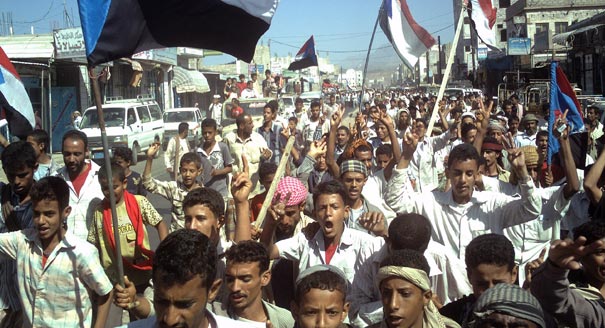
Yemen’s secessionist Southern Movement threatens the country’s stability, but a military campaign against it would only further inflame its supporters and increase support for al-Qaeda in the Arabian Peninsula. A political solution is required.

Link Copied
By Stephen Day
Published on Mar 23, 2010

Additional Links

Full Text

Yemen’s secessionist Southern Movement is undergoing a radical transformation that threatens the country’s stability. But a military campaign against the movement would only further inflame its supporters and increase support for al-Qaeda in the Arabian Peninsula. A political solution is required that addresses the unresolved problems from the country’s poorly-executed unification in the early 1990s.

Map: Yemen

Map of Yemen
  • view map
Map of Yemen showing current governorate boundaries and former North/South boundary.

Key Conclusions:

  • The demands of the southern leaders were originally moderate calls for equality, but a severe response from Yemeni President Saleh (who used government media to create scandals about the movement’s leaders and arrested religious figures) pushed the movement to demand secession.
     
  • Al-Qaeda’s leader in Yemen, Nasser al-Wahayshi, has declared support for the Southern Movement, but Southern leaders have thus far rejected his endorsement.
     
  • The primary problem in the South is not links between al-Qaeda and the Southern Movement, but unrest fueled by widespread opposition to the government and the perception of economic exploitation by the military and security forces.  

Policy Recommendations:

  • Arab leadership. Arab countries should lead the push for Yemen’s government to negotiate with southerners, improve economic development, and begin national reconciliation. Western-backed initiatives will only increase mistrust of the central government.
     
  • Reconciliation. Yemen’s government and representatives of the Southern Movement should commence national reconciliation talks. The talks must include domestic political opponents, southern women, and exiled southern leaders and members of the business community.
     
  • Address root causes. Instead of a military crackdown on the Southern Movement, the government needs to reduce corruption, respect human rights, and allow political opponents to peacefully organize.
     
  • Presidential transition. Saleh’s presidential term ends in 2013. Stepping down peacefully, and refusing to install a member of his family in his place, would go a long way in convincing the Southern Movement to drop its plans for secession.


“The success of the political effort in the South will require steady, outside pressure and effective mediation, preferably by an Arab leader like Jordan’s late King Hussein, who tried to assist Yemenis in 1994,” writes Day. But “ultimately, the success of such an effort will depend on Yemeni leaders on all sides, and their willingness to tackle problems left unsolved since the 1990s.”

About the Author

Stephen Day

Stephen Day
Middle EastYemenGulfPolitical ReformSecurityForeign Policy

Carnegie does not take institutional positions on public policy issues; the views represented herein are those of the author(s) and do not necessarily reflect the views of Carnegie, its staff, or its trustees.

More Work from Carnegie China

  • Commentary
    Malaysia’s Year as ASEAN Chair: Managing Disorder

    Malaysia’s chairmanship sought to fend off short-term challenges while laying the groundwork for minimizing ASEAN’s longer-term exposure to external stresses.

      Elina Noor

  • Commentary
    When It Comes to Superpower Geopolitics, Malaysia Is Staunchly Nonpartisan

    For Malaysia, the conjunction that works is “and” not “or” when it comes to the United States and China.

      Elina Noor

  • Commentary
    Neither Comrade nor Ally: Decoding Vietnam’s First Army Drill with China

    In July 2025, Vietnam and China held their first joint army drill, a modest but symbolic move reflecting Hanoi’s strategic hedging amid U.S.–China rivalry.

      • Nguyen-khac-giang

      Nguyễn Khắc Giang

  • Commentary
    China’s Mediation Offer in the Thailand-Cambodia Border Dispute Sheds Light on Beijing’s Security Role in Southeast Asia

    The Thai-Cambodian conflict highlights the limits to China's peacemaker ambition and the significance of this role on Southeast Asia’s balance of power.

      Pongphisoot (Paul) Busbarat

  • Trump and Xi on a red background
    Commentary
    Emissary
    China Is Determined to Hold Firm Against Trump’s Pressure

    Beijing believes that Washington is overestimating its own leverage and its ability to handle the trade war’s impacts. 

      • Sheena Chestnut Greitens

      Rick Waters, Sheena Chestnut Greitens

Get more news and analysis from
Carnegie China
Carnegie China logo, white
  • Research
  • About
  • Experts
  • Events
  • Contact
  • Careers
  • Privacy
  • For Media
Get more news and analysis from
Carnegie China
© 2026 Carnegie Endowment for International Peace. All rights reserved.