• Commentary
  • Research
  • Experts
  • Events
Carnegie China logoCarnegie lettermark logo
War in Saada: From Local Insurrection to National Challenge

Source: Getty

Paper

War in Saada: From Local Insurrection to National Challenge

The Yemeni government is mired in an unwinnable and sporadic civil conflict in the northern governorate of Saada that has weakened the central government, accelerated the economic crisis, and threatens global stability by emboldening al-Qaeda.

Link Copied
By Christopher Boucek
Published on May 5, 2010

Additional Links

Full Text

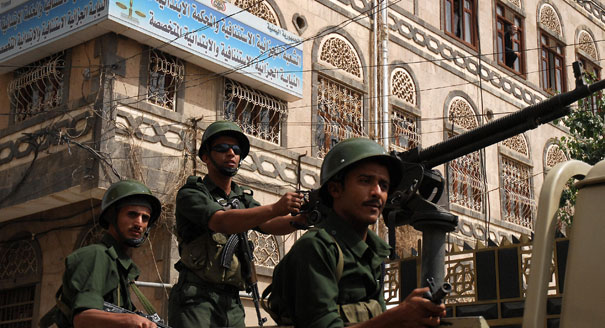
The Yemeni government has been mired in an unwinnable and sporadic civil conflict in the northern governorate of Saada since 2004. This war has weakened the central government, accelerated the economic crisis, and threatened global stability by emboldening al-Qaeda, concludes a paper by Christopher Boucek.

Key conclusions about the conflict in Saada:

  • Fighting likely to continue. The current cease-fire agreed to in February 2010 is likely to fail as the central government shows little interest in addressing the core grievances of the rebelling Houthis.
     
  • Priorities are misguided. The Southern secessionist movement is Yemen’s more serious security threat, but the regime is more involved in Saada for two key reasons: the government believes the war is winnable, and uses the military operations in the North to send a message to agitators in the South.
     
  • Costs are escalating. In the six years the war evolved from a local insurrection into a national challenge, devastating the economy and consuming crucial resources.
     
  • Burdens disproportionately felt by noncombatants. The six rounds of fighting came with high humanitarian costs. Hostilities displaced over 250,000 people, killed hundreds or thousands (the exact number of casualties is unknown), and destroyed significant civilian infrastructure.
     
  • Conflict expands beyond borders. When Saudi Arabia’s military entered the conflict in November 2009 following Houthi incursions, conditions went from bad to worse. But there is no evidence that the conflict in Saada is a proxy war between Saudi Arabia and Iran as commonly asserted.

“The government’s uncompromising position in Saada has exacerbated local grievances and rapidly accelerated Yemen’s economic crisis,” writes Boucek. “Without a serious international effort at mediation, further fighting is inevitable—and poses a serious threat to Yemeni stability.”

 

About the Author

Christopher Boucek

Former Associate, Middle East Program

Boucek was an associate in the Carnegie Middle East Program where his research focused on security challenges in the Arabian Peninsula and Northern Africa.

    Recent Work

  • Q&A
    Yemen After Saleh’s Return and Awlaki’s Exit

      Christopher Boucek

  • Q&A
    Rivals—Iran vs. Saudi Arabia

      Christopher Boucek, Karim Sadjadpour

Christopher Boucek
Former Associate, Middle East Program
Christopher Boucek
Middle EastYemenGulfPolitical ReformSecurityForeign Policy

Carnegie does not take institutional positions on public policy issues; the views represented herein are those of the author(s) and do not necessarily reflect the views of Carnegie, its staff, or its trustees.

More Work from Carnegie China

  • Commentary
    Malaysia’s Year as ASEAN Chair: Managing Disorder

    Malaysia’s chairmanship sought to fend off short-term challenges while laying the groundwork for minimizing ASEAN’s longer-term exposure to external stresses.

      Elina Noor

  • Commentary
    When It Comes to Superpower Geopolitics, Malaysia Is Staunchly Nonpartisan

    For Malaysia, the conjunction that works is “and” not “or” when it comes to the United States and China.

      Elina Noor

  • Commentary
    Neither Comrade nor Ally: Decoding Vietnam’s First Army Drill with China

    In July 2025, Vietnam and China held their first joint army drill, a modest but symbolic move reflecting Hanoi’s strategic hedging amid U.S.–China rivalry.

      • Nguyen-khac-giang

      Nguyễn Khắc Giang

  • Commentary
    China’s Mediation Offer in the Thailand-Cambodia Border Dispute Sheds Light on Beijing’s Security Role in Southeast Asia

    The Thai-Cambodian conflict highlights the limits to China's peacemaker ambition and the significance of this role on Southeast Asia’s balance of power.

      Pongphisoot (Paul) Busbarat

  • Trump and Xi on a red background
    Commentary
    Emissary
    China Is Determined to Hold Firm Against Trump’s Pressure

    Beijing believes that Washington is overestimating its own leverage and its ability to handle the trade war’s impacts. 

      • Sheena Chestnut Greitens

      Rick Waters, Sheena Chestnut Greitens

Get more news and analysis from
Carnegie China
Carnegie China logo, white
  • Research
  • About
  • Experts
  • Events
  • Contact
  • Careers
  • Privacy
  • For Media
Get more news and analysis from
Carnegie China
© 2026 Carnegie Endowment for International Peace. All rights reserved.