

Commentary
Dmitri Trenin
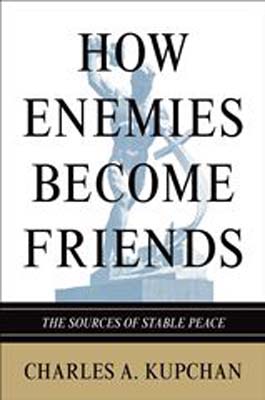
The rise of major non-Western powers makes the avoidance of traditional geopolitical rivalries a must if one wants a peaceful world order. This is particularly relevant to Euro-Atlantic zone, which is still divided on security issues.
Source: Foreign Affairs

By Charles A. Kupchan
Princeton University Press. 448 pp. $29.95
One of the United States' strongest assets has been its capacity to turn its rivals into partners and its adversaries into allies. The United Kingdom, Mexico, Germany, and Japan all fought against the United States before they joined with it in what has become a zone of stable peace. At the start of the twenty-first century, this capacity is needed as much as ever before. The rise of major non-Western powers, such as Brazil, China, India, Iran, South Africa, Turkey, and others makes the avoidance of traditional geopolitical rivalries a must if one wants a peaceful world order.
In How Enemies Become Friends, Kupchan discusses how and why peace breaks out. He takes on the notion that stable peace can only be the product of liberal democratic development, an idea he calls unnecessary and unwise, and uses a rigorous theoretical framework and a wealth of historical evidence to elucidate pathways to stable peace. These include unilateral accommodation, reciprocal restraint, societal integration, and the generation of new narratives and identities.
Kupchan's findings are particularly relevant to Euro-Atlantic relations. Two decades after the end of the Cold War, Europe is still divided on security issues. Both NATO and the EU have expanded considerably, but countries such as Russia, Ukraine, Georgia, Armenia, and Azerbaijan are beyond the zone of stable peace. The theory of democratic peace has worked for some but not others. Kupchan's timely book can help solve the hard cases.
This book review originally appeared in Foreign Affairs.
Reprinted by permission of FOREIGN AFFAIRS, November 01, 2010. Copyright 2010 by the Council on Foreign Relations, Inc.
Former Director, Carnegie Moscow Center
Trenin was director of the Carnegie Moscow Center from 2008 to early 2022.
Recent Work
Dmitri Trenin
Dmitri Trenin
Carnegie does not take institutional positions on public policy issues; the views represented herein are those of the author(s) and do not necessarily reflect the views of Carnegie, its staff, or its trustees.