

Paper
Richard Youngs, Thomas Carothers
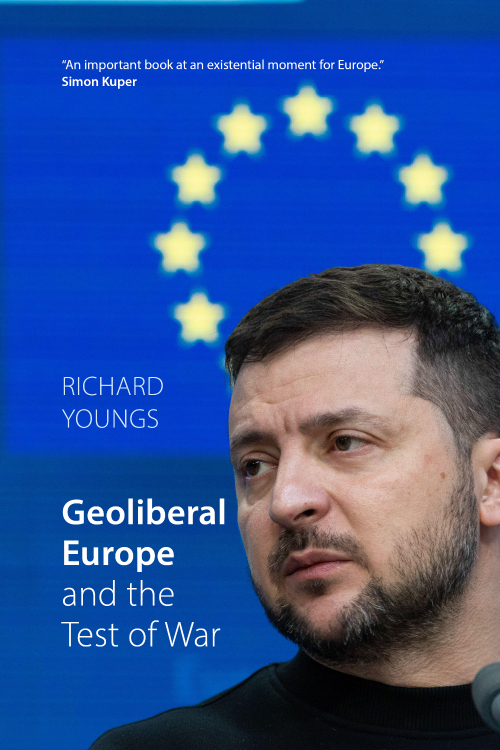
Russia’s invasion of Ukraine has pushed Europe into a new strategic era. But as the conflict persists, European governments and institutions are struggling to move past crisis-driven, short-term policies and design a new European order.
Source: Agenda Publishing
Russia’s invasion of Ukraine has pushed Europe into a new strategic era. The knock-on effects of the war have combined to open a period of reordering across the European continent. European governments and the European Union collectively have begun to fashion policies for this shift, recognizing this to be a pivotal historical moment. Richard Youngs unpacks the different dynamics that have come to characterize European policies in the wake of the war: the nature of EU integration, geopolitical power, defense priorities, European borders, liberal values, the green transition, and economic sovereignty.
The book looks to the future and outlines the issues and choices with which European governments still need to grapple. Youngs develops the notion of geoliberalism as a way of addressing these challenges and guiding European governments and the EU into the fragile order taking shape in the shadow of Ukraine’s war.
“A must-read for everyone thinking about how Europe can live up to today’s geopolitical challenges while remaining true to its liberal foundations.”
—Anna Lührmann, Minister of State for Europe and Climate, Germany.
“Russia’s unprovoked full-scale invasion of Ukraine required the European Union to rise to the urgency of the moment. Now, the task is to build a new European and global order. Youngs’ book is essential reading for anyone wanting to understand how and why that can be accomplished.”
—Erik Jones, Director, Robert Schuman Centre, European University Institute.
“Youngs poses a very big question, in clear prose: how will Russia’s invasion of Ukraine change Europe? His notion of ‘geoliberalism’ could become crucial in understanding our new era. This is an important book at an existential moment for Europe.”
—Simon Kuper, columnist, Financial Times.
“A major exploration of Europe’s shifting geopolitical landscape, a must-read for anyone hoping to understand the consequences of Putin’s war on Ukraine.”
—Norma Percy and Lotte Murphy-Johnson, producers of Putin vs the West.

Senior Fellow, Democracy, Conflict, and Governance Program
Richard Youngs is a senior fellow in the Democracy, Conflict, and Governance Program, based at Carnegie Europe. He works on EU foreign policy and on issues of international democracy.
Recent Work

Richard Youngs, Thomas Carothers
Richard Youngs
Carnegie does not take institutional positions on public policy issues; the views represented herein are those of the author(s) and do not necessarily reflect the views of Carnegie, its staff, or its trustees.

But their "principal to principal" model will only be as effective as the political strength of each leader back home.

Damien Ma

U.S. unpredictability has allowed China to capitalize on its positioning as the “responsible great power”. Paradoxically, the more China wins the perception game, the more likely expectations will rise for Beijing to deliver not just words but to demonstrate with its deeds.

Chong Ja Ian

Hanoi and Beijing have long treated each other as distant cousins rather than comrades in arms. That might be changing as both sides draw closer to hedge against uncertainty and America’s erratic behavior.

Nguyễn Khắc Giang

Across Asia, China is better positioned to withstand energy shocks from the fallout of the Iran war. Its abundant coal capacity can ensure stability in the near term. Yet at the same time, the country’s energy transition away from coal will make it even less vulnerable during the next shock.
Damien Ma

Malaysia’s chairmanship sought to fend off short-term challenges while laying the groundwork for minimizing ASEAN’s longer-term exposure to external stresses.

Elina Noor