This week, Vietnamese President and Communist Party General Secretary Tô Lâm will arrive in Beijing for his first state visit since his term began last week. Following the first of what China has called “3+3” ministerial-level strategic dialogue meetings between the two countries in late March, Lâm’s trip gestures to China’s priority in Hanoi’s policymaking under his presidential term, policymaking that is built on shared political parties, economic development, and a governance model centering public security. The agenda includes deepening practical cooperation on energy, infrastructure, economy and trade, and science and technology—in hope of easing ongoing energy supply shortages and pressures faced in the manufacturing sector.
In March, during the “3+3” dialogue, China’s foreign, defense, and public security ministers met together with their Vietnamese counterparts in Hanoi. While bilateral visits often pair foreign and defense ministers, China is making steady efforts to push diplomacy through its internal security apparatus—where the Ministry of Public Security and the Chinese Communist Party’s Central Political and Legal Affairs Commission steer law enforcement cooperation agendas and capacity-building programs with counterpart police agencies. With this development, China continues to position itself as a source of political stability and diplomatic predictability, standing in stark contrast to the United States under Donald Trump’s administration. Whether the Chinese leadership considers the outcomes of this dialogue a success could shape the future of its bilateral diplomacy with strategic neighbors and like-minded leaders.
The tri-ministerial visit to Hanoi signals to Beijing’s partners and the United States in two ways. First, China’s new public image of the ministerial trio signals a deliberate manifestation of President Xi Jinping’s “comprehensive national security concept” and new forms of outreach under the Global Security Initiative, under which China is deepening global cooperation to support regime security. Second, the elevation of this format marked a renewed opportunity for China to signal amity and mutual political trust with its strategic partners.
Expanding Common Ground at the “3+3” Dialogue
Against the backdrop of the U.S. military operation in Venezuela and the war in Iran, China is seizing the opportunity to promote its governance approach that centers on internal stability amid global disruptions. Xi’s conceptualization of an all-encompassing view of national security (总体国家安全观)—that inherently bounds the Chinese Communist Party’s security to national security and economic development—has driven China’s diplomacy and governance since 2014. Public security is considered a primary instrument to realize the domestic stability that this concept envisions.
Following the success of the first “3+3” dialogue co-chaired by senior officials from both sides in December 2024, Xi solidified consensus with Vietnamese leaders to officially elevate the dialogue to the ministerial level during his April 2025 visit to Southeast Asia. In the same visit, Xi set forth “six mores” for China-Vietnam cooperation, specifically calling for deeper political, security, and practical cooperation.
In a press interview following the ministerial “3+3” dialogue on March 16, Chinese Foreign Minister Wang Yi highlighted the two countries’ joint effort on safeguarding and maintaining political system security. The two foreign ministries reached consensus on mutual support for each other’s initiatives, domestically and through multilateral forums such as ASEAN, the Lancang-Mekong Cooperation, and BRICS.
Chinese Defense Minister Dong Jun met with his Vietnamese counterpart to discuss expanding armed forces’ cooperation reinforcing border and maritime stability, focused on shared responsibilities for protecting regional and maritime security despite unsettled disagreements. Vietnamese leaders signaled in response their amicable attitude regarding efforts to manage their differences, resolve disputes through peaceful negotiations, and make progress in demarcation of the South China Sea.
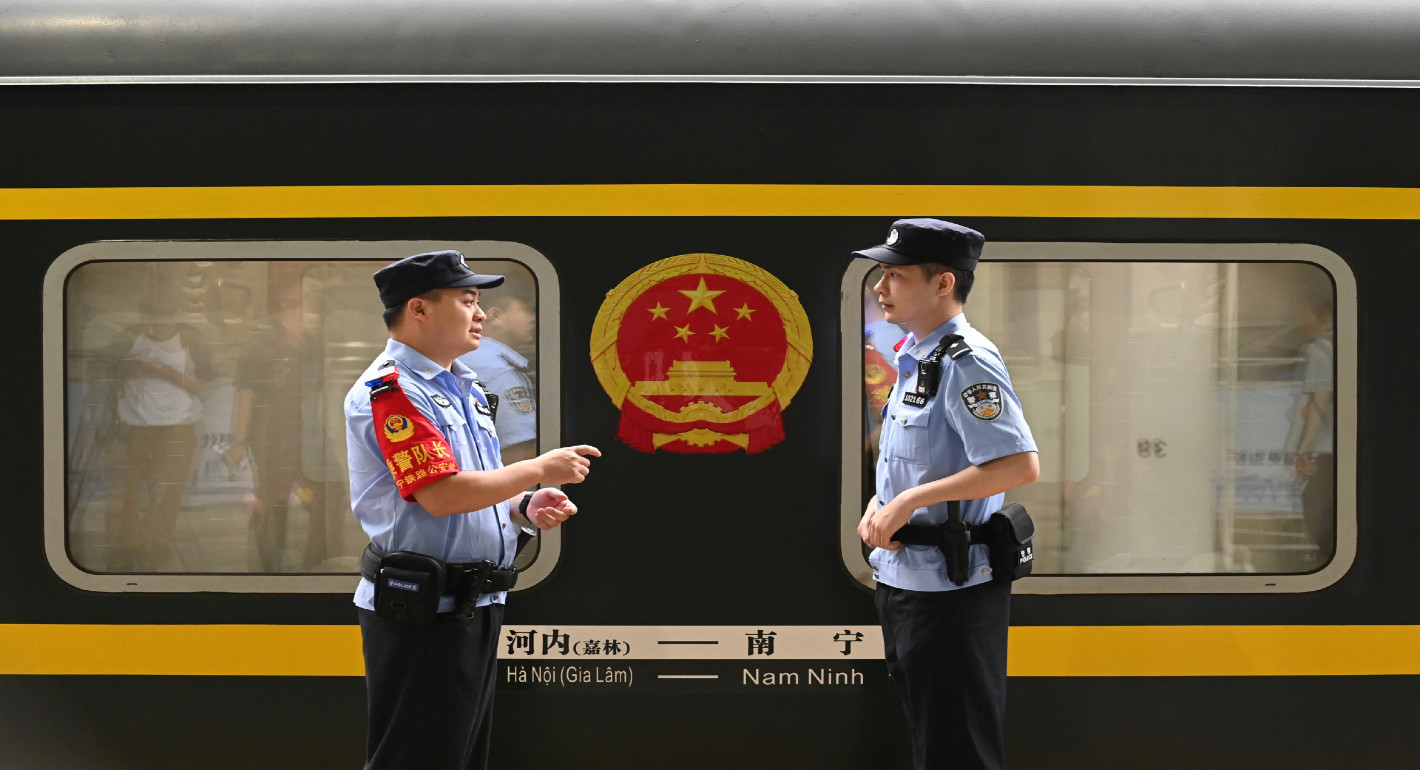
The incorporation of internal security priorities into China’s strategy abroad highlights that the Ministry of Public Security has become increasingly active in party-state foreign outreach, through regular ministerial-level meetings with counterparts. Last month’s “3+3” dialogue was followed by the two countries’ public security ministers holding their ninth ministerial conference on crime prevention and control on March 17.
Chinese Minister of Public Security Wang Xiaohong emphasized cooperation priorities in political security and in preventing so-called color revolutions. In Wang’s subsequent conversations during the ministerial meeting on crime control with his Vietnamese counterpart, Lương Tam Quang, the two parties fostered discussions on further law enforcement cooperation. The meeting readout suggests that China and Vietnam are consolidating a pattern of law enforcement focused on cybersecurity, combating online gambling and telecom fraud, drug control, and fugitive repatriation, as well as building police force capabilities through information- and technology-sharing. The meeting concluded with three additional security agreements signed by both sides, including one specifically on security protection that encompasses security for high-level visits, major political events, and the safety of agencies, enterprises, and citizens from both countries.
This visit concluded with the seventeenth meeting of the China-Vietnam Steering Committee for Bilateral Cooperation, where Foreign Minister Wang Yi reiterated China’s intentions to strengthen security cooperation in countering terrorist and fraudulent activities, with plans to implement agreements from the “3+3” ministerial meeting. A second ministerial meeting of the China-Vietnam “3+3” dialogue is set to be hosted in a Chinese city.
Public Security Diplomacy
Countries in Southeast Asia—a priority region under China’s Global Security Initiative—remain strategic weights in Beijing’s optimization calculus for nonmilitary security diplomacy and police training. In addition to bilateral initiatives, China has been engaging substantially through multilateral security forums. For example, the Global Public Security Cooperation Forum (Lianyungang; held by the Ministry of Public Security) serves as one of the predominant convenings for senior officials from interior and public security ministries. China-ASEAN and the Lancang-Mekong Integrated Law Enforcement and Security Cooperation Center (LMLECC)—encompassing Cambodia, Laos, Myanmar, Thailand, and Vietnam—function as targeted, regional consortiums for coordinating joint law enforcement actions and information-sharing for combating transnational cybercrimes, such as telecom fraud, scam networks, and underground online gambling operations. For Southeast Asia, public security cooperation over combating and preventing transnational crimes, drug and human trafficking, fugitive repatriation, border enforcement, and information-sharing aims to advance regional security by strengthening social stability.
An acceptance from a partner state to engage in a “3+3” dialogue with China communicates an openness to and validation of China’s governance model where internal security fosters domestic development. China started its “3+3” mechanism with Vietnam, where shared political systems founded on communist party leadership provide an obvious foundation. If successful, the dialogue with Vietnam could set a precedent for future Chinese diplomatic engagements.
The agenda for the Vietnamese president’s visit to China between April 14 and 17 will continue to evolve both countries’ investments into internal security cooperation, including a prospective agreement on importing Chinese surveillance tools. Given Lâm’s background in public security—where he began his political career serving in the police force, then later joined the Ministry of Public Security and subsequently rose in position to serve as the former minister of public security from 2016 to 2024—further expansion of cooperation between Vietnam’s and China’s public security ministries and police agencies should be expected.
What This Means for Southeast Asia’s Balancing Act
For countries in Southeast Asia, maintaining their long-held balancing act between the two rivals proves challenging in a time when U.S. allies in Asia are grappling with the realities and consequences of the Trump administration—from costly, sweeping tariffs to rising energy prices since the U.S. attacks on Iran—juxtaposed with China’s offer of an alternative security landscape for regional and global stability.
China’s “3+3” ministerial dialogue as a new diplomatic lever in Southeast Asia unveils a regional emphasis in preferences for strategic partners. As it seeks to tighten neighboring-country security partnerships, Beijing is likely to continue working through multilateral security forums, especially LMLECC, China-ASEAN, and regional ad hoc groups. But it may also look to expand this bilateral mechanism to countries like Laos, Myanmar, Thailand, and Cambodia, who either share borders with China or share Beijing’s vision of domestic and regional security. Time will tell whether it is useful to Beijing, and its neighbors, to expand the “3+3” mechanism—but in the meantime, developments with Vietnam mark an important step forward in China’s global outreach.
Acknowledgments
The author thanks Evan Feigenbaum, Sheena Chestnut Greitens, Darcie Draudt-Véjares, Robin McCoy, and Teddy Tawil for their helpful feedback on previous drafts.