

Commentary
Beijing is trying to navigate the overall situation regarding Ukraine, especially the substance of interactions between Washington and Moscow.
- +1
Ellen Nakashima, Zhao Long, Pavlo Klimkin, …
Source: Getty
Ukraine’s asymmetric approach has rendered Russia’s Black Sea Fleet functionally useless. But a long-term commitment will be needed to maintain this balance of power.
For centuries, the Black Sea has been a strategic crossroads of global trade and power. Linking the Eurasian continent to the Mediterranean and beyond, it has served as a commercial artery and a geopolitical fault line. Empires have fought over access to its waters for centuries, from the Russo–Turkish wars and the Crimean War to the two world wars. Yet despite its enduring significance, the Black Sea has long been overlooked in Western strategic thinking. Only in 2025 did the European Union (EU) publish its first comprehensive strategy for the region, and NATO still lacks a dedicated Black Sea strategy.1
Moscow’s determination to dominate the Black Sea runs deep in its strategic culture. The Russian Empire viewed control of these waters as essential for projecting economic, political, and military influence into the Balkans, the Eastern Mediterranean, and beyond. In the twentieth century, the Soviet Union controlled the Black Sea in a condominium with NATO member Türkiye, making it a central arena of the Cold War. When the Soviet Union collapsed in 1991, the largest share of its Black Sea coastline, naval infrastructure, and maritime economic zone was inherited by newly independent Ukraine. From Moscow’s perspective, this was an intolerable loss. Russia’s challenge to Ukraine’s sovereignty in the Black Sea began immediately in the early 1990s and intensified over the decades, culminating in the illegal annexation of Crimea in 2014 and the de facto occupation of a vast portion of Ukraine’s maritime zone.
Russia’s full-scale invasion of 2022 aimed not only to seize Ukrainian land but also to reimpose its dominance at sea. Its initial war plans foresaw a rapid occupation of Ukraine’s coastline, including the critical port cities of Odesa and Mykolaiv. If it had succeeded in that, Moscow would have been able to restore much of its Cold War-era control over the Black Sea, strangle Ukraine’s economy, and use control over the flow of food and energy for coercion. The world learned in 2022 that Ukraine is vital to global food security. Russia’s blockade of Ukrainian ports triggered a surge in grain prices, placing millions—particularly in Africa and the Middle East—at risk of hunger until a UN-brokered agreement, and later Ukraine’s military power, prompted Moscow to retreat.
At the outset of the invasion, Ukraine seemed to stand no chance of resisting at sea. It possessed virtually no fleet, while Russia had an apparently overwhelming superiority, having reinforced its Black Sea Fleet with vessels transferred from other theaters.2 Moscow initially dismissed negotiations to restore freedom of navigation, calculating that time and military pressure would cement its control. Yet the course of the war at sea defied this assumption. Against all odds, Ukraine used long-range missiles, unmanned maritime drones, and precision strikes—a combination of weapons produced domestically and supplied by Western partners—to inflict severe damage on Russia’s fleet. The flagship cruiser Moskva was sunk, bases in Crimea were repeatedly struck, and key naval assets were forced to withdraw to Russia’s Black Sea port of Novorossiysk. Despite the stark asymmetry between their assets, Ukraine reopened maritime routes and restored a degree of freedom of navigation.
This success, however, is not the end of the story. It is a temporary balance, not a permanent outcome. Russia does not view its setbacks as decisive. It continues to rebuild and innovate, and it frames the current situation as reversible. Moscow regards the Black Sea as a strategic necessity, not an optional theater. Its goal remains unchanged: to dominate these waters and deny Ukraine the economic and security lifeline they represent.
The presence of a strong Russian fleet will perpetually threaten shipping, ports, and infrastructure. It will always provide Moscow with a lever for the coercion of Ukraine and Europe.
The blunt reality is that the presence of a strong Russian fleet will perpetually threaten shipping, ports, and infrastructure. It will always provide Moscow with a lever for the coercion of Ukraine and Europe. The only way to achieve lasting peace and security in the Black Sea, therefore, is to ensure that Russia’s naval capabilities are not just degraded temporarily but kept structurally paralyzed. As Andriy Zagorodnyuk explains with his concept of “strategic neutralization,” Ukraine’s innovative asymmetric approach has already proven that it is possible to render Russia’s Black Sea Fleet functionally useless without fully destroying it or matching it on a ship-for-ship basis.3
Ukraine’s primary objective in the Black Sea, working alongside its partners, should be the preservation of the current balance of power. But consolidating this achievement demands long-term commitment: scaling up Ukraine’s maritime strike capacity, institutionalizing the support of its coalition of partners, and integrating Black Sea security into NATO and EU frameworks. In other words, the Black Sea will remain insecure until Russia’s fleet ceases to be able to function as an offensive force. That is the starting point from which any serious strategy must proceed.
The Black and Azov Seas have become a central arena of geopolitical confrontation,4 where energy security, food supply chains, and military power intersect. Since Russia’s full-scale invasion of Ukraine in 2022, these maritime zones have gone from being a peripheral to a core focus of Euro-Atlantic security. No longer an overlooked flank, the Black Sea has become a decisive strategic space, the control of which will determine the future of European resilience and deterrence.
The Crimean War of 1853–1856 offers a striking historical precedent, in which the Russian Empire pursued naval supremacy and control over critical maritime chokepoints. Through a military build-up in Sevastopol and the occupation of Danubian principalities, Russia sought to project dominance in the region under the guise of protecting Orthodox Christians living in the Ottoman Empire. It aimed to disrupt navigation, control the Bosporus and Dardanelles Straits, and displace regional competitors. Russian unilateralism and the breakdown of diplomatic frameworks like the 1841 London Straits Convention triggered joint responses from Britain, France, and Sardinia, culminating in a war that would ultimately demilitarize the Black Sea—for a time—under the 1856 Treaty of Paris.
Today, Russia’s behavior mirrors this nineteenth-century logic of coercion. Since its illegal annexation of Crimea in 2014, Moscow has engaged in a campaign of “managed instability” in the Black Sea, using maritime blockades, hybrid warfare, and militarization to challenge international norms. Prior to the full-scale invasion, it weaponized administrative control over the Kerch Strait to delay merchant traffic and conducted live-fire exercises to obstruct navigation. Moreover, Russia’s anti-access and area denial (A2/AD) posture in occupied Crimea—featuring Kalibr missiles, S-400 systems, Bastion coastal defenses, and a nuclear-capable naval presence5—has extended its coercive sphere over the Black Sea, the Balkans, and the Eastern Mediterranean. With its maritime bastion doctrine, Moscow aims to deny NATO access to strategic corridors while protecting its logistics and strike platforms.
In February 2022, Russia escalated its confrontation into full-scale maritime aggression. Its blockade of Ukrainian ports and grain terminals in Odesa, Mykolaiv, and the Danube Delta, combined with its occupation of parts of Ukraine’s agricultural heartland, left roughly 25 million tons of grain stranded in Ukraine in mid-2022, severely disrupting global markets. Russia’s aggression directly contributed to a sharp surge in global wheat prices—at one point nearly 60 percent higher year-on-year in early 2022—and exacerbated food insecurity in import-dependent regions, particularly the Horn of Africa.6 Eventually, Russia proposed its own agricultural sources—and harvests of stolen Ukrainian grain—to offset the drop in Ukrainian exports, a familiar tactic in which it creates a global problem and then presents itself as the only solution.
Russia is also attempting to assert its control over energy corridors in the region. The Black Sea’s subsea shelf in Ukrainian waters may contain over 1 trillion cubic meters of natural gas, with further reserves confirmed in the fields covered by Romania’s Neptun Deep project (100+ billion cubic meters) and Türkiye’s Sakarya field (over 700 billion cubic meters).7 Collectively, these fields could meet a meaningful share of the EU’s gas demand, if properly developed. Yet their exploitation remains constrained by Russia’s sea control, naval mines, and threats to offshore infrastructure, highlighting how energy insecurity stems not only from scarcity, but also from militarized obstruction.
Russia’s sea control highlights how energy insecurity stems not only from scarcity, but also from militarized obstruction.
Events in the Black Sea also have profound consequences for European interests. Russia’s coercive posture in the Black Sea, combined with its growing political influence in Georgia, have hampered Europe’s ability to forge new economic corridors to Asia and slowed the development of the Trans-Caspian International Transport Route, limiting Europe’s options for secure energy and trade flows. The August 2025 U.S.-brokered peace agreement between Armenia and Azerbaijan may signal an eventual breakthrough for connectivity in the region.8 Russia’s military strength in the Black Sea also has had major repercussions for the Middle East. Occupying Crimea in 2014 made Russia far better positioned to transport weapons, ammunition, and personnel to its naval base in Tartus, Syria, which enabled it to support the regime of former president Bashar al-Assad and to intervene directly to defend it in 2015. In other words, the occupation of Crimea allowed Moscow to solidify its position as a coercive power broker in the Middle East, contributing to destruction and the displacement of millions of people, many of whom sought refuge in Europe.
The maritime balance of power in the Black Sea has undergone a profound transformation since the start of Russia’s full-scale invasion. In February 2022, Moscow held near-total dominance, controlling roughly 90 percent of the operational battle space north of a line from the Danube Delta to Crimea. This dominance collapsed following the Ukrainian missile strike that sank the Moskva in April 2022, which reduced Russia’s uncontested zone to a 10–15 kilometer strip off Crimea’s western coastline.9
As Ukrainian precision strikes expanded into the central and eastern Black Sea, Russia was able to maintain partial control over roughly 60 percent of the wider battle space—stretching from Crimea to Georgia—until another wave of Ukrainian attacks between August 2023 and March 2024 forced the bulk of its fleet to withdraw to Novorossiysk. Today, Russia’s operational freedom has contracted to approximately 25 percent of the maritime battle space, largely confined to a roughly 25-kilometer-wide strip along its Caucasus coast. In contrast, Ukraine now dictates the operational tempo across more than 60 percent of the battle space, denying Russia the initiative and imposing new constraints on its maneuver.10
Ukraine now dictates the operational tempo across more than 60 percent of the battle space in the Black Sea, denying Russia the initiative and imposing new constraints on its maneuver.
This shrinking of the battle space has been matched by a sharp decline in Russian naval capabilities, a remarkable achievement by Ukraine, which effectively has no conventional navy. Ukraine’s innovative use of land-based missiles, unmanned surface drones, and precision strikes has fundamentally reshaped the nature of maritime warfare in the Black Sea. The Russian fleet’s capacity to conduct long-range missile strikes has fallen by a quarter, while its anti-ship missile capability has dropped by nearly 40 percent.11 Its amphibious assault potential has been even more severely affected, with seven out of twelve landing ships destroyed, disabled, or in extended repair. Russian logistical flexibility has eroded as well: Novorossiysk remains its only fully functional naval base in the Black Sea, significantly limiting operational reach. Finally, Ukrainian strikes in Crimea have degraded Russia’s command-and-control capacity, forcing it to relocate assets and diminishing its ability to coordinate operations.
When Russia attempts to rebuild its Black Sea Fleet, it will have to do so with an entirely new generation of smaller, less capable vessels and alternative weapon systems, a tacit acknowledgement that its previous model of maritime dominance is no longer viable. Moreover, its residual assets are poorly positioned to counter Ukraine’s distributed, unmanned, and robotic maritime strategy. Whereas Russia has shown substantial tactical evolution and adaptation in the land and air domains over the course of the war, it has yet to demonstrate any meaningful adaptation in the maritime domain.
Crimea remains Russia’s critical military hub in the Black Sea. Since 2014, Moscow has fortified the peninsula with layered defenses, establishing the 126th Coastal Defense Brigade, the 32nd Army Corps, and units from the national guard (Rosgvardiya) and other security agencies there. Fortifications at the Perekop and Chonhar corridors, coastal anti-landing defenses, and integrated air-defense systems were designed to secure the peninsula against any potential Ukrainian offensive.
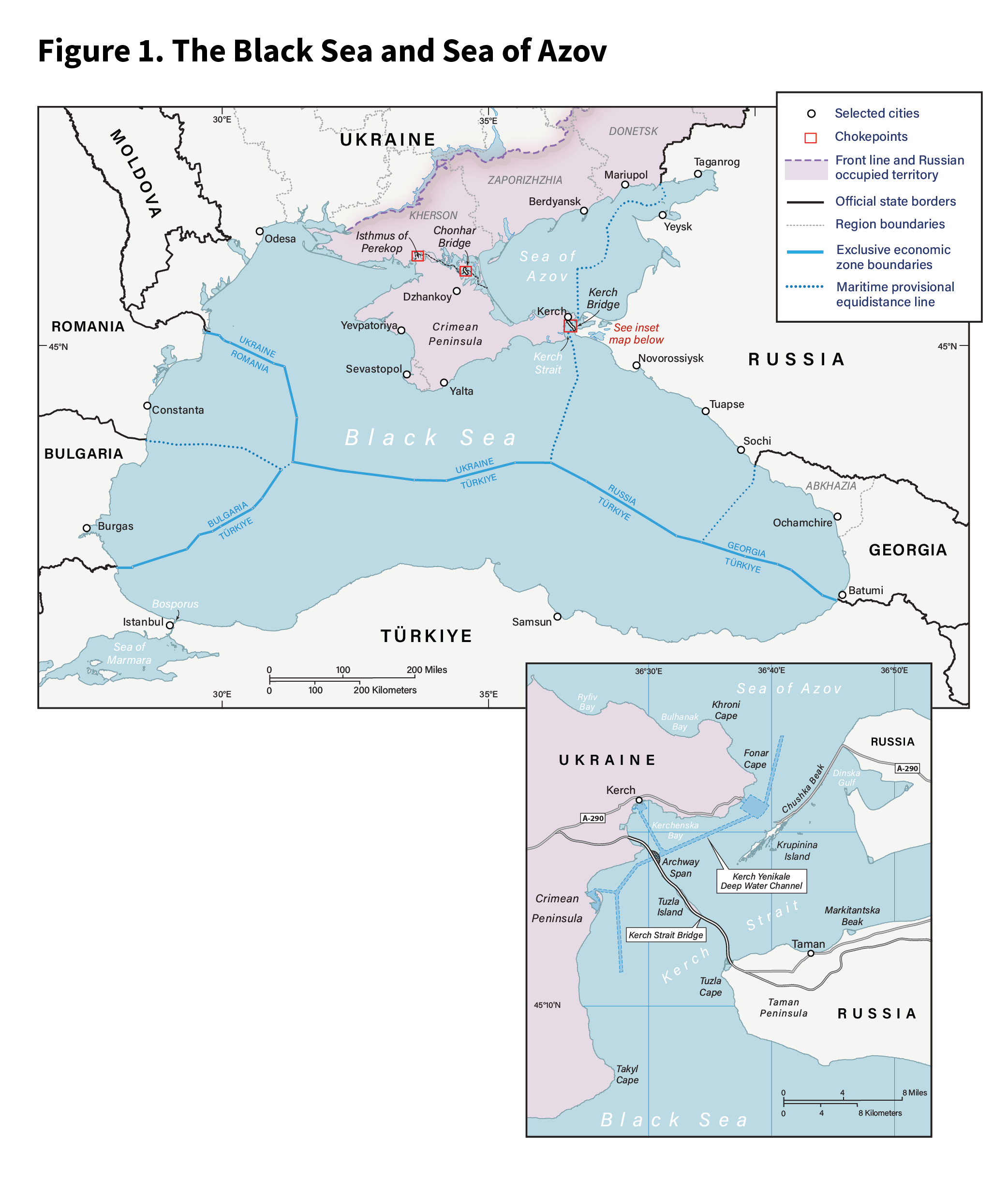
Yet these defenses have proven increasingly vulnerable. Ukraine’s strikes on the Kerch Bridge between 2022 and 2024 have severely reduced its throughput, making it the weakest link in Russia’s logistical chain. If the bridge were rendered completely inoperable—and if Ukraine managed to disrupt the Perekop and Chonhar routes (see figure 1) as well as maritime supply lines—Crimea would be isolated from mainland Russia. Ukrainian special operations raids and systematic strikes have further exposed gaps in coastal defenses and eroded air-defense coverage, leaving critical infrastructure and fleet assets exposed.
Russia’s naval losses in the Black Sea can be estimated to be 25–75 percent of its capabilities across key domains (see figure 2).12 Moscow is unlikely to fully restore these within the next year. While it will attempt partial recovery, three structural constraints endure: reduced control over the battle space, diminished strike and amphibious capacity, and Crimea’s growing vulnerability as the fleet’s strategic anchor.
For Ukraine and its partners, these dynamics create a window of opportunity to consolidate their maritime advantage. By sustaining pressure on Russia’s logistics and command infrastructure, integrating coalition support, and further exploiting unmanned and distributed naval systems, Kyiv can accelerate its functional defeat at sea. Russia’s inability to adapt to the new paradigm of robotic and asymmetric naval warfare represents not only an operational weakness but also a pathway toward the strategic end state of a Black Sea free from Russian maritime coercion.
Returning to the model of functional defeat as a guiding framework for the near term, the primary objective for Ukraine and its partners in the Black Sea should be the preservation of the current balance of power: one that significantly constrains the Russian navy’s operational freedom and its ability to assert maritime control while protecting transportation routes through Romanian, Bulgarian, and Turkish waters. Given technological advances and the evolving nature of naval conflicts, sustaining this equilibrium is a complex undertaking. It demands not only the maintenance of capable naval forces but also the implementation of an effective counterstrategy requiring the sustained, coordinated efforts of Ukraine and its allies.
Ukraine’s maritime successes and innovations are laying the groundwork for Russia’s long-term functional defeat in the maritime domain by severely restricting the ability of its navy to exercise control in the Black Sea—and potentially by creating the conditions for a fundamental limitation of its naval presence there altogether. There is a historical precedent: The 1856 Treaty of Paris, which concluded the Crimean War, effectively demilitarized the Black Sea, ensuring that no major power could exercise unilateral control over it. For a time, this arrangement reduced the risk of conflict and fostered regional stability. A modern equivalent, brokered with the participation of a coalition of Ukraine, other Black Sea states, and extra-regional partners, could provide enduring security guarantees and curb Russia’s maritime ambitions. Such an arrangement may seem overly ambitious at present, but sustained focus by Kyiv and its partners and cumulative pressure on Moscow could unlock pathways once deemed implausible.
International sanctions can contribute significantly to undermining Russia’s ability to sustain its naval forces and infrastructure.
Economic pressure should be a key element of any strategy to constrain Russia’s naval capabilities in the Black Sea. As these are expensive to build, operate, and maintain, budgetary constraints become a critical vulnerability for Moscow. International sanctions can contribute significantly to undermining its ability to sustain its naval forces and infrastructure. For example, a 2025 study found that Russian naval operational readiness in the Black Sea had dropped by over 40 percent since early 2022 due to a lack of repair capacity, loss of spare parts, and reliance on outdated vessels.13 Western sanctions targeting the shipping and insurance sectors caused a 27 percent decline in the transit of Russian maritime cargo volume through sanctioned ports in 2023–2024.14 And Russia’s shipbuilding output fell by approximately 35 percent between 2022 and 2024, primarily due to its loss of access to European and Asian components, including propulsion systems, navigation electronics, and dual-use microchips.15
The Black Sea remains a front line and a fault line where NATO, the EU, and powers in the region face the challenge of shaping a security order under conditions of ongoing war. While the five littoral states other than Russia share a broad interest in maritime stability, their policies differ according to national priorities and alliance obligations.
The EU’s first Black Sea Strategy, issued in May 2025—fleshing out this regional dimension of its broader Maritime Security Strategy—is the first comprehensive framework that explicitly acknowledges the Black Sea as a region of heightened geopolitical contestation. It was a response to Russia’s full-scale invasion of Ukraine, its blockade of Ukrainian ports, and the growing risk to energy and data infrastructure in the basin.16 The strategy places stronger emphasis on three interlinked priorities. First, the protection of critical infrastructure—grain ports in the Danube Delta, energy facilities in Bulgaria and Romania, and underwater pipelines and cables—was elevated to a strategic task. Second, the EU committed to deeper operational complementarity with NATO in the Black Sea. While NATO retains primacy in collective defense there, the EU is positioning itself as the primary actor for resilience, maritime domain awareness, and hybrid threat response. Third, the Black Sea Strategy identifies new paths to integrate Ukraine into the EU’s security architecture; for example, extending maritime surveillance, information-sharing platforms, and naval training initiatives to Ukraine makes it a de facto participant in the EU’s regional security planning.
But the EU’s Black Sea strategy, while important, has its shortcomings. It rightly emphasizes resilience, maritime domain awareness, critical infrastructure protection, and economic connectivity. Yet none of these measures will deliver durable security so long as Russia retains a Black Sea Fleet capable of threatening Ukraine or other littoral states. Monitoring systems, diversified trade routes, and resilience mechanisms are necessary, but they are stopgaps. The strategy also is not well tailored to Russia’s hybrid naval warfare and use of a “shadow fleet.” Moreover, the EU is constrained by structural limitations. It pledged to establish a Black Sea Maritime Security Hub to facilitate monitoring and information-sharing, but it stopped short of establishing a permanent maritime security mission in the Black Sea, preferring to rely on member states’ voluntary contributions and NATO’s forward presence. This leaves gaps in deterrence, particularly given Türkiye’s control of the Bosporus and Dardanelles Straits and its balancing between NATO and Russia.
For its part, NATO’s new Maritime Strategy, issued in October 2025, fails to acknowledge actual threats in the region.17 It refers to the Black Sea only once—among a list of broader challenges—without addressing specific security gaps or defining NATO’s position and, more importantly, its actions in a region where members and partners are acutely affected by the absence of collective security.
Any successful Black Sea strategy will need to include Türkiye. Traditionally, it was the only regional actor capable of constraining Russia’s dominance in the Black Sea. But its careful calibration between Ukraine and Europe, on the one hand, and Moscow, on the other, has made it more of a regional stabilizer than a security provider. At the same time, Türkiye’s relative influence has diminished as Ukraine shapes the Black Sea environment through hard power and asymmetric maritime successes.
For Ukraine, Türkiye has been an invaluable security partner since the start of the full-scale invasion. Its defense company Baykar was one of the first foreign companies to establish a joint venture with Ukraine, enabling production and maintenance of Bayraktar TB2 unmanned aerial vehicles (UAVs), with plans to produce TB3 systems. At the same time, Türkiye continues an ambitious modernization of its naval forces, having commissioned four Ada-class corvettes and two more under construction. The flagship aircraft carrier TCG Anadolu, commissioned in 2023, is envisaged to function as the world’s first drone carrier, capable of deploying Bayraktar TB3 strike UAVs—an innovation that positions Türkiye as a technological leader in the region.
In 2022, Ankara invoked the Montreux Convention to close the Bosporus and Dardanelles Straits to warships of the belligerents, a step rooted in its long-standing commitment to preserving the credibility of the convention and its role as a neutral gatekeeper. This decision subsequently enabled Türkiye’s broader balancing posture by constraining Russian naval reinforcement while limiting the expansion of NATO’s naval presence in the Black Sea. Yet this balancing remains ambiguous: Türkiye maintains intensive economic ties with Russia, has avoided comprehensive enforcement of Western sanctions on it, and refrains from clear political alignment in the war.
Türkiye’s location, naval modernization, and regional ambitions ensure that it will remain a pivotal actor in the Black Sea. But future regional stability is likely to depend on a more distributed framework that is anchored by Ukraine’s deterrent capabilities, strengthened cooperation among smaller littoral states, and recalibrated Turkish engagement within NATO and with the EU.
Achieving the strategic end state in the Black Sea of removing Russia’s capacity to project power and establishing a stable maritime order there requires a multilayered approach that merges technological innovation, operational adaptation, and political consolidation. The core determinant will be Ukraine’s ability, backed by its partners, to sustain and expand the asymmetric advantages it has created, embedding them within a resilient Euro-Atlantic security framework.
The technological domain is the first priority. Ukraine’s breakthroughs in unmanned and robotic maritime warfare must be scaled up dramatically. Production of surface and underwater drones should focus on greater range, autonomy, and precision, while integrating artificial intelligence for navigation and target acquisition in contested electronic environments. Ukraine’s ability to combine swarms of naval drones with UAVs into synchronized strike packages has already transformed the operational environment and should become the doctrinal standard. Parallel investment in long-range strike systems must ensure flexible launch options across air, land, and sea platforms. Equally critical is sustained investment in maritime domain awareness; satellites, coastal radars, passive sensors, and reconnaissance buoys must feed into an integrated NATO–EU information architecture that enables network-centric operations.
Operationally, Ukraine’s task is not to destroy the Russian Black Sea Fleet in a set-piece battle, but to deny it operational freedom at sea. This requires continuous asymmetric pressure against high-value targets, logistical choke points, and supply lines into occupied Crimea, around Novorossiysk, and around the new port Russia is constructing in Ochamchire, in the occupied Abkhazia region of Georgia. Techniques will include unmanned interdiction, mining, and precision strikes, reinforced by non-kinetic measures such as legal challenges and commercial restrictions on Russian shipping. At the same time, Ukraine must reinforce the protection of its maritime infrastructure—grain ports, energy terminals, undersea cables—through layered air and missile defense, rapid-reaction naval units, and enhanced underwater counter-sabotage capabilities.
Ukraine’s task is not to destroy the Russian Black Sea Fleet in a set-piece battle, but to deny it operational freedom at sea.
The political and coalition dimension is equally important. The Maritime Capability Coalition, co-led by Norway and the United Kingdom, should be formalized under NATO–EU frameworks as a standing Black Sea security mechanism for joint exercises, capability development, and coordinated deterrence. In addition, Bulgaria, Romania, and Türkiye should expand the Mine Counter Measures Black Sea Task Group that they stood up to include protection of trade routes and energy facilities from Russian attacks, as Romania’s defense minister alluded to last year.18 Engagement with Türkiye and with ambivalent actors such as Georgia should be directed at reducing their economic interlinkages with Russia as well as with China.
Legal and economic tools can act as force multipliers. Sanctions must extend beyond individual and defense-linked entities to cover Russia’s shipbuilding sector, port operators, insurers, and “shadow fleet” facilitators. Coordinated EU–G7 measures to block investment in Russian-controlled port projects—particularly the Ochamchire facility—will constrain Moscow’s long-term maritime options. In parallel, Ukraine and its partners must accelerate the development of alternative trade corridors through Bulgaria, Romania, and Türkiye, supported by EU financing, insurance guarantees, and security arrangements. Stricter vessel registry monitoring and denial of port access will close loopholes that allow Russia’s “shadow fleet” to circumvent restrictions, further eroding Moscow’s maritime mobility.
The convergence of technological superiority in unmanned warfare, an operational model built on denial and disruption, institutionalized maritime coalitions, and comprehensive economic and legal pressure provides a viable pathway toward the strategic end state of removing Russia’s capacity to project power and establishing a stable maritime order in the Black Sea. It is not a matter of merely resisting Russian coercion but of an order in which Moscow’s naval presence is structurally constrained, freedom of navigation is guaranteed, and the region is anchored in a resilient, cooperative Euro-Atlantic security architecture.
Alina Frolova
Deputy Chairperson, Centre for Defence Strategies in Kyiv
Alina Frolova is deputy chairperson of the Centre for Defence Strategies in Kyiv. She served as deputy minister of defense of Ukraine from 2019 to 2020. Frolova is the coordinator of the Security Track in the International Crimea Platform Expert Network.
Stepan Yakymiak
Captain (ret.), Ukrainian Navy; Expert, Centre for Defence Strategies in Kyiv
Stepan Yakymiak, captain (ret.) in the Ukrainian Navy, is an expert at the Centre for Defence Strategies in Kyiv. He formerly served as adviser to the commander of the Maritime Task Force of the Defense Forces of Ukraine in the Russo-Ukrainian War (2022) and as head of the Naval Forces Department of the National Defense University of Ukraine (2014–2024). Captain Yakymiak holds a PhD in military science and is a member of the Security Track in the International Crimea Platform Expert Network.
Carnegie does not take institutional positions on public policy issues; the views represented herein are those of the author(s) and do not necessarily reflect the views of Carnegie, its staff, or its trustees.
Beijing is trying to navigate the overall situation regarding Ukraine, especially the substance of interactions between Washington and Moscow.



Ellen Nakashima, Zhao Long, Pavlo Klimkin, …
“It’s not so clear how we’re going to get out of this.”

Paul Haenle, Philippe Le Corre
The war in Ukraine is increasing Beijing’s concern about Washington’s intentions.

Paul Haenle, Tong Zhao
Beijing believes its contradictory approach best protects its interests.
Paul Haenle, Sam Bresnick

It’s about managing oil prices, bread prices, and strategic partnerships.



Amr Hamzawy, Karim Sadjadpour, Aaron David Miller, …