Source: Al-Hayat
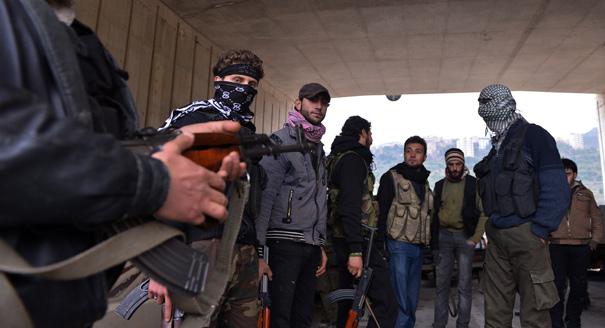
The fall of Idlib city and nearby Jisr al-Shughur to Syria’s rebels in the northwest of the country and their gains around Daraa in the south in recent weeks are commonly viewed as the outcome of a marked improvement in relations and direct coordination between their main regional backers Turkey, Saudi Arabia, and Qatar. In this view, these powers seek to shift the military balance against the Assad regime ahead of a nuclear deal between the P5+1 and Iran, which could open the way to strike a separate bargain with Iran over Syria. But the regime may be too strapped militarily and economically and too brittle politically to survive a bargain.
The rebels have not yet overturned the strategic balance, and still face a hard struggle before they might do so. Certainly, their performance has benefitted very considerably from significant improvements in their coordination, battle management, and unity of purpose. They are likely to clear remaining regime pockets in Idlib province and take an even bigger prize—Daraa city—while threatening the regime’s corridor to its garrison in Aleppo city and inching closer to Hama and Homs. But the rebels are not strong enough to break the regime, which reportedly trained 2,500-3,000 officers in 2014 alone and continues to receive enough military assistance from Russia and Iran to slow and possibly stop, though no longer reverse, further rebel advances in the immediate future.
However, the Assad regime has reached the peak of its ability to mobilize further resources to prosecute the war. Its attempt to encircle Aleppo since late 2014 has stalled, and its forces have been engaged in “fire-fighting” mode in the face of constant pressure from the rebels or the Islamic State to the east of Hama and Homs provinces and in the Damascus region. The fact that prior to their fall to the rebels, both Idlib city and Jisr al-Shughur were manned exclusively by Syrian army troops and loyalist militiamen—rather than Hezbullah, Iranian, or Iraqi fighters—suggests that their will to fight is declining.
Most significantly, the regime’s fundamental failure to engage in meaningful political dialogue with anyone inside or outside Syria to resolve the conflict or to address grievances among its own support base by moderating massive corruption in its ranks and cronyism in its award of public contracts leaves it with no prospect of recovering politically, economically, or militarily. State institutions have hollowed to an unprecedented degree, the devaluation of the Syrian Pound appears to be out of control, and reports of assassinations and ambushes of middle ranking army and security officers in the coastal province suggest that factional rivalries and political rifts within the regime camp may be deepening.
The regime looks increasingly brittle. This has major implications for what might follow a nuclear deal with Iran, and indeed for what may follow if a deal is not reached. Conventional wisdom is that Iran—at least if it can find common ground with Russia—has the ability both to pressure the regime to make genuine concessions and to compel its regional rivals to accept a compromise that leaves Assad in office. But how much leverage does Iran (even if backed by Russia) actually have over the Assad regime to concede a deal it does not like? And given the severe decline of regime cohesion and resources, how far can Iran (and Russia) push the regime without breaking it?
Iran and Russia cannot stem the regime’s ebb. There is little more they can do that they have not already done to shore it up short of a major military deployment, but this would come at even greater cost to them, deepen the domestic legitimacy crisis of the regime, and accelerate the institutional collapse of the Syrian state. Under these conditions, failure to reach a nuclear deal with Iran is not likely to alter the picture. Indeed, the tables may even turn on Iran and Russia: they may actually need the leverage and resources that their regional rivals can bring to Syria, in the hope of preserving key state institutions including the army, while accepting that they can no longer protect the regime or its head.
The rebels still cannot win, but for the first time since the start of the Syrian conflict, the regime can lose. However, this is not yet an imminent prospect. For now, it can re-establish a military equilibrium by contracting territorially to more stable frontlines, while reducing state services further and squeezing yet more income from the population in order to concentrate its resources more narrowly on regime maintenance. This will allow it to fight back and its main external backers to lobby hard on its behalf over the medium term.
But should the regime be forced to cede significant powers in the context of a regional bargain, it could crumble as the intricate networks on which it has maintained itself so far unravel and realign. All external actors should anticipate what could become a rapidly evolving situation on the ground with well-prepared emergency responses and carefully targeted interventions. The recent proposal to build a Syrian National Stabilization Force that could provide law and order in a transition is a good example of such thinking. Other critical political, administrative, and financial priorities should also be identified and addressed in similar fashion.
While the regional powers position themselves and their local allies in Syria ahead of a possible nuclear deal with Iran, they should allocate a growing part of their attention and resources to planning for what may come after.
This article was originally published in Arabic by Al-Hayat.