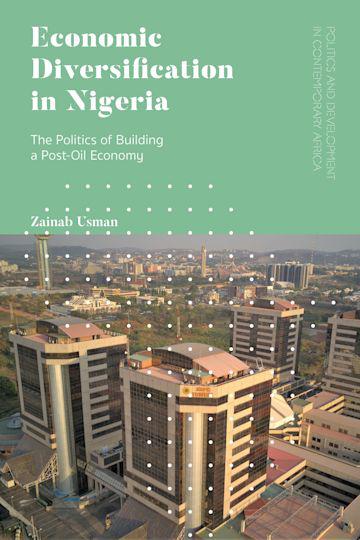
Economic Diversification in Nigeria: The Politics of Building a Post-Oil Economy
Nigeria’s major development challenge is not the ‘oil curse’, but of achieving economic diversification beyond its dependence on oil revenues, and politics plays an important role in the policy choices that have created and exacerbated this challenge.
Nigeria has for long been regarded as the poster child for the ‘curse’ of oil wealth. Yet despite this, Nigeria achieved strong economic growth for over a decade in the 21st century, driven largely by policy reforms in non-oil sectors. This open access book argues that Nigeria’s major development challenge is not the ‘oil curse’, but rather one of achieving economic diversification beyond oil, subsistence agriculture, informal activities, and across its subnational entities. Through analysis drawing on economic data, policy documents, and interviews, Usman argues that Nigeria’s challenge of economic diversification is situated within the political setting of an unstable distribution of power among individual, group, and institutional actors.
Since the turn of the century, policymaking by successive Nigerian governments has, despite superficial partisan differences, been oriented towards short-term crisis management of macroeconomic stabilization, restoring growth and selective public sector reforms. To diversify Nigeria’s economy, this book argues that successive governments must reorient towards a consistent focus on pro-productivity and pro-poor policies, alongside comprehensive civil service and security sector overhaul. These policy priorities, Nigeria’s ruling elites are belatedly acknowledging, are crucial to achieving economic transformation; a policy shift that requires a confrontation with the roots of perpetual political crisis, and an attempt to stabilize the balance of power towards equity and inclusion.
Advance Praise
“This book ably demonstrates that what is seemingly absurd and contradictory about Nigeria has to be traded carefully with the results an investigative and inquisitive mind may find. In a country of paradoxes only a few can offer us plausible and documented explanations as to why you can be the largest oil producer or economy of an entire continent and fail to convincingly diversify its economy. An exciting read for all those struggling to explain structural transformation slow pace in Africa”
—Carlos Lopes, Professor, Nelson Mandela School of Public Governance, University of Cape Town, South Africa
“Grounded in rich data, careful reflections, and an understanding of economic forces, this is the first book in two decades to offer a comprehensive understanding of the Nigerian postcolonial economy. It identifies the critical challenges against the background of available resources and opportunities, successes and failures, and the political forces that have disabled the creation of a diversified economy. Zainab Usman successfully argues that the wealth from oil and culture are not at the root of the country’s slow development, rather it is that the politics and institutions are unconducive to creating a resilient, multi-faceted economy. Its recommendations on policies are viable and can be transformational”
—Toyin Falola, The Jacob and Frances Sanger Mossiker Chair in the Humanities, the University of Texas at Austin, USA
“This fantastic book is a must-read for anyone interested in how an economy can diversify. It is sobering about the failures, and motivating about the successes of governments in Nigeria. In Kano State a lack of a clear well-aligned vision and unified capacity to implement led to failure. But in Lagos State a clear vision and investments in administrative capacity successfully diversified revenue. This book is well-written and hearteningly positive about how governments can better create conditions for economic success.”
—Professor Ngaire Woods, Dean of the Blavatnik School of Government, University of Oxford, UK
“A highly readable and very compelling analysis of how the fragmentation of power and politics in Nigeria have held back its development and, more importantly, what can be done about it. A must read for anyone interested in development and Nigeria”
—Mushtaq Khan, Professor of Economics, SOAS University of London, UK
“This scholarly work by a brilliant young Nigerian explores the impact of natural resource endowment on the people and politics of Africa’s most populous nation. The author leaves us in no doubt that Nigeria’s ruling elite have failed to deliver the dividends of economic development to its citizens, but goes beyond the typical blame game to proffer 5 building blocks which Nigeria should pursue in order to address the challenge of economic transformation. My wish is that sooner than later Zainab finds herself in a position of power and influence where she can contribute to changing the trajectory of Nigeria’s growth and progress.”
—Aigboje Aig-Imoukhuede, Former Group Managing Director and Chief Executive Officer of Access Bank Plc, Nigeria
Carnegie does not take institutional positions on public policy issues; the views represented herein are those of the author(s) and do not necessarily reflect the views of Carnegie, its staff, or its trustees.
The paradox of the European Commission’s decision is that the main victims will not be those it formally targets. Major Russian businesses associated with the Putin regime have long adapted to sanctions with the help of complex schemes involving third countries, offshore companies, and nonpublic entities.
A new book by Alexandra Prokopenko looks at why the Russian ruling class became the regime’s willing servants—and how they might fare in a post-Putin world.
The volume of frozen private assets might seem insignificant compared with Russia’s sovereign reserves, but these are the savings of millions of people who believed that foreign securities were a safe investment and in the institution of private property.
International compliance and anti-money laundering standards are currently formulated in such a way that the Western financial system does not differentiate between Russian political prisoners and ISIS militants.
Caught between problems at home and in the West, Forbes list Russians are resorting to a variety of survival strategies. The end result will be the disappearance of oligarchs from Russia once and for all.