

Commentary
Judy Dempsey
{
  "authors": [
    "Judy Dempsey"
  ],
  "type": "legacyinthemedia",
  "centerAffiliationAll": "",
  "centers": [
    "Carnegie Endowment for International Peace",
    "Carnegie Europe"
  ],
  "collections": [],
  "englishNewsletterAll": "",
  "nonEnglishNewsletterAll": "",
  "primaryCenter": "Carnegie Europe",
  "programAffiliation": "",
  "programs": [],
  "projects": [],
  "regions": [
    "Middle East",
    "Russia"
  ],
  "topics": []
}
Source: Getty
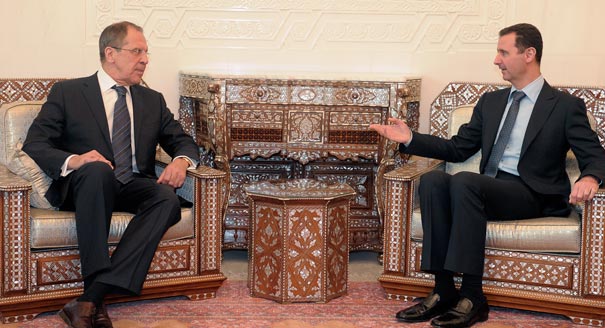
At the annual security conference in Munich, Russia’s foreign minister stunned the conference by saying that Moscow was not on the side of President Bashar al-Assad.
Source: New York Times

Hardly a word.
This was despite the presence of U.S. Secretary of State Hillary Rodham Clinton, who was expected this weekend to try to persuade her Russian counterpart, Sergey Lavrov, to support more sanctions against the Islamic Republic, but behind the scenes.
But what hit the top of the agenda here was Syria.
In her speech to the conference, Mrs. Clinton said she was trying to win wide support from the international community for the U.N. proposal, initiated by the Arab League, to end the violent crackdown by President Bashar al-Assad’s security forces and arrange a transition of power.Hours later, Russia and China vetoed that proposal. But before that happened, Mr. Lavrov delivered a rather polemical speech. The question and answer period was dominated by Syria.
Why, asked participants, wouldn’t Russia support the Arab League proposals? Why was Russia still supplying arms to the Syrian regime? Why was Russia supporting President Assad?
Mr. Lavrov took the questions in his stride. The veteran diplomat said from early on Russia had supported calls by the Syrian people for change.
But while it was all very well to ask the security forces to stop the violence and return to their barracks, he said, what about asking the armed groups who were causing mayhem to disarm? They were not being criticized at all, Mr. Lavrov said.
As for Russia supporting the Assad regime, Mr. Lavrov denied that. “We are not friends or allies of Assad,” he said — despite Moscow’s decades-long political and military support of Damascus.
“Whether we sold weapons to Syria did not change the balance in the Middle East. Whatever we sell to Syria does not affect the international balance,” Mr. Lavrov said.
Senator John McCain was having none of it. “It’s time to stop the talking. It’s time to demand Assad’s departure, and now,” he said. The audience applauded.
After the Russian and Chinese veto, Mrs. Clinton held a press conference. She said she had spoken to Mr. Lavrov.
Then, she asked, “Are we going to be complicit in the violence and bloodshed in Syria?”
Reports circulated Saturday night that Mr. Lavrov would head to Damascus next week for talks.

Nonresident Senior Fellow, Carnegie Europe
Judy Dempsey is a nonresident senior fellow at Carnegie Europe
Recent Work
Judy Dempsey
Judy Dempsey
Carnegie does not take institutional positions on public policy issues; the views represented herein are those of the author(s) and do not necessarily reflect the views of Carnegie, its staff, or its trustees.

A summer of escalation in the Black Sea has hurt Ukraine economically and is exacerbating world food security. A truce is needed—as is a broader reframing of Europe’s Ukraine strategy.

Thomas de Waal

European Commission President Ursula von der Leyen is about to give her annual address on the state of the EU. Here’s what she won’t—but should—say.

Rym Momtaz

The EU’s responses to two recent incidents expose the gulf between European perceptions and capabilities. Unless the union can bridge that gap, it will never become a real geostrategic power.
Rym Momtaz

European states control several Overseas Countries and Territories around the world that carry strategic, economic, and environmental weight. As great powers challenge the rules-based order, defending them is a geopolitical imperative for Europe.

Marc Pierini

In supporting Europe’s far-right, MAGA and Russia both want the same thing: a weaker EU. Europe must defend itself without abandoning the openness these forces exploit.

Armida van Rij