

{
  "authors": [
    "Christophe Jaffrelot",
    "Milan Vaishnav"
  ],
  "type": "event",
  "centerAffiliationAll": "dc",
  "centers": [
    "Carnegie Endowment for International Peace"
  ],
  "collections": [],
  "englishNewsletterAll": "ctw",
  "nonEnglishNewsletterAll": "",
  "primaryCenter": "Carnegie Endowment for International Peace",
  "programAffiliation": "SAP",
  "programs": [
    "South Asia"
  ],
  "projects": [],
  "regions": [
    "South Asia",
    "India"
  ],
  "topics": [
    "Political Reform",
    "Economy",
    "Security",
    "Foreign Policy"
  ]
}
Modi’s Transformative Moment?
Fri, October 17th, 2014
Washington, DC
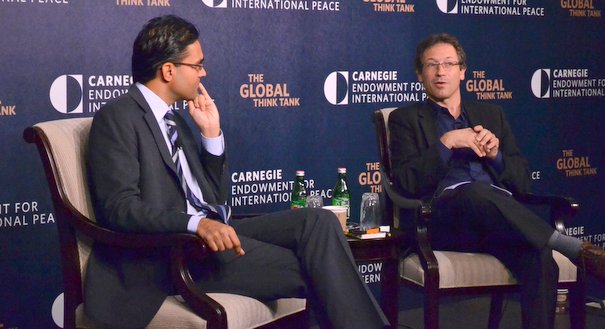
The first one hundred days of a new government can be tumultuous as power shifts hands and leaders make dramatic decisions, as evidenced by then Indian prime minister Vajpayee’s nuclear test soon after he assumed office in 1998. But Prime Minister Narendra Modi has thus far proceeded in a more nuanced fashion, making an assessment of his first four months in office more complicated.
Has continuity prevailed in India’s economic and foreign policies? Or does the new budget, new developmental initiatives, and recent summits with leaders of Japan, China, and the United States reflect a fundamentally new dispensation? Has change come about through Modi’s leadership, or through larger shifts in India’s social and institutional landscape? Christophe Jaffrelot and Milan Vaishnav discussed Modi’s first few months in office and what it could mean for India.
The Carnegie Endowment for International Peace is grateful for the support of the Indian Council for Cultural Relations in making this event possible.
Christophe Jaffrelot
Christophe Jaffrelot is a nonresident scholar in the South Asia Program at the Carnegie Endowment for International Peace, a senior research fellow at the Center for International Studies and Research (CERI) at Sciences Po in Paris, professor of Indian politics and sociology at King’s India Institute, London, and a global scholar at Princeton University. He is one of the world’s leading experts on Indian domestic politics and society.
Milan Vaishnav
Milan Vaishnav is an associate in Carnegie’s South Asia Program, where he directs Carnegie’s “India Decides 2014” initiative. His primary research focus is the political economy of India.
Carnegie India does not take institutional positions on public policy issues; the views represented herein are those of the author(s) and do not necessarily reflect the views of Carnegie, its staff, or its trustees.
Event Speakers
Former Nonresident Scholar, South Asia Program
Jaffrelot’s core research focuses on theories of nationalism and democracy, mobilization of the lower castes and Dalits (ex-untouchables) in India, the Hindu nationalist movement, and ethnic conflicts in Pakistan.
Director and Senior Fellow, South Asia Program

Milan Vaishnav is a senior fellow and director of the South Asia Program and the host of the Grand Tamasha podcast at the Carnegie Endowment for International Peace. His primary research focus is the political economy of India, and he examines issues such as corruption and governance, state capacity, distributive politics, and electoral behavior. He also conducts research on the Indian diaspora.