

In The Media
Michele Dunne, Robert Kagan
{
  "authors": [
    "Robert Kagan"
  ],
  "type": "legacyinthemedia",
  "centerAffiliationAll": "",
  "centers": [
    "Carnegie Endowment for International Peace"
  ],
  "collections": [],
  "englishNewsletterAll": "",
  "nonEnglishNewsletterAll": "",
  "primaryCenter": "Carnegie Endowment for International Peace",
  "programAffiliation": "",
  "programs": [],
  "projects": [],
  "regions": [
    "Middle East",
    "Iraq"
  ],
  "topics": [
    "Foreign Policy"
  ]
}
REQUIRED IMAGE
Source: The Washington Post
Twenty-nine Democratic senators voted in the fall of 2002 to authorize the invasion of Iraq. There isn't enough room on this page to list the Democratic foreign policy experts and former officials, including those from the top ranks of the Clinton administration, who supported the war publicly and privately -- some of whom even signed letters calling for the removal of Saddam Hussein. Nor is there any need to list the many liberal, and conservative, columnists on this and other editorial pages around the country who supported the war, or the many prominent journalists who provided the reporting that helped convince so many that the war was necessary.
The question of the day is, what makes Joe Lieberman different? What makes him now anathema to a Democratic Party and to liberal columnists who once supported both him and the war? Why is there now a chance he will lose the Democratic primary in Connecticut after so many years of faithfully serving that state and his own party?
It will not be because he is a bad Democrat. As others have pointed out, on the broadest range of social, economic and even foreign policy issues he has been a stalwart member of his party. Indeed, the questioning of his Democratic credentials is absurd given that he was, after all, the party's candidate for vice president in 2000.
It will not be because he is a hawk. Lest anyone forget, Lieberman was put on the 2000 ticket partly because he was a foreign policy and defense hawk, and most emphatically on the question of Iraq. In the 1990s he was the leading sponsor of a Senate resolution, which eventually passed with 98 votes, to provide money to Iraqis for the express purpose of overthrowing Hussein. This was what made him attractive to Democrats in 2000. It made him a fitting companion to that other hawk on the ticket, Al Gore. For remember, Gore, too, had gained the nomination as a relative hard-liner on foreign policy, including policy on Iraq.
If Lieberman loses, it will not even be because he supported the war. Almost every leading Democratic politician and foreign policymaker, and many a liberal columnist, supported the war. Nor will he lose because he opposes withdrawing troops from Iraq this year. Most top Democratic policymakers agree that early withdrawal would be a mistake. Nor, finally, is it because he has been too chummy with President Bush. Lieberman has offered his share of criticism of the administration's handling of the Iraq war and of many other administration policies.
No, Lieberman's sin is of a different order. Lieberman stands condemned today because he didn't recant. He didn't say he was wrong. He didn't turn on his former allies and condemn them. He didn't claim to be the victim of a hoax. He didn't try to pretend that he never supported the war in the first place. He didn't claim to be led into support for the war by a group of writers and intellectuals whom he can now denounce. He didn't go through a public show of agonizing and phony soul-baring and apologizing in the hopes of resuscitating his reputation, as have some noted "public intellectuals."
These have been the chosen tactics of self-preservation ever since events in Iraq started to go badly and the war became unpopular. Prominent intellectuals, both liberal and conservative, have turned on their friends and allies in an effort to avoid opprobrium for a war they publicly supported. Journalists have turned on their fellow journalists in an effort to make them scapegoats for the whole profession. Politicians have twisted themselves into pretzels to explain away their support for the war or, better still, to blame someone else for persuading them to support it.
Al Gore, the one-time Clinton administration hawk, airbrushed that history from his record. He turned on all those with whom he once agreed about Iraq and about many other foreign policy questions. And for this astonishing reversal he has been applauded by his fellow Democrats and may even get the party's nomination.
Apparently, amazingly, dispiritingly, it all works. At least in the short run, dishonesty pays. Dissembling pays. Forgetting your past writings and statements pays. Condemning those with whom you once agreed pays. Phony self-flagellation followed by self-righteous self-congratulation pays. The only thing that doesn't pay is honesty. If Joe Lieberman loses, it will not be because he supported the war or even because he still supports it. It will be because he refused to choose one of the many dishonorable paths open to him to salvage his political career.
He is the last honest man, and he may pay the price for it. At least he will be able to sleep at night. And he can take some solace in knowing that history, at least an honest history, will be kinder to him than was his own party.
Robert Kagan, a senior associate at the Carnegie Endowment for International Peace and transatlantic fellow at the German Marshall Fund, writes a monthly column for The Post.

Former Senior Associate
Kagan, author of the recent book, The Return of History and the End of Dreams (Knopf 2008), writes a monthly column on world affairs for the Washington Post and is a contributing editor at both the Weekly Standard and the New Republic.
Recent Work

Michele Dunne, Robert Kagan
Robert Kagan, Michele Dunne
Carnegie India does not take institutional positions on public policy issues; the views represented herein are those of the author(s) and do not necessarily reflect the views of Carnegie, its staff, or its trustees.

After the chill in ties between 2020 and 2024 that brought India–China relations to their lowest point in several decades, the two countries have engaged each other afresh. This paper argues that there are predominantly four imperatives guiding India’s approach to China, and they exist in an order of priority.

Saheb Singh Chadha

This piece argues that India’s central challenge is not managing a single flashpoint but resolving the underlying tension between expansion and institutional coherency of the BRICS grouping.

Vrinda Sahai

A partnership between India, a country of subcontinental size, and Africa, a continent of fifty-four countries, may seem asymmetric until one notes that both are home to nearly the same number of people—1.4 billion. This essay spells out the existing challenges to the partnership, its optimal potential, and the possible pathways to realize it over the next quarter-century.

Rajiv Bhatia

The India–EU Free Trade Agreement (FTA) is shaping up to be one of the most consequential trade negotiations, both economically and strategically. But, what’s in the agreement, what’s missing, and what will determine its success in the years ahead
Vrinda Sahai, Nicolas Köhler-Suzuki
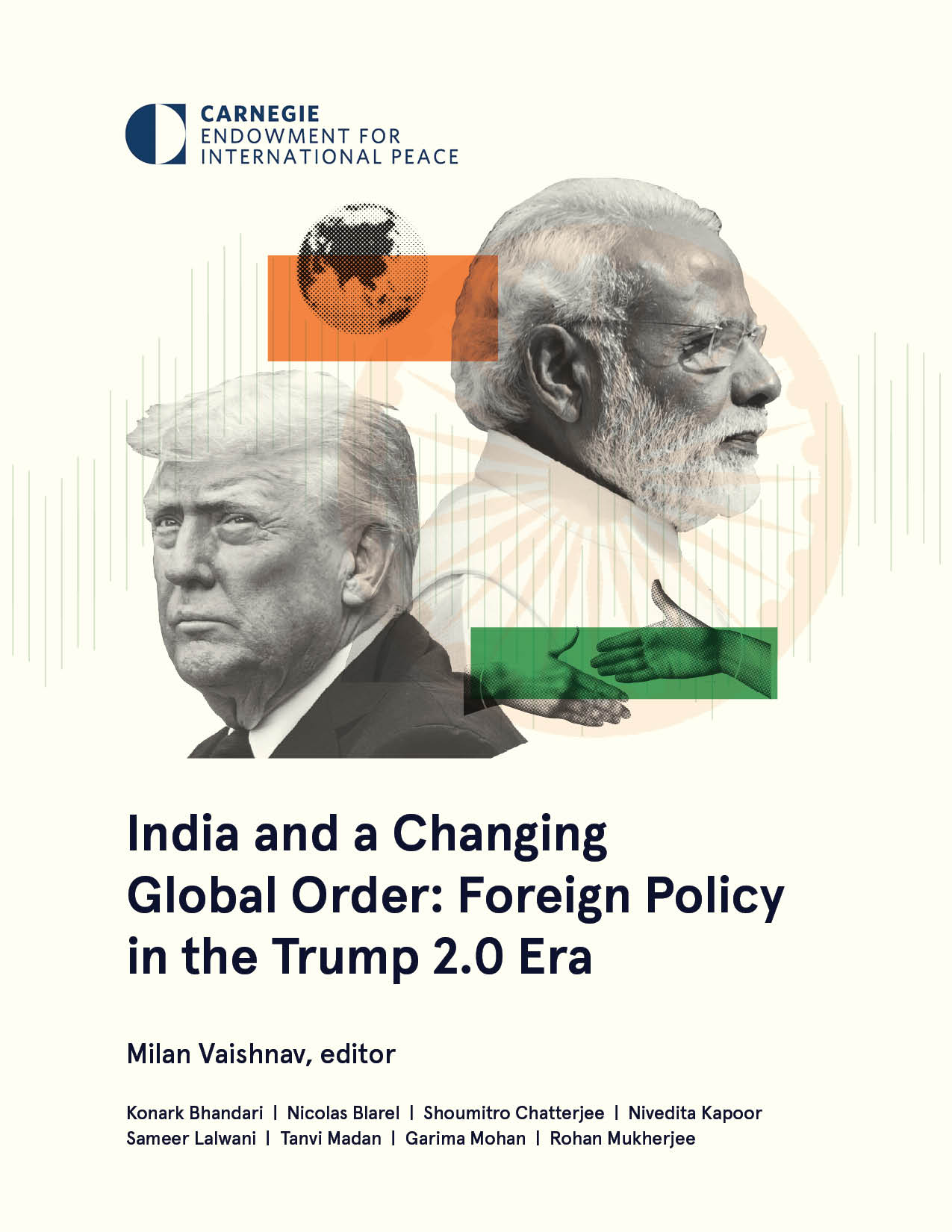
Trump 2.0 has unsettled India’s external environment—but has not overturned its foreign policy strategy, which continues to rely on diversification, hedging, and calibrated partnerships across a fractured order.



Milan Vaishnav, ed., Sameer Lalwani, Tanvi Madan, …