

Paper
Paul Salem
{
  "authors": [
    "Paul Salem"
  ],
  "type": "legacyinthemedia",
  "centerAffiliationAll": "dc",
  "centers": [
    "Carnegie Endowment for International Peace",
    "Malcolm H. Kerr Carnegie Middle East Center"
  ],
  "collections": [],
  "englishNewsletterAll": "democracy",
  "nonEnglishNewsletterAll": "",
  "primaryCenter": "Malcolm H. Kerr Carnegie Middle East Center",
  "programAffiliation": "DCG",
  "programs": [
    "Democracy, Conflict, and Governance",
    "Middle East"
  ],
  "projects": [],
  "regions": [
    "Middle East",
    "Lebanon"
  ],
  "topics": [
    "Political Reform",
    "Democracy",
    "Foreign Policy"
  ]
}
Source: Getty
Recent electoral successes by Islamist parties throughout the Arab world have shown those movements to be viable political opposition to many undemocratic regimes. Most analyses examine those movements only within their individual domestic political environments. Yet equally important is the impact of broader, regional issues on domestic politics and the resulting tensions with ruling regimes. But wars rarely proceed as expected, and no participant in this war got what it had bargained for.
Source: Foreign Affairs

Blind Into Beirut
Hezbollah's July 12 raid into Israel, backed by Iran, was intended to entangle Israel in a limited skirmish on its northern border and a drawn-out prisoner exchange at a time when Iran was facing mounting pressure over its nuclear program. Israel, backed by the United States, responded with a large-scale war meant to deliver a knockout blow to Hezbollah and thereby remove the missile threat to northern Israel, weaken Iran in any upcoming showdown, and eliminate what the United States considers a major opponent in the war on terrorism. Washington also hoped to give a boost to the Lebanese government, which it considered a potential democratic success story.
But wars rarely proceed as expected, and no participant in this war got what it had bargained for. Hezbollah ended up in a full-scale war, in which it won some battlefield victories and popularity in the Arab and Muslim world but which devastated its Lebanese Shiite constituency and narrowed its tactical and political options. Israel, despite unleashing massive airpower on Hezbollah strongholds, failed to knock out the organization or even to stop its missile attacks, while the setbacks suffered by Israel's ground invasion had the effect of puncturing the aura of invincibility long projected by the Israel Defense Forces. Tehran reaped some benefit from Hezbollah's increased popularity and perhaps can point to the organization's robust performance as a warning to those considering military action against Iran, but this war wasted much of the deterrent power that it had vested in Hezbollah for its own hour of need. Meanwhile, the United States looked on helplessly as the crisis drove Arab and Muslim public opinion further against it and weakened an already fragile Lebanon. As is the case with most proxy wars, the highest price was paid by the host country, Lebanon, which found itself the arena of regional and international war. The terrible toll on civilian life, housing, and infrastructure made this one of the most devastating wars in Lebanon's recent history.
Significantly, the crisis was resolved diplomatically rather than militarily, with the passage of United Nations Security Council Resolution 1701 -- a transformative resolution that provides a meaningful basis for moving forward and a framework for new political and security realities in Lebanon and the region. The deployment of the Lebanese army to southern Lebanon with UN troop support has put an end to four decades of control by nonstate actors. Resolution 1701 is an important step toward a stable and sovereign Lebanon. It deserves sustained support and beckons the international community to make renewed efforts to find multilateral diplomatic solutions to other conflicts in the area.
To read full article click on PDF icon above.
Reprinted by permission of FOREIGN AFFAIRS, November/December 2006. Copyright 2006 by the Council on Foreign Relations, Inc.
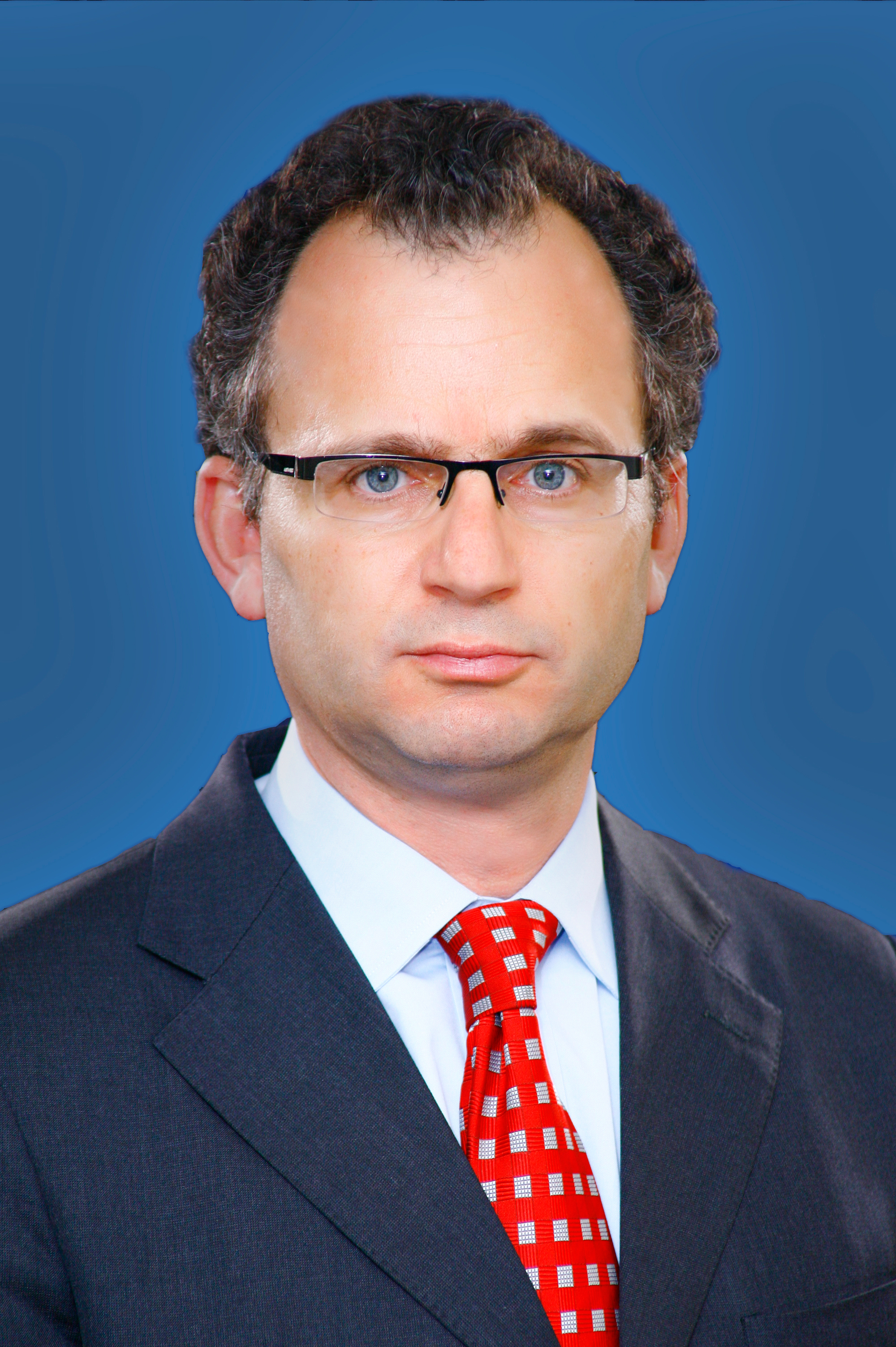
Senior Fellow at the Middle East Institute
Paul Salem is a senior fellow at the Middle East Institute.
Recent Work
Paul Salem
Paul Salem
Carnegie India does not take institutional positions on public policy issues; the views represented herein are those of the author(s) and do not necessarily reflect the views of Carnegie, its staff, or its trustees.

After the chill in ties between 2020 and 2024 that brought India–China relations to their lowest point in several decades, the two countries have engaged each other afresh. This paper argues that there are predominantly four imperatives guiding India’s approach to China, and they exist in an order of priority.

Saheb Singh Chadha

This piece argues that India’s central challenge is not managing a single flashpoint but resolving the underlying tension between expansion and institutional coherency of the BRICS grouping.

Vrinda Sahai

A partnership between India, a country of subcontinental size, and Africa, a continent of fifty-four countries, may seem asymmetric until one notes that both are home to nearly the same number of people—1.4 billion. This essay spells out the existing challenges to the partnership, its optimal potential, and the possible pathways to realize it over the next quarter-century.

Rajiv Bhatia

The India–EU Free Trade Agreement (FTA) is shaping up to be one of the most consequential trade negotiations, both economically and strategically. But, what’s in the agreement, what’s missing, and what will determine its success in the years ahead
Vrinda Sahai, Nicolas Köhler-Suzuki
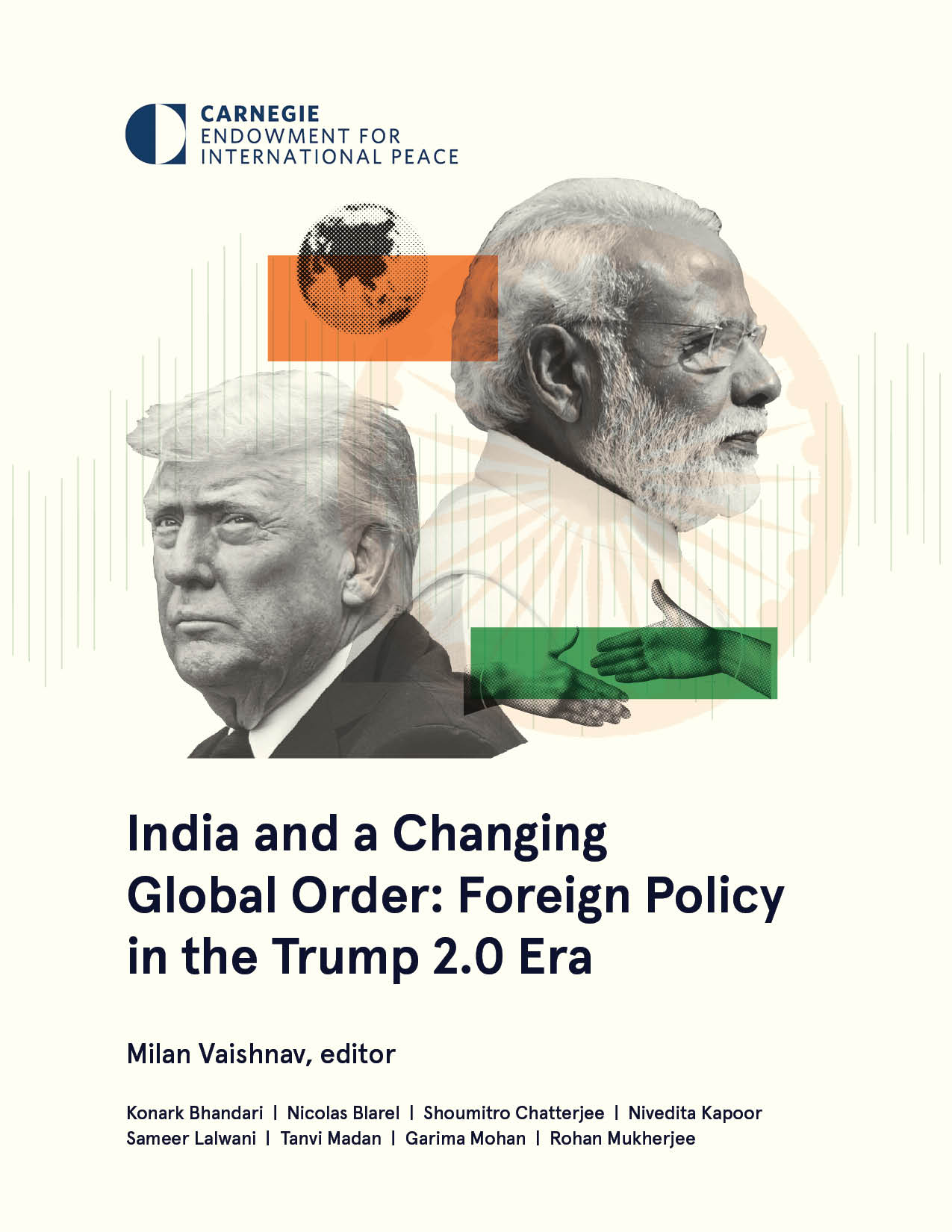
Trump 2.0 has unsettled India’s external environment—but has not overturned its foreign policy strategy, which continues to rely on diversification, hedging, and calibrated partnerships across a fractured order.

Milan Vaishnav, ed., Sameer Lalwani, Tanvi Madan, …