

Paper
Ashley J. Tellis
{
  "authors": [
    "Ashley J. Tellis"
  ],
  "type": "legacyinthemedia",
  "centerAffiliationAll": "dc",
  "centers": [
    "Carnegie Endowment for International Peace"
  ],
  "collections": [],
  "englishNewsletterAll": "asia",
  "nonEnglishNewsletterAll": "",
  "primaryCenter": "Carnegie Endowment for International Peace",
  "programAffiliation": "AP",
  "programs": [
    "Asia"
  ],
  "projects": [],
  "regions": [
    "North America",
    "United States",
    "East Asia",
    "China",
    "Taiwan"
  ],
  "topics": [
    "Security",
    "Military",
    "Foreign Policy"
  ]
}
Source: Getty
On Jan. 11, 2007, a Chinese medium-range ballistic missile slammed into an aging weather satellite in space. The resulting collision not only marked Beijing's first successful anti-satellite (ASAT) test but, in the eyes of many, also a head-on collision with the Bush administration's space policies.
Source: The Wall Street Journal

As one analyst phrased it, U.S. policy has compelled China's leaders to conclude "that only a display of Beijing's power to launch . . . an arms race would bring Washington to the table to hear their concerns." This view, which is widespread in the U.S. and elsewhere, misses the point: China's ASAT demonstration was not a protest against the Bush administration, but rather part of a maturing strategy designed to counter the overall military superiority of the U.S.
Since the end of the Cold War, Chinese strategists have been cognizant of the fact that the U.S. is the only country in the world with the capacity -- and possibly the intention -- to thwart China's rise to great power status. They also recognize that Beijing will be weak militarily for some time to come, yet must be prepared for a possible war with America over Taiwan or, in the longer term, over what Aaron Friedberg once called "the struggle for mastery in Asia." How the weaker can defeat the stronger, therefore, becomes the central problem facing China's military strategy.
Chinese strategists have struggled to find ways of solving this conundrum ever since the dramatic demonstration of American prowess in Operation Desert Storm. And after carefully analyzing U.S. operations in the Persian Gulf, Kosovo and Afghanistan, they believe they have uncovered a significant weakness.
The advanced military might of the U.S. is inordinately dependent on a complex network of space-based command, control, communications, and computer-driven intelligence, surveillance and reconnaissance capabilities that enables American forces to detect different kinds of targets and exchange militarily relevant information. This network is key to the success of American combat operations. These assets, however, are soft and defenseless; while they bestow on the American military definite asymmetric advantages, they are also the source of deep vulnerability. Consequently, Chinese strategists concluded that any effort to defeat the U.S. should aim not at its fundamental strength -- its capacity to deliver overwhelming conventional firepower precisely from long distances -- but rather at its Achilles' heel, namely, its satellites and their related ground installations.
Consistent with this calculus, China has pursued, for over a decade now, a variety of space warfare programs, which include direct attack and directed-energy weapons, electronic attack, and computer-network and ground-attack systems. These efforts are aimed at giving China the capacity to attack U.S. space systems comprehensively because, in Chinese calculations, this represents the best way of "leveling the playing field" in the event of a future conflict.
The importance of space denial for China's operational success implies that its counterspace investments, far from being bargaining chips aimed at creating a peaceful space regime, in fact represent its best hope for prevailing against superior American military power. Because having this capacity is critical to Chinese security, Beijing will not entertain any arms-control regime that requires it to trade away its space-denial capabilities. This would only further accentuate the military advantages of its competitors. For China to do otherwise would be to condemn its armed forces to inevitable defeat in any encounter with American power.
This is why arms-control advocates are wrong even when they are right. Any "weaponization" of space will indeed be costly and especially dangerous to the U.S., which relies heavily on space for military superiority, economic growth and strategic stability. Space arms-control advocates are correct when they emphasize that advanced powers stand to gain disproportionately from any global regime that protects their space assets. Yet they are wrong when they insist that such a regime is attainable and, therefore, ought to be pursued.
Weaker but significant challengers, like China, simply cannot permit the creation of such a space sanctuary because of its deleterious consequences for their particular interests. Consequently, even though a treaty protecting space assets would be beneficial to Washington, its specific costs to Beijing -- in the context of executing China's national military strategy -- would be remarkably high.
Beijing's attitude toward space arms control will change only given a few particular developments. China might acquire the capacity to defeat the U.S. despite America's privileged access to space. Or China's investments in counterspace technology might begin to yield diminishing returns because the U.S. consistently nullifies these capabilities through superior technology and operational practices. Or China's own dependence on space for strategic and economic reasons might intensify to the point where the threat posed by any American offensive counterspace programs exceed the benefits accruing to Beijing's own comparable efforts. Or the risk of conflict between a weaker China and any other superior military power, such as the U.S., disappears entirely.
Since these conditions will not be realized anytime soon, Washington should certainly discuss space security with Beijing, but, for now, it should not expect that negotiation will yield any successful agreements. Instead, the U.S. should accelerate investments in solutions that enhance the security of its space assets, in addition to developing its own offensive counterspace capabilities. These avenues -- as the Bush administration has correctly recognized -- offer the promise of protecting American interests in space and averting more serious threats to its global primacy.
Former Senior Fellow
Ashley J. Tellis was a senior fellow at the Carnegie Endowment for International Peace.
Recent Work
Ashley J. Tellis
Ashley J. Tellis
Carnegie India does not take institutional positions on public policy issues; the views represented herein are those of the author(s) and do not necessarily reflect the views of Carnegie, its staff, or its trustees.

On the last day of the India AI Impact Summit, India signed Pax Silica, a U.S.-led declaration seemingly focused on semiconductors. While India’s accession to the same was not entirely unforeseen, becoming a signatory nation this quickly was not on the cards either.

Konark Bhandari

This piece examines India’s response to U.S. sanctions and tariffs, specifically assessing the immediate market consequences, such as alterations in import costs, and the broader strategic implications for India’s energy security and foreign policy orientation.

Vrinda Sahai
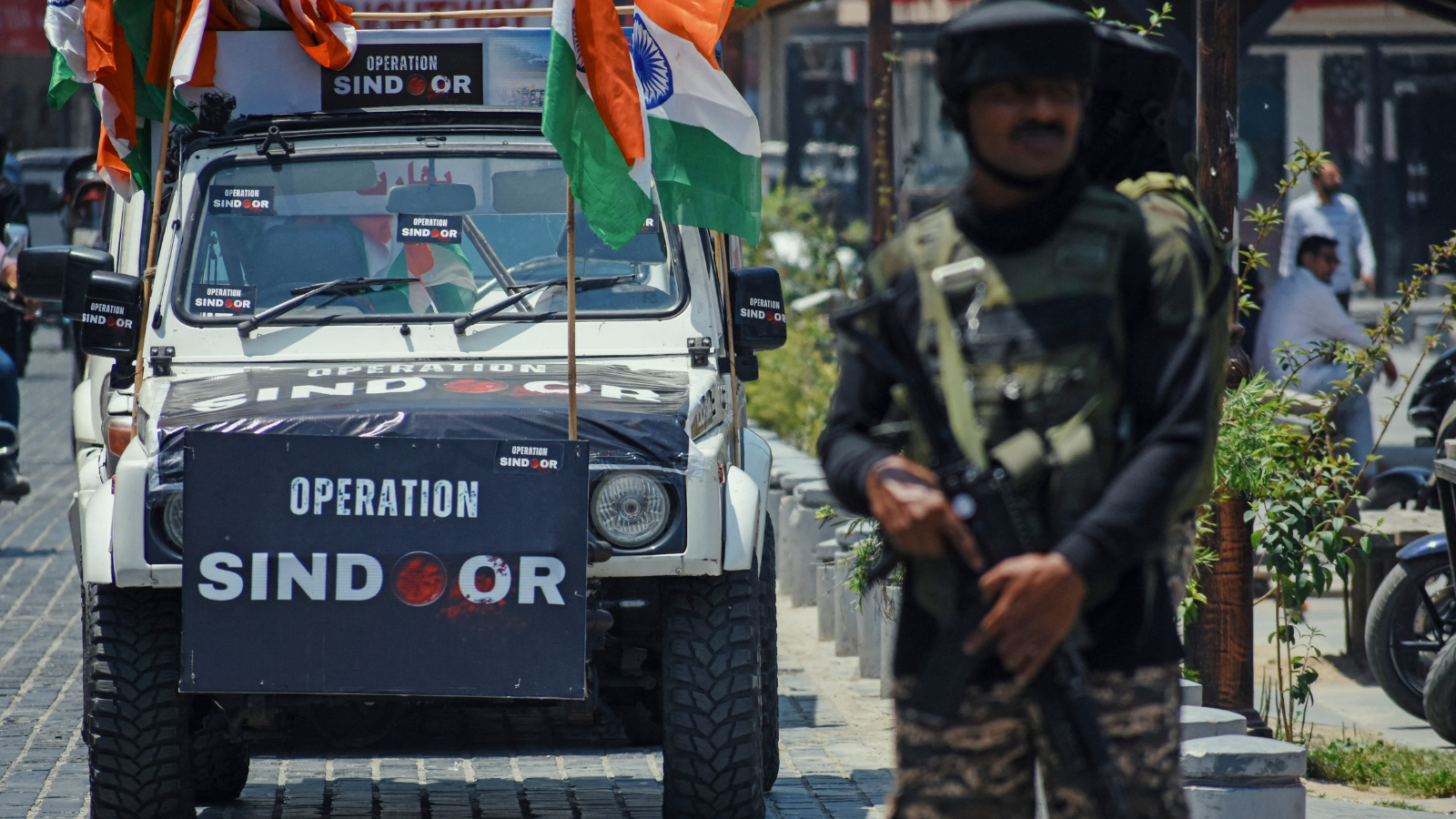
The India-Pakistan conflict that played out between May 6 and May 10, 2025, offers several military lessons. This article presents key takeaways from Operation Sindoor and breaks down how India’s preparations shaped the outcome and what more is needed to strengthen future readiness.

Dinakar Peri
This book offers a comprehensive analysis of India's evolving relationship with sovereignty in a complex global order. Moving beyond conventional narratives, it examines how the sovereignty principle shapes India's behavior across four critical domains—from traditional military power to contemporary data governance.

Rudra Chaudhuri, Nabarun Roy

This paper examines the evolution of India-China economic ties from 2005 to 2025. It explores the impact of global events, bilateral political ties, and domestic policies on distinct spheres of the economic relationship.

Santosh Pai