

Commentary
Nikolay Petrov
{
  "authors": [
    "Nikolay Petrov"
  ],
  "type": "legacyinthemedia",
  "centerAffiliationAll": "",
  "centers": [
    "Carnegie Endowment for International Peace",
    "Carnegie Russia Eurasia Center"
  ],
  "collections": [],
  "englishNewsletterAll": "",
  "nonEnglishNewsletterAll": "",
  "primaryCenter": "Carnegie Russia Eurasia Center",
  "programAffiliation": "",
  "programs": [],
  "projects": [],
  "regions": [
    "Caucasus",
    "Russia"
  ],
  "topics": [
    "Political Reform",
    "Democracy",
    "Economy"
  ]
}
REQUIRED IMAGE
Since the inauguration, the presidential web site has evolved into the domain of President Dmitry Medvedev, and the updated version of the White House's web site now carries information about Prime Minister Vladimir Putin's activities. But the smooth transfer of power between presidents is a complicated process, and it is important to examine how Medvedev will be able to build constructive relationships with the regions.
Source: The Moscow Times
Since the inauguration, the presidential web site has evolved into the domain of President Dmitry Medvedev, and the updated version of the White House's web site now carries information about Prime Minister Vladimir Putin's activities. But the smooth transfer of power between presidents is a complicated process, and it is important to examine how Medvedev will be able to build constructive relationships with the regions.
According to official information, Medvedev has held 10 individual meetings with governors since the presidential election and two visiting sessions of the State Council, in Tobolsk and Dubno.
These meetings have dealt with issues familiar to Medvedev -- small-business development and innovation. Key government ministers participated in the forums, including Finance Minister Alexei Kudrin, Deputy Prime Minister Alexander Zhukov, Economic Development and Trade Minister Elvira Nabiullina and Education and Science Minister Andrei Fursenko. Alexander Shokhin, the director of the Russian Union of Industrialists and Entrepreneurs also attended, along with Sergei Borisov, the director of the Opora business organization. The former head of the presidential administration, Sergei Sobyanin, was there, although Regional Development Minister Dmitry Kozak did not participate.
Presidential meetings with the governors is part ritual and part substantive. The official Kremlin web site usually includes a record of only the ritual part during the first minutes of the meeting, which looks about the same as under Putin, except that some of the issues raised relate to Medvedev's achievements as the former first deputy prime minister in charge of national projects. It is too early to draw any conclusions about the content of these meetings. It is clear, however, that everything will depend on who controls the country's main resources -- Medvedev or Putin. It is worth noting that Putin handed over the bulk of these meetings to Medvedev, with Putin holding only four meetings with individual governors between the presidential election and the inauguration.
Among all of the regional leaders who have recently met with Medvedev, only Primorye Governor Sergei Darkin is at risk of losing his job, according to a March survey of political experts rating the chances of political survival for governors that was posted on the Strategema.org web site. The other regional heads seem to be on solid footing. Four are the heads of republics, including Chechen President Ramzan Kadyrov, Ingush President Murat Zyazikov and North Ossetian President Taimuraz Mamsurov. Regional leaders from the Southern and Central federal districts, the Far East, the Urals and the Volga districts met with the new president, but no governors from the Northwest or Siberia met with Medvedev during this period.
Getting acquainted is one thing, but some very serious tasks stand before the new president and the governors.
By the end of this year, a dozen regional leaders will reach the end of their appointed terms -- eight in December and four from May to September: Governors Yevgeny Savchenko of Belgorod, Mustafa Batdyev of Karachayevo-Cherkessia, Valery Serdyukov of Leningrad and Viktor Kress of Tomsk. We can only hope that the authorities, who have appealed to the public for support of the major reforms that will be carried out, will finally understand that such lofty goals can only be achieved by improving the link between elected officials and the people. Returning direct gubernatorial elections would be a good start.
When making the new gubernatorial appointments -- or at least participating in the process -- Medvedev will have to think about strengthening his position in the regions. It is clear that Medvedev now hopes to base his authority on the support of two groups: the Russian Association of Lawyers, or RAL, and small and medium-size businesses.
In the regions, the RAL is headed by fairly high-ranking officials, and sometimes even by the region's governor, as in Astrakhan and Kirov. But heading the region's RAL did not save Stavropol Governor Alexander Chernogorov from losing his job, and it probably won't help Kirov Governor Nikolai Shaklein either.
The RAL is planning to hold a series of public events to provide legal assistance to citizens. It also wants to demonstrate the lawyers' usefulness and importance by taking legal action against corrupt and ineffective officials -- including governors. If Medvedev intends to build up his power base, this may be one of his best opportunities.
Nikolai Petrov is a scholar in residence at the Carnegie Moscow Center.
Former Scholar-in-Residence, Society and Regions Program, Moscow Center
Nikolay Petrov was the chair of the Carnegie Moscow Center’s Society and Regions Program. Until 2006, he also worked at the Institute of Geography at the Russian Academy of Sciences, where he started to work in 1982.
Recent Work
Nikolay Petrov
Nikolay Petrov
Carnegie India does not take institutional positions on public policy issues; the views represented herein are those of the author(s) and do not necessarily reflect the views of Carnegie, its staff, or its trustees.

This piece argues that India’s central challenge is not managing a single flashpoint but resolving the underlying tension between expansion and institutional coherency of the BRICS grouping.

Vrinda Sahai

On March 10, 2026, India’s Union Cabinet approved amendments to Press Note 3, a regulation that mandated government approval on all foreign direct investment (FDI) from countries sharing a land border with India. This amendment raises questions primarily about whether its stated benefits will materialize and if the risks have been adequately weighed. This piece will address the same.

Konark Bhandari

This piece examines India’s response to U.S. sanctions and tariffs, specifically assessing the immediate market consequences, such as alterations in import costs, and the broader strategic implications for India’s energy security and foreign policy orientation.
Vrinda Sahai
This paper examines the evolution of India-China economic ties from 2005 to 2025. It explores the impact of global events, bilateral political ties, and domestic policies on distinct spheres of the economic relationship.
Santosh Pai
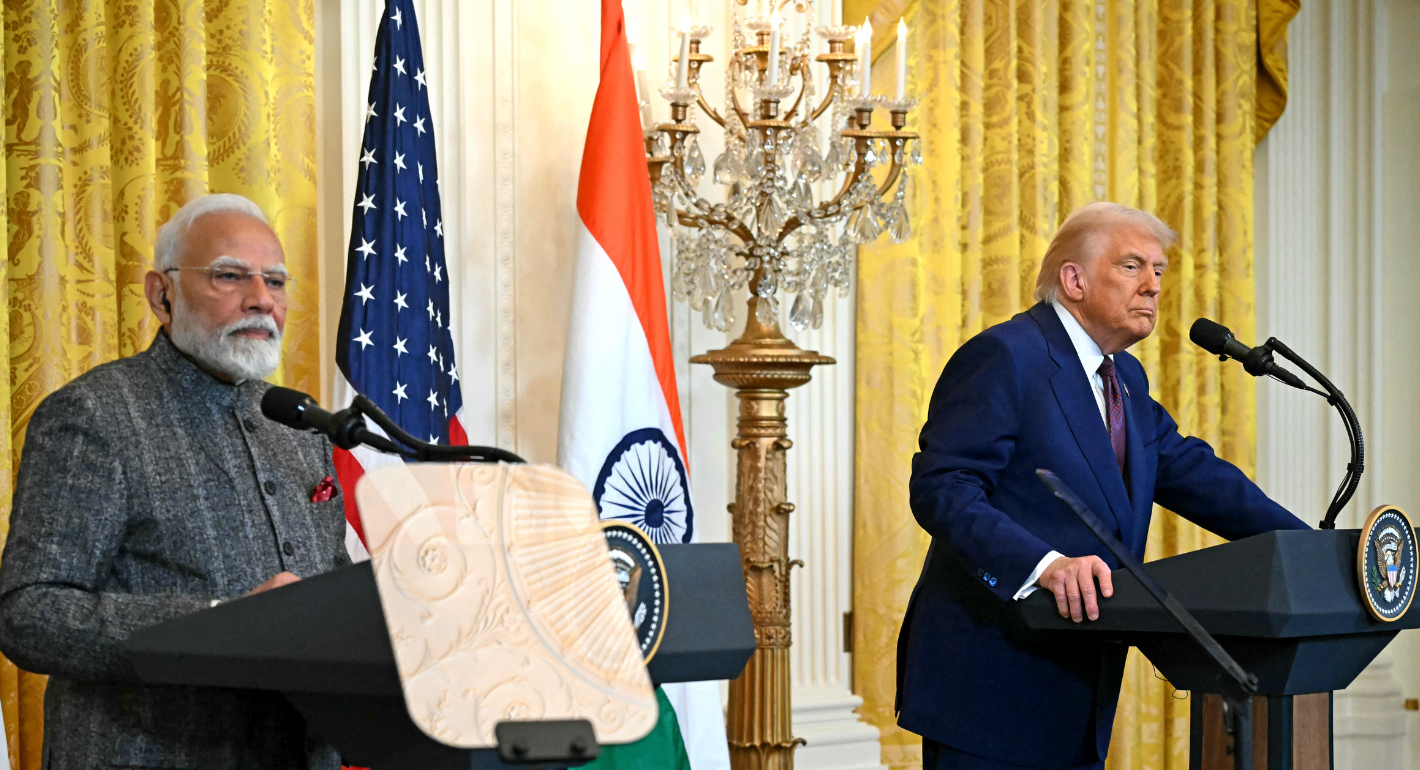
The India-U.S. relationship currently appears buffeted between three “Ts”—TRUST, Tariffs, and Trump.
Arun K. Singh